Industrial heat pumps for process heat up to 120°C
Tetra Heat Pump is a product of Promethean Energy Private Limited. We build industrial heat pumps that deliver continuous process heat up to 120°C, in air source, water source and cascade configurations. A single machine reaches 1,450 kW, and a multi-unit project reaches 5 MW, with supply temperature held to ±0.5°C.
Coefficient of performance depends on the lift. Water source units reach COP 4.5 to 5.2 at 60°C output, and performance falls as the output temperature rises toward the 120°C ceiling. Against PNG, LPG, furnace oil, LDO and diesel, that delivers 40 to 70% lower energy cost for the same heat.
The envelope
A heat pump moves heat from a source you already have to the temperature your process needs. It does not burn anything, so what it costs to run is set by the electricity price and by the lift between source and output.
The full specification, including the duties above the ceiling and what happens to them, is on the high temperature heat pumps page.
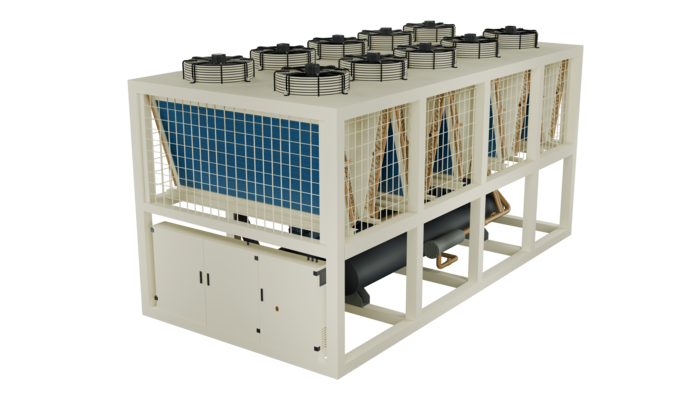
Which configuration suits your duty?
Choose a water source machine wherever a usable liquid stream already exists on site, and an air source machine everywhere else. Cascade is a stage arrangement that works with either source. You need it when your output temperature is higher than one compression stage can reach. The full comparison is here →
Air source
Typical duties:
- • Process heating up to 120°C
- • Retrofits with no plant room
- • Food processing and pasteurisation
- • Commercial hot water systems
Water source
Typical duties:
- • Automotive pre-treatment and washing
- • Chemical process heating
- • Pharmaceutical hot water and CIP
- • Waste heat recovery
Cascade
Typical duties:
- • Outputs a single stage cannot reach
- • Duties toward the 120°C ceiling
- • High lift from a cool source
No COP is published for an air source machine at a stated operating point, because there is no single operating point. It tracks ambient air, which moves through the day and through the year. The rated 4.5 to 5.2 belongs to a water source unit at 60°C output.
Performance parameters
A 5 MW installation is several machines, not one 5 MW machine. The distinction decides plant room space, electrical supply and how much redundancy you get for free.
What comes with the machine
What COP should you expect at your output temperature?
COP is the heat delivered divided by the electricity consumed. It falls as the gap between source and output widens, so a single headline figure describes no real duty. Take the number at the temperature you are actually moving.
Both ends belong to the same machine. Most process hot water in an Indian plant sits nearer 60°C than 120°C, which is the comfortable end of the curve. Run the arithmetic on your own duty with the savings calculator, or read the method behind it.
Which fuel are you displacing?
Breakeven COP is the efficiency at which a heat pump exactly matches what you pay now. Below it the heat pump loses, above it every point of COP is margin. The figures below use the Maharashtra HT-I energy charge of ₹8.44 per kVAh. For a plant on the MSEDCL grid in and around Mumbai, the page on industrial heat pumps in Mumbai covers where that tariff is headed and what your connection will need.
| Incumbent fuel | Breakeven COP | What that means |
|---|---|---|
| PNG at ₹68 per SCM, Gujarat industrial | 1.17 | Beaten at any working COP |
| Furnace oil at ₹71.99 per kg | 1.10 | Beaten at any working COP |
| LDO at ₹107.65 per litre | 0.67 | Beaten at any working COP |
| PNG at ₹41.60 per SCM, pre-crisis | 1.90 | Still beaten, with a narrower margin |
| Biomass briquette at ₹8,500 per tonne | 3.33 | Not a cost case |
| Coal delivered at ₹6,000 per tonne | 4.35 | Not a cost case |
Against coal and biomass, the case is compliance
Solid fuel breaks even at COP 3.3 to 6.5, and a 120°C machine does not reach that on grid power. The case against coal rests on other grounds. There is no stack, no ash, no fuel handling labour and no exposure to coal availability. You also have a clean answer when a customer audits your scope 1 emissions.
What an installation actually costs, and what moves that number, is set out on the cost page. The wider comparison against each incumbent boiler is in heat pump versus boiler running costs. A plant still firing light diesel oil has the widest gap of all, and the heat pump vs diesel boiler comparison gives its breakeven for each state tariff. If you have been quoted an industrial electric boiler instead, read what it costs to run and what it adds to your connected load before you sign.
Which duties in your plant are in range?
Each industry page carries the process temperature split for that sector, including the loads a heat pump cannot serve.
Process heat, 80 to 120°C
- → Chemical process heatingAqueous jacketed reactors to 88°C, low-boiler reboilers, drying
- → Pharmaceutical hot water and CIPHVAC reheat, CIP circuits, loop sanitisation at 80 to 95°C
- → The full high-temperature envelopeIncluding every duty above the 120°C ceiling and what happens to it
- → Boiler feed water preheatingWarming the feed to a boiler that keeps raising steam, from heat the plant already rejects
- → Waste heat recovery systemsCompressor cooling water, condenser heat and effluent, used directly or lifted to process temperature
Process heat, 50 to 80°C
- → Automotive pre-treatmentDegrease at 55 to 80°C, phosphating, hot rinses, component washing
- → Food and beverage processingPasteurisation hot water loops, CIP caustic at 70 to 85°C
- → Hotel hot water and laundryGuest hot water at 45 to 70°C, laundry at 60 to 85°C
- → Commercial water heaters for hotels and hospitalsOne central plant in place of many geysers, for hotels, hospitals, hostels and campuses
- → Metal finishingGalvanising degrease, flux tank, pickling and phosphating baths
Four installations, with the figures those projects published
Customers are anonymised because large clients rarely grant permission to be named. Everything except the customer's identity stays specific.
- 1.5 MW across multiple units
- 400 t CO2 avoided a year
- 18-month payback
- 600 kW installation
- Temperature and humidity held together
- Same requirement as a pharma cleanroom
- 900 kW with heat recovery
- Refrigeration condenser heat as the source
- Measured at one plant
- 200-room property
- 250 t CO2 avoided a year
- Storage sized to the evening peak
Before you specify
How the cycle works
What the machine is doing, why the datasheet COP is not the one on your bill, and where a heat pump is the wrong answer.
Read article →Choosing the source
Air source, water source and cascade set against each other on source stability, footprint, noise and where each one is the wrong answer.
Read article →Service and reliability
What actually fails on this equipment in Indian conditions, and what to ask a supplier before you sign.
Read article →The rest of the scope
Tell us the duty and we will tell you if it fits
Send the output temperature you need, the source you have, and the fuel you are burning today. That is enough for us to say whether a heat pump is the right answer, and where it stops.