A 1.5 MW heat pump installation on an automotive paint shop pre-treatment line
Outcome
- Sector
- Automotive paint shop
- Load
- 1.5 MW installation, multiple units
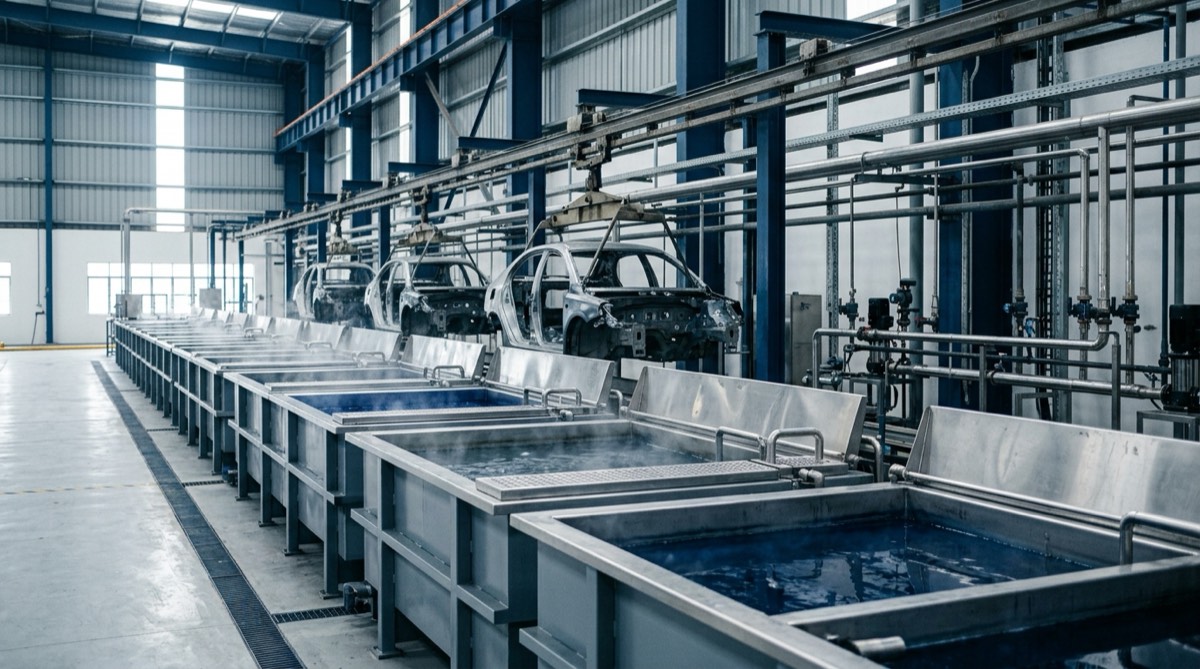
An automotive paint shop in India replaced fuel-fired process heating on its pre-treatment line with a 1.5 MW Tetra Heat Pump installation, delivered as more than one unit because a single machine tops out at 1,450 kW. It took the loads inside its range: alkaline degrease at 55 to 80°C, zinc phosphating at 50 to 60°C, the hot rinses between them, and paint shop AHU reheat. The ovens stayed on the existing plant, because ED cure at 190°C, bake at 140 to 200°C and powder cure at 177 to 204°C are all beyond what an industrial heat pump delivers. Energy cost for the duty fell by 65%, the installation avoids 400 tonnes of CO2 a year, and simple payback was 18 months.
What can a heat pump actually take in a paint shop?
It can take the pre-treatment line, and nothing downstream of it.
| Paint shop duty | Temperature | Heat pump |
|---|---|---|
| Alkaline degrease | 55 to 80°C | In range |
| Zinc phosphating | 50 to 60°C | In range |
| Hot rinses and component washing | 55 to 80°C | In range |
| Paint shop AHU reheat | Ambient dependent | In range |
| ED bath conditioning | 28 to 32°C | In range, as a cooling duty |
| ED cure oven | 190°C | Out of range |
| Bake oven | 140 to 200°C | Out of range |
| Powder cure oven | 177 to 204°C | Out of range |
That split is the engineering story of a paint shop retrofit. Tetra Heat Pump units deliver continuous output up to 120°C with ±0.5°C control, in air source, water source and cascade configurations, which covers every duty in the top half of that table and none of the ovens below it.
Heating and cooling on the same line, at the same time
The reason a paint shop repays a heat pump faster than its fuel bill alone would suggest lies in the fifth row of that table.
The pre-treatment baths have to be held between 50 and 80°C. The electrodeposition bath, on the same line at the same time, has to be held at 28 to 32°C, which is a cooling duty. In most shops a chiller meets it by rejecting that heat to atmosphere while, nearby, fuel is burned to make heat of almost the same grade.
A heat pump reads those as one duty, taking heat out of the loop that needs cooling and putting it into the baths that need heating, so both ends of the transfer are useful work. This installation was built around that recovery rather than as a straight boiler swap.
What was installed
1.5 MW of capacity, and that is an installation rather than a machine. A single Tetra Heat Pump unit reaches 1,450 kW, and total project capacity runs to 5 MW across multiple units. That changes what you allow for plant room space and for the incoming supply.
Tetra Heat Pump is a product of Promethean Energy Private Limited. The units run refrigerants including R1234ze and R245fa, and control integrates with BMS, SCADA and PLC networks over Modbus and BACnet, so the bath setpoints stay in the system already holding them.
What changed
| Line | Value | What it covers |
|---|---|---|
| Installed capacity | 1.5 MW | More than one unit. Single-unit capacity is 1,450 kW |
| Energy cost for the duty | 65% lower | The pre-treatment heating load, not the whole paint shop |
| CO2 avoided | 400 tonnes a year | Fuel no longer burned for that duty |
| Simple payback | 18 months | On the energy cost saving |
Read the second row precisely. The 65% is the cost of heating that duty, not the shop’s total energy bill, and it says nothing about the ovens, which burn what they always burned.
Why the saving is that size, and where it would not be
Two things put it there. The first is the lift. A pre-treatment duty between 50 and 80°C sits at the favourable end of a heat pump’s curve. Tetra Heat Pump water source units are rated at COP 4.5 to 5.2 at 60°C output, and performance falls as output rises toward the 120°C ceiling, so a plant asking for 110 or 120°C would not see this shop’s number.
The second is the fuel displaced. Against piped gas, LPG, furnace oil, LDO and diesel the breakeven COP is 1.0 to 1.2: a heat pump has to return only a little more than one unit of heat per unit of electricity to match the incumbent on running cost. Everything above that is margin, and at a pre-treatment lift there is plenty. The same arithmetic against a boiler is worked through on the blog.
It does not carry across to coal or biomass. Breakeven against solid fuel runs 3.3 to 6.5, and against those fuels the case for a heat pump is stack emissions, air quality, labour and customer audit rather than running cost. A 65% cost saving against coal is not a figure to put in front of an energy manager.
What to check before you assume the same result
Your own breakeven COP sets the ceiling: your electricity price per kWh divided by the delivered cost of a useful kWh of heat from the fuel you burn now.
Your ovens stay. A pre-treatment retrofit shrinks a fuel bill; it does not close a fuel account.
Your sanctioned load goes up, and this catches plants out. Moving a 1.5 MW thermal duty onto electricity raises connected load. In Maharashtra the security deposit is twice the average billing cycle, recalculated annually, so a larger monthly bill pulls a larger deposit through. Gujarat computes it as though the whole load were a new service rather than the increment. Budget for both.
Working the same sum on your plant
Put your tariff, your fuel price and your bath temperature into the calculator and see where the breakeven lands. The automotive page has the full load list, paint manufacturing the resin and let-down side, and the high temperature heat pump page the equipment detail. Other projects sit under case studies; a look at your load profile starts here.
Frequently asked questions
- Which paint shop loads can an industrial heat pump serve?
- It took the pre-treatment line. Alkaline degrease runs 55 to 80°C, zinc phosphating 50 to 60°C, and the hot rinses and component washing between them sit in the same band. Paint shop AHU reheat is also in range. These are the duties an industrial heat pump can take over in an automotive paint shop.
- Can a heat pump run a paint shop curing oven?
- No. ED cure runs at 190°C, bake ovens at 140 to 200°C and powder cure at 177 to 204°C. Tetra Heat Pump units deliver continuous output up to 120°C, so every oven in a paint shop stays on the plant that was already firing it. A retrofit reduces the fuel bill rather than ending it.
- Was the 1.5 MW a single machine?
- No. A single Tetra Heat Pump unit reaches 1,450 kW, so 1.5 MW of installed capacity is more than one unit. Total project capacity runs to 5 MW across multiple units. The distinction matters for plant room space and for the electrical connection.
- What was the payback on the paint shop installation?
- Simple payback was 18 months, calculated on the energy cost saving alone. Energy cost for the pre-treatment heating duty fell by 65% and the installation avoids 400 tonnes of CO2 a year.
- Does a heat pump help with the electrodeposition bath?
- Yes, and it is the part of a paint shop most often missed. The ED bath is held at 28 to 32°C, which is a cooling duty, while the pre-treatment baths a few metres away need 50 to 80°C of heat. A heat pump can move heat from one to the other instead of running a chiller and a burner against each other.
Is your plant a fit?
The output temperature of the duty you want to move, the fuel you burn now and your landed electricity tariff decide it.