Industrial heat pumps for chemical processing: which duties are in range, and how to size for a batch plant
Which duties in a chemical plant an industrial heat pump can serve, which stay on fired heat, and why the decision usually turns on the batch load profile rather than on price. See the full heat pump specification →
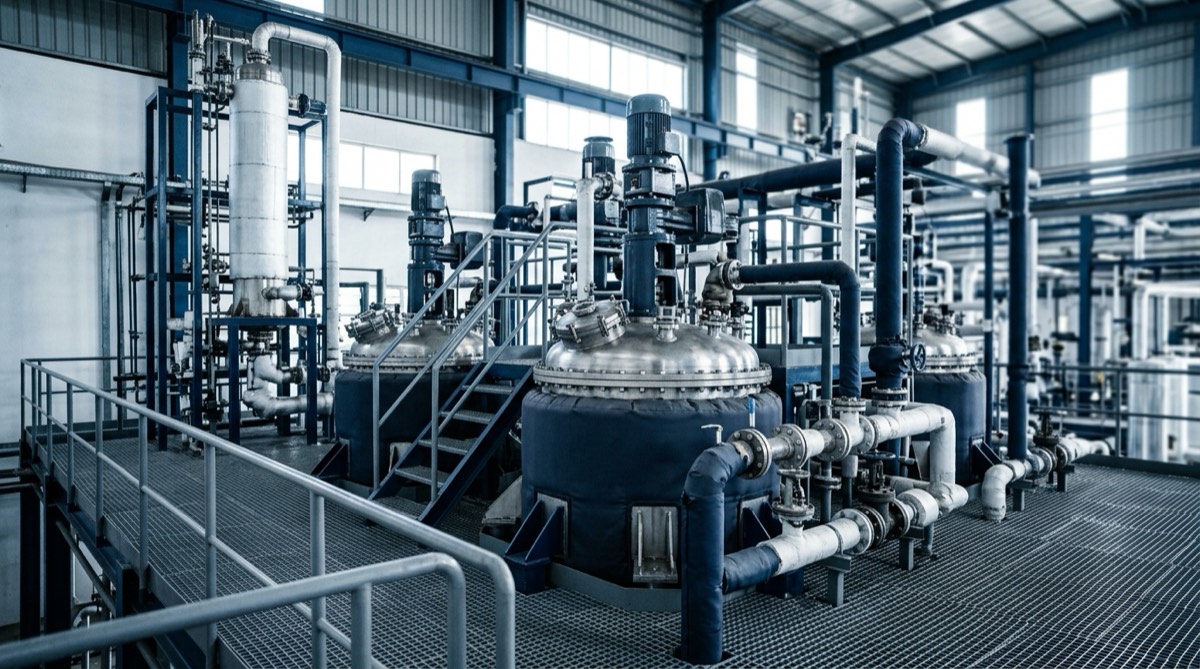
Applications
- →
Aqueous jacketed reactor heating
To 88°C on the utility side of the vessel, leaving the vessel, the agitator and the batch record unchanged.
- →
Low-boiler and solvent recovery column reboilers
60 to 110°C, long hours at a steady duty, the easiest load in the plant to size against.
- →
Crystalliser heating and cooling cycles
Dissolve warm, cool through the curve, reheat for the next charge: one machine serves both sides.
- →
Tray, vacuum tray and fluid bed drying
60 to 120°C, though 120°C is the ceiling of the machine as well as the top of the band.
- →
Plant hot water loop for vessel, drum and IBC washing
Below 100°C, with no product contact and no change to any batch record.
- →
Reactor condenser and column overhead heat recovery
Heat rejected into cooling water becomes the source, which shortens the lift.
Industry Benefits
- Aqueous jacket loops to 88°C without touching the vessel
- Reboilers, crystalliser cycles and drying inside the range
- Condensers and column overheads used as the heat source
- Hot water below 100°C, outside the Indian Boiler Regulations
- Sized against the batch cycle, with a buffer for the heat-up
- Skid sited outside the classified area wherever pipework allows
Process temperatures
| Process | Temperature | Heat pump |
|---|---|---|
| Aqueous jacketed reactor | To 88°C | In range |
| Low-boiler reboiler, including solvent recovery | 60 to 110°C | In range |
| Crystalliser cycle | Heating and cooling within one cycle | In range |
| Drying | 60 to 120°C | In range |
| Plant hot water loop | Below 100°C, outside the Indian Boiler Regulations | In range |
| Synthesis reaction | 150 to 300°C | Not served |
| Vacuum column reboiler | Above the 120°C output ceiling | Not served |
| Calcination | 500°C and above | Not served |
A chemical plant’s heating duties split cleanly by temperature. Aqueous jacketed reactors up to 88°C, low-boiler reboilers at 60 to 110°C, crystalliser heating and cooling cycles and drying duties at 60 to 120°C can be served directly by a Tetra Heat Pump, displacing PNG, furnace oil, diesel or thermic fluid firing. Synthesis reactions at 150 to 300°C, vacuum columns and calcination cannot, and on those the heat pump earns its place by pre-heating rather than by replacing. The question that decides most chemical projects is not price but load profile: a batch plant’s peak duty can be several times its average, and a machine sized for the peak spends most of its life at part load, so the sizing has to be done against the batch cycle and a buffer, not against a nameplate.
Which chemical plant heating duties suit a heat pump?
The process temperature table above is the short answer, and it reads as two lists rather than one gradient. The in-range duties are often a large share of the fuel bill, because a boiler raising steam at pressure to serve an 80°C jacket wastes most of the temperature it made. The out-of-range rows are not near misses.
Aqueous reactor jacket heating
The 88°C boundary is roughly what a water-based jacket loop carries at or near atmospheric pressure, with margin, before the circuit has to be pressurised or moved onto thermic fluid.
The retrofit sits on the utility side of the vessel. The heat pump charges a buffer, the buffer feeds the existing jacket circulation pump and control valve, and the steam or thermic fluid path stays connected for duties above the band. Nothing about the vessel, the agitator or the batch record changes, and controls tie into the existing PLC, SCADA or BMS network.
Tetra Heat Pump units, a product of Promethean Energy Private Limited, are built in air source, water source and cascade configurations delivering continuous output up to 120°C with ±0.5°C control, which covers an aqueous jacket loop to 88°C, a low-boiler reboiler and the drying band, and none of the synthesis duties above them; the full specification is here. A reactor held at 150 to 300°C is a different machine’s job, and the most a heat pump does there is pre-heat the charge.
Reboilers, crystallisers and drying
Low-boiler reboilers at 60 to 110°C carry most of the solvent recovery load in fine chemicals and intermediates. They run long hours at a steady duty, which makes them the easiest load in the plant to size against.
Crystalliser cycles need heating and cooling on the same vessel, often in one shift: dissolve warm, cool through the curve, reheat for the next charge. A machine making hot water at one end and chilled water at the other serves both sides, so one electrical input does two jobs.
Drying at 60 to 120°C covers tray, vacuum tray and fluid bed dryers. Watch where in that band your dryer sits, because 120°C is both the top of the band and the ceiling of the machine, and efficiency there is not efficiency at 70°C.
Your condensers are a heat source, not only a load
Reactor condensers and column overheads reject heat continuously into cooling water, a tower or a chiller that costs money to run, while jackets, reboilers and hot water loops in the same plant need heat. This is the strongest configuration available in a chemical plant and few enquiries specify it: when the source is a warm process stream rather than ambient air the lift is smaller, and that is where the efficiency comes from.
COP depends on the lift. Tetra Heat Pump water source units reach COP 4.5 to 5.2 at 60°C output, and performance falls as output temperature rises toward the 120°C ceiling; measured performance in Indian conditions is about 2.26 at 110°C and about 2.0 at 120°C. So log cooling water flow and temperature rise on the condensers alongside the heating loops. A plant condensing overheads and heating jackets in the same hour already has both ends of the machine on site.
Sizing for a batch plant
Demand in a batch plant fluctuates sharply, and a machine sized for the peak will run badly for most of its life. This is the objection that the sector actually raises. It is a design objection rather than a price objection, and it deserves a design answer.
The peak is the heat-up. Bringing a charge from ambient to reaction temperature demands a large duty briefly, after which the vessel needs only the smaller amount of heat that holds it there. Several vessels on a staggered schedule may peak together or may not. Size on the highest half hour and you buy a machine that almost never sees the load it was selected for.
| Step | What to do | Why it matters |
|---|---|---|
| Log a full campaign | Flow rate, flow and return temperature on every heated loop, at short interval | One shift shows one heat-up. A campaign shows the coincidence between vessels |
| Log the cooling side | Condenser and chiller duty on the same timeline | The heating and cooling peaks may be simultaneous |
| Split transient from steady | Separate heat-up demand from hold demand | Only the steady part must be met in real time |
| Size to average, buffer the peak | Select nearer the time-averaged duty, add buffer volume, stage units where needed | Buffer is cheaper than compressor capacity running a few hours a month |
A thermal store charged between batches decouples the machine from the batch clock: it runs steadily for long hours, the store discharges into the heat-up, and the peak never reaches the compressor. Staging works alongside it, since a project can be built from more than one machine, up to 1,450 kW in a single unit and up to 5 MW across multiple units.
Plant hot water loops
Vessel and line washing, drum and IBC cleaning, filter and centrifuge wash-down, floor cleaning and HVAC reheat all draw hot water below 100°C, usually made by bleeding steam into a calorifier, so a boiler runs through the night and the weekend to keep a wash-water tank warm.
Below 100°C that loop is not a registered boiler under the Indian Boiler Regulations, so the certified attendant on every shift and the annual inspection shutdown do not attach to it. Few vendors in India raise that, and it is a real operating advantage over steam.
There is no product contact and no change to any batch record, so this is the shortest path from decision to running plant, and it sits at the friendly end of the temperature curve. Plants in pharmaceutical and paint manufacturing start in the same place.
Heat pumps in and around a classified area
A chemical plant asks where the machine sits relative to the hazardous area before it asks what it costs, and the answer that holds up is a siting answer. An industrial heat pump is a packaged skid: compressors, heat exchangers, a control panel and pipework. Sited in an unclassified part of the plant and connected to the process by pipe, none of it stands inside a classified area, which then sees pipework, insulation and instrumentation rather than rotating machinery and electrical enclosures. Where the pipe run makes that impossible, the requirement moves onto the equipment and becomes a specification the buyer sets. Promethean Energy obtains that certification project by project, to the standard the plant specifies, and has supplied certified equipment on previous projects.
| Item | What to confirm | Who owns it |
|---|---|---|
| Zone classification | The zone assigned to the plot where the skid would stand | Plant, from its classification drawing |
| Siting and separation | Whether an unclassified location within reach of the pipework exists | Plant, vendor confirms pipe run limits |
| What sits inside the zone | Items that cannot be relocated: sensors, valves, junction boxes | Joint, agreed on the layout drawing |
| Cable and instrument routing | How power and signal cross the boundary, and the sealing required | Plant’s electrical standard |
| Certification to specify | For anything inside the zone, the certification the plant requires | Plant specifies, vendor supplies to it |
Written that way, the hazardous area becomes a scope item with an owner rather than a yes or no question.
What fuel are you replacing?
The saving arises out of the gap between what a useful kilowatt-hour of heat costs you today and what the same kilowatt-hour costs through a heat pump. It therefore depends on the fuel you burn quite as much as it depends on the machine.
| Incumbent | Cost per useful kWh thermal | Breakeven COP | Verdict |
|---|---|---|---|
| PNG, Gujarat industrial, ₹68/SCM, Jun 2026 | ₹7.24 | 1.17 | Beaten comfortably |
| Furnace oil, ₹71.99/kg, 1 Aug 2026 | ₹7.70 | 1.10 | Beaten comfortably |
| Light diesel oil, ₹107.65/litre, 1 Aug 2026 | ₹12.58 | 0.67 | The most expensive heat here |
| Thermic fluid heater | Set by the fuel firing it | Use that fuel’s row | A distribution choice, not a heat source |
| Electric resistance, Maharashtra HT-I | ₹8.70 | Any working machine | The clearest case of all |
| Biomass briquette, about ₹8,500/tonne, 2026 | ₹2.54 | 3.33 | Marginal on cost |
| Coal, delivered ₹6,000/tonne | ₹1.94 | 4.35 | The heat pump loses on running cost |
| Heat pump at COP 3.5, Maharashtra HT-I | ₹2.41 | For comparison |
Those figures are a calculation rather than a published index, so the assumptions travel with them: 1 kWh is 860 kcal; gas 9,500 kcal/SCM; furnace oil 10,050 kcal/kg; coal 3,800 kcal/kg; gas boiler 85% efficient, oil 80%, solid fuel 70 to 72%, electric resistance 97%; electricity at the Maharashtra HT-I energy charge of ₹8.44 per kVAh, billed per kVAh, so poor power factor costs more per useful unit. The LDO figure of 10,700 kcal/kg and the briquette figure of 4,000 kcal/kg are indicative and were not independently verified.
Against gas and furnace oil the breakeven COP is 1.0 to 1.2, and at COP 3.5 on the Maharashtra tariff running cost falls 67% against today’s Gujarat industrial gas and 69% against furnace oil. The figure that matters more for a capital decision is the one against the old gas price: even at the pre-crisis Morbi rate of ₹41.60 per SCM the saving is 46%, so the case does not depend on gas staying expensive. There is a fuller version of this comparison.
Against solid fuel the position is different. Breakeven against coal and briquette is 3.3 to 6.5, which a machine at chemical process temperatures does not reach, and on delivered coal at ₹6,000 per tonne the heat pump costs about 24% more to run. If you fire coal or briquette the reasons to change are stack emissions, ash handling, storage, the labour a solid fuel boiler carries and what your customers’ audits ask. They are not fuel cost.
Two provisions are worth a word with your finance team. Heat pumps are named in Appendix I item 8(ix) of the Income Tax rules and attract 40% accelerated depreciation. ADEETIE, the Ministry of Power scheme running FY2025-26 to FY2027-28, lists chemicals among its 14 eligible sectors and offers interest subvention of 5% for micro and small enterprises and 3% for medium ones to MSMEs with a Udyam ID in a notified cluster. Around 71% of the predecessor TEQUP scheme’s funds went unused, so treat a subvention as a reason to talk rather than a reason to buy.
Where a heat pump is the wrong answer here
Synthesis at 150 to 300°C is out of range by a wide margin. Vacuum columns need reboiler conditions above the 120°C ceiling. Calcination at 500°C and above is off by a factor of four or more. High-pressure steam duties, for stripping, jet ejectors or direct injection, keep the boiler; the heat pump takes the low-temperature loads the steam plant serves badly, so the header shrinks rather than disappearing.
One more case is commercial, not technical. A plant whose in-range loads run only a few hundred hours a year will not recover the capital however good the COP is, so annual running hours belong in the first conversation.
Working out whether your plant is a candidate
List your heated loops with the temperature each actually needs, split them at the boundaries in the table above, then log one complete campaign on the loops inside the split, heating and cooling together. The calculator gives a first pass on running cost, and you can send the load profile over for a proper look.
Related industries
Automotive
Which automotive heating duties an industrial heat pump serves and which it cannot. Pre-treatment at 55 to 80°C is in range, every cure oven is not.
Read the Automotive page →Food and Beverage
Which food and beverage duties a heat pump serves: HTST 72 to 75°C, LTLT 63°C, CIP caustic 70 to 85°C, blanching to 98°C, and what stays on steam.
Read the Food and Beverage page →Technology Specifications
Output temperature, capacity and configuration for the industrial heat pump range.
View Specifications →System Integration
How a unit ties into the pipework, the controls and the plant you already run.
Learn About Integration →Maintenance & Support
Servicing, spares and support once the unit is running.
Explore Support Options →Frequently asked questions
- Can a heat pump heat a chemical reactor jacket?
- Yes, on aqueous jacketed duties up to 88°C. The heat pump heats the jacket circulation loop rather than the reaction mass, so it connects to the utility side of the vessel and not to the process. Synthesis reactions run at 150 to 300°C and are out of range for any industrial heat pump.
- Can a heat pump run a distillation column reboiler?
- On low-boiler columns with reboiler duty in the 60 to 110°C band, yes, and that covers a large share of solvent recovery work in Indian fine chemicals. Vacuum columns and any reboiler needing more than 120°C stay on fired or steam heat.
- Can a heat pump supply a chemical plant hot water system?
- Yes, and it is usually the easiest first project in a chemical plant. A hot water loop below 100°C is not a registered boiler under the Indian Boiler Regulations, so the certified attendant on every shift and the annual inspection shutdown do not apply to it. The loop feeds vessel washing, drum and IBC cleaning, floor wash-down and HVAC reheat from one circuit with a buffer.
- How do you size a heat pump for a batch chemical plant?
- It should be sized against the batch cycle rather than against the peak. Log the flow rate and flow and return temperatures on each heated loop across one complete campaign, then size nearer the time-averaged duty and cover the peak from a buffer vessel, staging additional units where the campaign genuinely needs more capacity. Sizing on the instantaneous peak produces a machine that spends most of its running hours far below its nameplate.
- Where does the heat pump sit relative to a classified area?
- It sits outside the classified area wherever the pipework allows. The packaged unit is normally sited in an unclassified part of the plant and connected to the process by pipework, so the classified area sees pipe, insulation and instrumentation rather than a compressor and a control panel. Any equipment that must sit inside the classified area has to carry certification appropriate to the zone assigned at that location, and that requirement belongs in the enquiry documents before a machine is selected. Promethean Energy obtains certification project by project, to the standard the buyer's site requires, and has done so on previous projects.
Send us your load profile
The next step is a load profile rather than a quotation.
Start a scoping conversation