Heat pumps in a paint plant: heated resin storage, thinning, filtration and drum washing
A paint plant's heat-intensive step is alkyd polycondensation at 150 to 280°C, and no heat pump reaches it. The duties that do fit are heated resin and binder storage, thinning and filtration, all at 60 to 70°C. CIP and drum washing also fit, at 50 to 85°C. Storage is the best of them because it runs flat all year at a small lift. See the full heat pump specification →
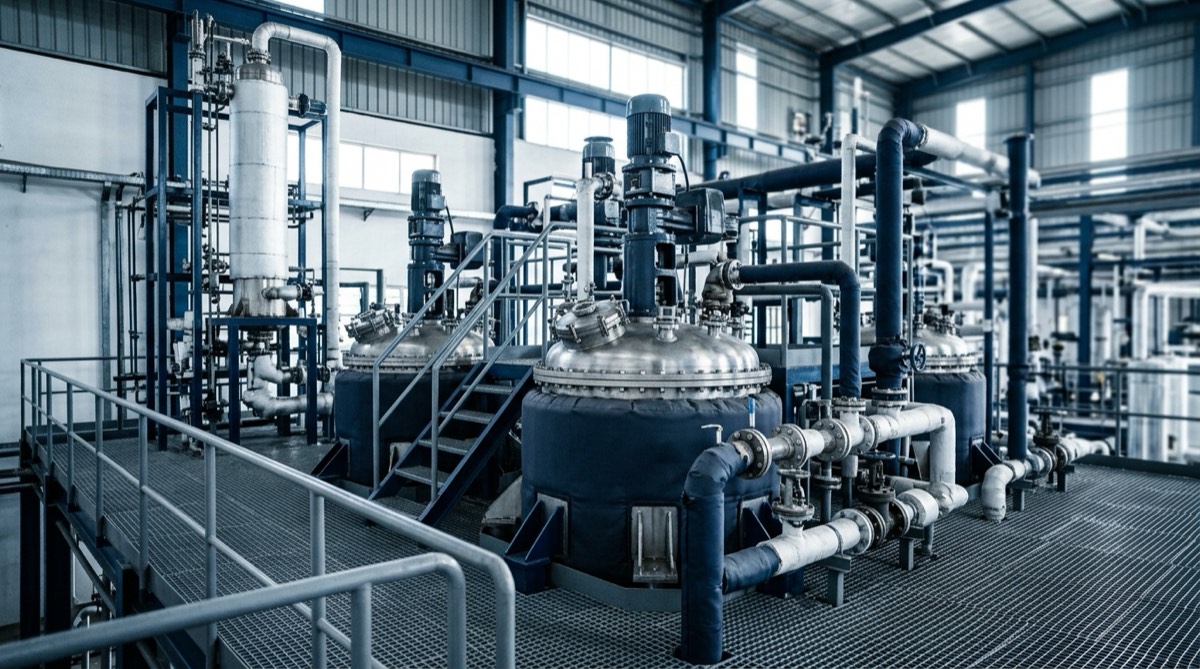
Applications
- →
Heated resin and binder storage
Held at 60 to 70°C continuously so the material stays pumpable, which makes it the steadiest load in the plant.
- →
Thinning and filtration
60 to 70°C, to bring viscosity into range before the material is filtered.
- →
Emulsion let-down
A warm aqueous duty, well inside the range.
- →
Clean-in-place and drum washing
50 to 85°C, the plant's other large hot water demand.
- →
Reactor condenser heat recovery
The condenser on a resin reactor rejects heat while the rest of the plant pays to make it.
Industry Benefits
- Resin and binder storage held at 60 to 70°C all year
- Thinning, filtration and let-down duties served directly
- CIP and drum washing at 50 to 85°C on the same circuit
- Reactor condenser rejection used as the heat source
- Hot water below 100°C, outside the Indian Boiler Regulations
Process temperatures
| Process | Temperature | Heat pump |
|---|---|---|
| Resin and binder storage | 60 to 70°C | In range |
| Thinning and filtration | 60 to 70°C | In range |
| Clean-in-place and drum washing | 50 to 85°C | In range |
| Emulsion let-down | Warm aqueous duty | In range |
| Alkyd polycondensation in the resin reactor | 150 to 280°C, typically 200 to 220°C held two hours | Not served |
A paint plant’s heat-intensive step is the resin reactor, and no heat pump reaches it. Alkyd polycondensation runs at 150 to 280°C, typically held at 200 to 220°C for around two hours, so the thermic fluid heater stays.
An industrial heat pump serves everything around it. That means heated resin and binder storage at 60 to 70°C, with thinning and filtration in the same band. It also means emulsion let-down, and clean-in-place and drum washing at 50 to 85°C. Our Tetra Heat Pump units deliver continuous output to 120°C with ±0.5°C control. We build single machines from 100 kW to 1,450 kW. That covers every duty on that list and none of the reactor.
What temperature does a paint plant actually need, sub-process by sub-process?
The plant has four temperature bands, and only one of them is out of range. The process temperature table above gives each with its figure.
Starting at the front of the plant, resin and binder storage is held at 60 to 70°C so the material stays pumpable. Thinning and filtration run in the same band, because viscosity has to be inside a window before the material goes through a filter. Emulsion let-down is a warm aqueous duty. At the back end, clean-in-place and drum washing run 50 to 85°C and represent the plant’s other large hot water demand.
The reactor is different. Alkyd polycondensation at 150 to 280°C is another kind of duty entirely. It is where most of the energy in a resin plant goes. It stays on the thermic fluid heater.
The real scope is the storage, the wash and the aqueous duties. On a plant that makes paint from bought-in resin, that is most of the thermal load. On a plant that cooks its own resin, it is the smaller half.
Why heated storage is the best duty in the plant
It runs flat, all year, at a small lift. That combination is rare, and it is worth more than size.
Resin and binder tanks are held warm continuously so the material remains pumpable, whether or not a batch is running. The load is therefore present across all 8,760 hours in a year, in production hours and outside them. Capital equipment earns its return on running hours. So a steady duty at 60 to 70°C is a better investment than a larger duty that appears twice a week.
The lift is the other half of it. Coefficient of performance falls as the gap between source and output widens. A 60 to 70°C output is at the comfortable end of the curve. Our water source units reach COP 4.5 to 5.2 at 60°C output. Performance falls as output rises toward the 120°C ceiling. Heated storage sits at the good end of that curve and stays there.
Most energy reviews in a paint plant start at the reactor because that is where the big number is. Start at the tank farm instead. It is the duty a heat pump can actually take, and it is running right now.
The reactor condenser is a heat source
The reactor a heat pump cannot heat is, at the same time, the best heat source in the building.
A resin reactor runs a condenser to take vapour off the batch, and that condenser rejects heat to a cooling circuit. A few metres away, the tank farm needs 60 to 70°C and the wash bay needs 50 to 85°C. Something is burning fuel to supply them. A water source machine takes heat out of the condenser loop and delivers it into the hot water circuit. One machine then does both jobs on one electricity input.
Two conditions apply, and both are usually satisfied on a paint plant. The pipe run between the loops has to be sensible, which in a compact plant it is. The loads also have to coincide in time. They do whenever a batch is cooking, because that is exactly when the wash and thinning demand is highest.
Other streams are worth walking the plant to find. They are the compressed air aftercoolers, warm wash water going to effluent, and any chilled water rejection on the emulsion side.
What does a zone 1 or zone 2 installation require?
Make the siting decision first, and the equipment specification second. Taking them in that order removes most of the cost.
A paint plant carries classified areas because solvents are handled, stored and processed there. The straightforward answer is to site the heat pump outside the classified zone, in the plant room or on a hardstanding. Pipework then runs into the area it serves. A hot water pipe crossing a zone boundary is an ordinary engineering detail. A compressor sitting inside a zone is not.
Where equipment must sit inside a classified area, hazardous area certification is obtained per project, to the zone you specify. It is not a blanket accreditation held by default, and the distinction matters when your own approval process asks who certified what.
Settle three things at design stage:
- the zone classification drawing for the area the machine will serve;
- where the zone boundary runs;
- which components would sit inside it if the obvious siting is not available.
Answering those three usually turns a certification conversation into a layout conversation.
Which fuel are you replacing?
| Incumbent fuel | Price and date | Per useful kWh thermal | Breakeven COP | Verdict |
|---|---|---|---|---|
| PNG, Gujarat industrial | ₹68 per SCM, June 2026 | ₹7.24 | 1.17 | Wins comfortably |
| Furnace oil | ₹71.99 per kg, 1 August 2026 | ₹7.70 | 1.10 | Wins comfortably |
| Light diesel oil | ₹107.65 per litre, 1 August 2026 | ₹12.58 | 0.67 | Widest margin here |
| Electric resistance | ₹8.44 per kVAh, Maharashtra HT-I | ₹8.70 | Just under 1 | Wins by definition |
| Biomass briquette | about ₹8,500 per tonne, 2026 | ₹2.54 | 3.33 | Close. Cost is not the argument |
| Coal, delivered | ₹6,000 per tonne | ₹1.94 | 4.35 | Heat pump loses on running cost |
The middle column is our own arithmetic. It assumes 1 kWh is 860 kcal. Gas is 9,500 kcal per SCM, furnace oil 10,050 kcal per kg and coal 3,800 kcal per kg. A gas boiler is taken as 85% efficient, oil as 80%, solid fuel as 70 to 72% and electric resistance as 97%. Light diesel oil and briquette calorific values are indicative. Maharashtra bills HT-I per kVAh, so poor power factor costs more per useful unit than ₹8.44 suggests.
For the 60 to 85°C duties on this page, the saving lands in a 40 to 70% band. That holds against PNG, LPG, furnace oil, LDO and diesel. Against delivered coal, the heat pump is about 24% dearer to run. There the case rests on compliance, air quality, labour and customer audit.
One thing to hold separate in the arithmetic: the thermic fluid heater serving the reactor is unaffected. Model the project against the fuel used by the duties in range, not against the plant’s whole fuel bill. The full comparison method sets the arithmetic out and the calculator runs it on your tariff.
A hot water circuit below 100°C is not a registered boiler under the Indian Boiler Regulations, and every in-range duty here sits below that line. The certified attendant on every shift and the annual inspection shutdown come off the loop you convert.
Working it out on your plant
You need three numbers, and you already have two of them. Take the share of your fuel bill that is not the reactor, because that is the addressable load. List the tank farm setpoints and the hours they are held, which is usually all of them. Then find the reactor condenser cooling circuit and measure what it is rejecting.
With those three, the calculator shows where breakeven lands on your tariff. Plants running similar aqueous and jacketed duties are covered on the chemical page. If you apply coatings instead of making them, the duty list is different and sits on the automotive page. The full temperature envelope sets out what the equipment delivers and where it stops. To start from your own process list, get in touch.
Related industries
Chemical
Which chemical plant duties a heat pump serves. Aqueous reactor jackets to 88°C, reboilers 60 to 110°C, drying to 120°C, and sizing for a batch load.
Read the Chemical page →Automotive
Which automotive heating duties an industrial heat pump serves and which it cannot. Pre-treatment at 55 to 80°C is in range. Every cure oven is out.
Read the Automotive page →Technology Specifications
Output temperature, capacity and configuration for the industrial heat pump range.
View Specifications →System Integration
How a unit ties into the pipework, the controls and the plant you already run.
Learn About Integration →Maintenance & Support
Servicing, spares and support once the unit is running.
Explore Support Options →Frequently asked questions
- Can a heat pump heat a resin reactor?
- No. Alkyd polycondensation runs at 150 to 280°C, typically held at 200 to 220°C for around two hours. That is well above the 120°C ceiling of an industrial heat pump. The reactor stays on its thermic fluid heater. What the reactor contributes instead is its condenser, which is a heat source.
- Which paint plant duties does a heat pump actually serve?
- It serves heated resin and binder storage at 60 to 70°C, and thinning and filtration in the same band. It also serves emulsion let-down, and clean-in-place and drum washing at 50 to 85°C. All of them are below 100°C and most of them run whenever the plant is open.
- Why is heated storage the best duty in a paint plant?
- It runs continuously at a small lift. Storage tanks are held warm so the material stays pumpable. The load is therefore present across all 8,760 hours of the year, whether or not production is running. Capital equipment earns its return on running hours, so a steady low-lift duty is worth more than a larger intermittent one.
- What does a hazardous area installation require?
- It needs a siting decision first, and an equipment specification second. The usual answer is to site the machine outside the classified zone and run pipework in, which removes the question entirely. Where equipment must sit inside a zone 1 or zone 2 area, hazardous area certification is obtained per project, to the zone you specify.
- Is a heat pump hot water loop a registered boiler in India?
- It is not, where the loop runs below 100°C. Every in-range duty on this page sits under that line. So the certified attendant on every shift and the annual inspection shutdown do not apply to the circuit you convert. The thermic fluid heater serving the reactor is unaffected and stays as it is.
Can a heat pump carry this duty in your plant?
Send us the output temperature, the flow or heat demand, the hours it runs and the fuel it burns today. Our engineers will size a unit against those figures and tell you which part of the load it can take and which part stays on the heating you run today.