Waste heat recovery systems: recover it directly where the stream is hot enough, lift it with a heat pump where it is not
A waste heat recovery system takes heat your plant already throws away and puts it into a duty that would otherwise burn fuel. Today that heat goes to a cooling tower, a drain or the stack. Which equipment does the job depends on one comparison. Where a stream is hotter than the duty you want to heat, a plain heat exchanger recovers it directly. Where the stream is cooler, a heat pump has to lift it.
Tetra Heat Pump, from Promethean Energy, does that lifting on Indian plants, a 1.5 MW automotive paint shop and a 900 kW dairy among them. It takes warm water streams up to process heat at as much as 120°C, in single machines of up to 1,450 kW.
Send us your stream temperatures and flows, and our team will tell you which streams to recover directly and which ones are worth lifting.
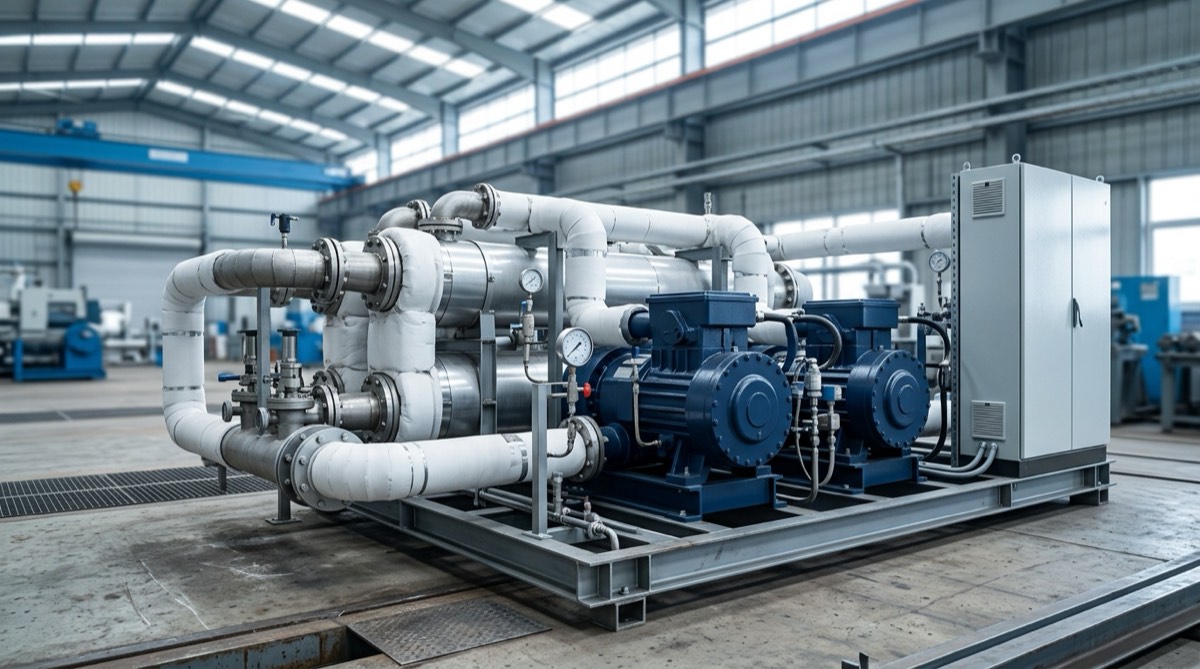
What a Tetra Heat Pump does with waste heat
Should a factory recover heat directly first, or install a heat pump?
Directly first, wherever the stream is hotter than the duty. A plate exchanger or an economiser runs on pumping power alone, so the heat it recovers costs next to nothing, and no heat pump can match that. A heat pump spends electricity to move heat uphill, hence its place is with the streams that are too cool to do the job by themselves. On most sites the order is:
Stop losing it
Stop the losses that need no equipment at all: condensate going to drain, live steam injected into the feed tank, hot water overflowing to a sump.
Recover directly
Recover directly from every stream hotter than a duty it can reach.
Lift what is left
Lift the warm streams that are left with a heat pump, to the temperature the duty needs.
Keep the boiler above 120°C
Keep the boiler for the duties above 120°C.
A dairy shows both sides of the rule. Desuperheater water from the ammonia plant comes off at 55 to 70°C and can feed washing and cleaning water at 40 to 60°C through a plain exchanger. The pasteuriser's hot water loop runs at 85 to 90°C, which no refrigeration stream reaches by itself, so that loop is a heat pump duty.
Please design the two together. An exchanger upstream takes the hottest part of a stream, and the heat pump gets whatever temperature is left. That temperature sets its COP, so both have to be settled on one heat balance. Direct recovery equipment, i.e. economisers, plate exchangers and desuperheaters, is engineered as its own job, and our scope starts with the streams too cool to use as they are.
What has a Tetra Heat Pump recovered on Indian plants?
Two of our published installations are heat recovery jobs, and in both the heat pump draws on heat the plant was already paying to get rid of.
A 1.5 MW automotive paint shop
lower energy cost for the pre-treatment heating duty
of CO2 avoided a year
simple payback
On a paint line the electrodeposition bath has to be held at 28 to 32°C, which is a cooling duty. A few metres away, the pre-treatment baths need alkaline degrease at 55 to 80°C and zinc phosphating at 50 to 60°C. Most shops run a chiller on the first and burn fuel for the second. On this line the heat pump takes heat out of the ED bath and puts it into pre-treatment, so the chiller and the burner stop working against each other. The installation is more than one machine, since a single unit goes up to 1,450 kW. Energy cost for the pre-treatment heating duty came down by 65%, and the plant avoids 400 tonnes of CO2 a year. Simple payback was 18 months, and every oven stayed on the existing plant. The paint shop case study gives the full duty list.
A 900 kW liquid milk dairy
hot water loop feeding the pasteuriser
heat the plant was already rejecting
In a fluid milk plant refrigeration takes 19% of plant energy. Centrifugation, homogenisation and pasteurisation together take 38%, at the same time. So the plant rejects condenser heat in one corner while paying to make heat in another. This installation joins the two. Its source is refrigeration heat the plant was already rejecting. Its output is the 85 to 90°C hot water loop that feeds the existing plate heat exchanger and also serves CIP. The heat pump never touches the milk, and since the loop stays below 100°C it is a hot water generator as per the Indian Boiler Regulations and needs no registration. The dairy case study sets out what was installed.
The other duties a heat pump can take in these plants are on our dairy page and automotive page.
Which waste heat jobs does a Tetra Heat Pump take on?
We lift warm liquid streams that are too cool to use as they are. We deliver it as hot water or process heat up to 120°C, for wash baths, CIP, hot water loops and boiler feed water. The sources we work from are:
- Air and refrigeration compressor cooling water.
- Refrigeration condenser heat and cooling tower return water.
- Process cooling water, such as reactor jacket and condenser cooling in paint and chemical plants.
- Cooling duties on the process itself, such as the ED bath at 28 to 32°C in an automotive paint shop.
- Warm effluent from dye houses and washing lines.
We do not take streams already hotter than their duty, furnace heat, outputs above 120°C such as steam at pressure, ovens and dryers, or power generation from waste heat.
Which waste heat streams can a plant recover, and at what grade?
Walk the utility area and the process floor with a thermometer. List every stream that is rejected to drain, to a cooling tower or to the atmosphere. Include the lukewarm ones that are easy to write off.
| Stream | Grade | Recover directly when | Lift with a heat pump when |
|---|---|---|---|
| Boiler and thermic fluid heater flue gas | The hottest stream in most utility areas | Always: an economiser on the feed water or an air preheater on the combustion air | Normally not a heat pump source |
| Condensate | Hot, and already treated water | Always: return it to the feed tank | Not needed |
| Refrigeration desuperheater, ammonia plants | Hot water at 55 to 70°C, about 50 litres an hour per TR | The duty is below that, e.g. washing water | The duty needs more than 70°C |
| Air and refrigeration compressor cooling | Warm | A duty needs only lukewarm water, such as pre-warming make-up water | The duty is hotter than the stream |
| Cooling tower return and process cooling water | Low grade | Seldom; it is too cool for most duties | Nearly always. It is the most common heat pump source |
| Process cooling duties, such as an electrocoat bath at 28 to 32°C or a reactor condenser | Low grade | Seldom | Heat is needed nearby; both the cooling and the heating become useful |
| Warm effluent from dye houses and washing lines | Warm, and dirty | Pre-warming incoming fresh water through a cleanable exchanger | The bath needs more than the effluent can give |
Please note two points while making this list. Firstly, a stream is of use only if it runs whenever the duty runs, so in case the compressor stops on Sunday and the duty does not, you need buffer storage between them. Secondly, distance and cleanliness matter as much as temperature. After pumping and pipe losses, a big stream at the far end of the site can be worth less than a small one beside the duty. Effluent needs an exchanger that can be opened and cleaned. In a boiler house, compressor cooling water near the feed tank can be lifted to warm the make-up water. Our boiler feed water preheating article works out.
A steel plant's furnace heat is far too hot for a heat pump and is recovered directly. That covers the blast furnace, DRI kiln and arc furnace, the reheat furnace at 1,200°C and the zinc bath at 445 to 465°C. The heat pump's place there is the finishing shop. Cooling water can supply galvanising degrease, flux tanks, pickling and phosphating, and our steel and metal page lists those duties with their temperatures.
What does a heat pump do with a stream that is too cool to use?
It picks up heat from the stream in its source-side exchanger, raises it to a higher temperature with a compressor, and delivers it to the duty through the load-side exchanger. The gap between the source and the output is the lift, and the lift sets the COP. The warmer the waste stream, the smaller the lift and the less electricity per unit of heat delivered.
Running as a water source machine, Tetra Heat Pump units are rated at COP 4.5 to 5.2 when delivering 60°C. The COP falls as the output is taken higher, and independent measurement in Indian conditions shows approx. 2.26 at 110°C and 2.0 at 120°C. A waste stream as the source is the reason to choose water source over air source, which has to lift from ambient air. We have compared the two in our article on air source and water source heat pumps, and the high temperature heat pump page has the full specification.
The stream also goes back cooler than it came. Whatever was cooling it before, a cooling tower or a chiller, then has less heat to reject. So on a cooling duty the heat pump gives you both outputs from one input of electricity. That is what it does on the paint shop's ED bath.
On running cost the heat pump only has to beat the fuel it replaces. Against PNG and furnace oil it breaks even at a COP of 1.0 to 1.2, and against LDO and diesel at 0.56 to 0.67. A machine working from a warm waste stream clears either by a wide margin. Hence it cuts the energy cost of the duty it takes over by 40 to 70% against PNG, LPG, furnace oil, LDO and diesel. Against coal the breakeven COP is 3.3 to 6.5, and there the reason to switch is compliance, air quality, labour and customer audit. Our calculator works out the breakeven on your own tariff and fuel.
Frequently asked questions
What is a waste heat recovery system?
It is equipment that takes heat a plant is already rejecting and puts it into a duty that would otherwise burn fuel. The heat comes from flue gas, condensate, compressor cooling, refrigeration condensers, cooling water or effluent. Where the stream is hotter than the duty, a heat exchanger or an economiser recovers it directly. Where the stream is cooler than the duty, a heat pump lifts it to the temperature needed. Tetra Heat Pump units do the lifting, to process heat at up to 120°C.
Waste heat recovery or a heat pump: which should a factory do first?
Direct recovery first, wherever a stream is hotter than the duty it can feed, since a heat exchanger needs only pumping power. Return condensate to the feed tank, keep the economiser in service, and pre-warm cold water with any stream hot enough to do it. A heat pump comes next, for the warm streams that are too cool to use as they are, and it lifts them to the duty temperature using electricity. The two are best designed together, because the direct exchanger decides how warm the stream is when it reaches the heat pump.
Has a Tetra Heat Pump recovered waste heat on an Indian plant?
Yes. On a 1.5 MW automotive paint shop installation it takes heat out of the electrodeposition bath, which is held at 28 to 32°C, and puts it into the pre-treatment baths. Energy cost for that heating duty fell by 65%, the plant avoids 400 tonnes of CO2 a year, and simple payback was 18 months. On a 900 kW liquid milk dairy it draws on refrigeration heat the plant was already rejecting and feeds the 85 to 90°C hot water loop that heats the pasteuriser.
Which waste heat sources suit an industrial heat pump?
Warm liquid streams that run whenever the heat is needed and are too cool to use directly. They include air and refrigeration compressor cooling water, refrigeration condenser heat and cooling tower return water. Reactor and condenser cooling in paint and chemical plants qualifies too, as do cooling duties such as an electrocoat bath at 28 to 32°C. So does warm effluent from dye houses and washing lines. The warmer the source, the smaller the lift and the higher the COP.
Can an industrial heat pump recover waste heat in a steel plant?
Not from steelmaking itself. Blast furnaces, DRI kilns, arc furnaces, reheat furnaces at 1,200°C and zinc baths at 445 to 465°C reject heat far too hot for a heat pump. That heat is recovered directly. A heat pump fits the finishing shop, where it draws on cooling water to supply galvanising degrease at 60 to 80°C, flux tanks at 80°C, sulphuric pickling at 30 to 50°C and phosphating at 50 to 60°C.
Send us your streams and we will tell you which route fits
- Every rejected stream, with its temperature, flow, running hours and distance from the nearest heat duty, and whether it is clean water, oily water or effluent.
- Every heat duty, with its temperature, running hours and the fuel heating it presently, along with that fuel's delivered price.
- Your electricity tariff and sanctioned load.
From these our team will work out, on one heat balance, which streams to recover directly and which ones a heat pump should lift. We will also work out what the lifted heat would cost you to run. Send them with the form below.