Heat pump vs diesel boiler: what LDO heat costs an Indian plant, and what can replace it
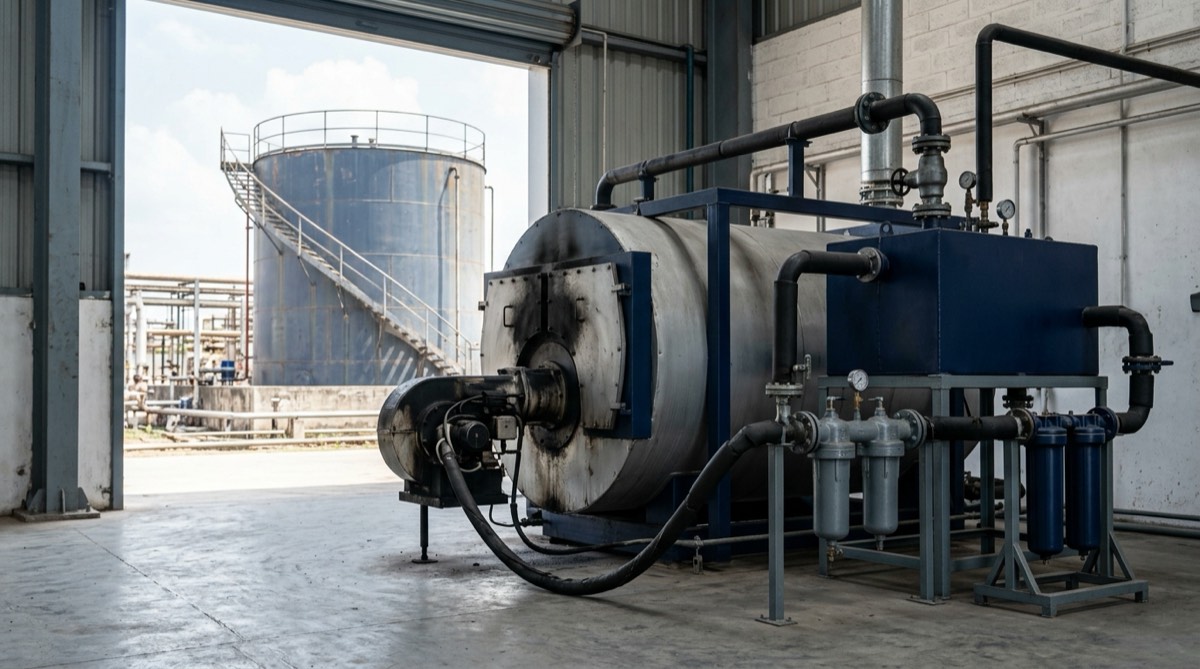
If your boiler fires light diesel oil (LDO), a heat pump needs a COP of only 0.56 to 0.67 to match your fuel cost, depending on which state’s tariff you pay. That is the lowest breakeven of any boiler fuel in our state-wise comparison below. At ₹107.65/litre on 1 August 2026, one useful kWh of heat from LDO costs approx. ₹12.58, whereas a heat pump running at COP 3.0 on the Maharashtra HT-I tariff gives the same kWh of heat for approx. ₹2.81.
On an oil-fired plant, Tetra Heat Pump, made by Promethean Energy, takes the hot water and process duties up to 120°C off the boiler, with single machines of up to 1,450 kW, and against LDO and diesel firing our systems cut heating energy cost by 40 to 70%. In case you want the figure for your own plant, send us your last fuel invoice and our team will work out the breakeven for you.
Please note that every figure on this page is for LDO. If your boiler burns high speed diesel (HSD), the method is the same with your own invoice price.
What COP does a heat pump need to beat a diesel boiler?
Between 0.56 and 0.67 against LDO, which means a heat pump giving even less than one unit of heat per unit of electricity would already match the diesel bill.
The breakeven COP is your electricity price per kWh divided by what one useful kWh of heat from your present fuel costs you. Above it, every point of COP is saving.
| Incumbent fuel | Maharashtra, ₹8.44 | Gujarat, ₹8.00 | Karnataka, ₹7.05 |
|---|---|---|---|
| LDO, ₹107.65/litre | 0.67 | 0.64 | 0.56 |
| PNG, ₹75/SCM, Morbi | 1.06 | 1.00 | 0.88 |
| PNG, ₹68/SCM, Gujarat | 1.17 | 1.10 | 0.97 |
| Furnace oil, ₹71.99/kg | 1.10 | 1.04 | 0.92 |
| PNG, ₹41.60/SCM, pre-crisis | 1.90 | 1.81 | 1.59 |
| Biomass briquette, ₹8,500/t | 3.33 | 3.15 | 2.78 |
| Coal delivered, ₹6,000/t | 4.35 | 4.12 | 3.63 |
| Coal delivered, ₹4,000/t | 6.53 | 6.19 | 5.45 |
The Gujarat column takes ₹8.00, which is inside the ₹7.50 to ₹8.50 landed range for GUVNL HT-I, and the Karnataka column takes approx. ₹7.05 before duty, so your own Karnataka breakeven will come out slightly higher once duty is added.
Liquid and gaseous fuels break even between 0.6 and 1.2 across this grid, and LDO has the lowest breakeven of that group in every state. Briquette and delivered coal need a COP of 2.8 to 6.5, which a heat pump on grid power generally cannot reach, so against coal we make the case on compliance and air quality.
Now compare these figures with what a machine actually delivers. Independent measurement under Indian conditions gives a COP of approx. 2.26 at 110°C output and approx. 2.0 at 120°C, and that is the hardest end of the range. At lower outputs the COP climbs: Tetra Heat Pump water source units reach COP 4.5 to 5.2 at 60°C output, and the figure comes down as the output is pushed toward 120°C. Even the 120°C figure is far above the LDO breakeven in every state in the grid.
What does one useful kWh of heat from LDO cost?
Approx. ₹12.58, or ₹14,623 per useful Mkcal, at ₹107.65/litre.
| Heat source | Price | Cost per useful Mkcal | Per useful kWh thermal |
|---|---|---|---|
| Light diesel oil | ₹107.65/litre | ₹14,623 | ₹12.58 |
| Electric resistance, Maharashtra HT-I | ₹8.44/kVAh | ₹10,117 | ₹8.70 |
| Heat pump, COP 2.5, Maharashtra HT-I | ₹8.44/kVAh | ₹3,926 | ₹3.38 |
| Heat pump, COP 3.0, Maharashtra HT-I | ₹8.44/kVAh | ₹3,271 | ₹2.81 |
This is our own calculation, taking 1 kWh as 860 kcal, an oil-fired boiler at 80% efficiency and electric resistance at 97%. The LDO calorific value of 10,700 kcal/kg is indicative and we could not verify it independently, hence please recheck the LDO row against your supplier’s certificate of analysis, which gives both the GCV and the density of the oil you actually receive. The Maharashtra rows treat one kVAh as one kWh, i.e. unity power factor. The same working for furnace oil, PNG, briquette and coal is in our article on the cost of industrial heat in India.
Can an electric heater replace a diesel boiler, or does it need a heat pump?
Both will cost less to run than LDO on the Maharashtra tariff, and the difference between the two is large.
An electric resistance heater gives useful heat at approx. ₹8.70 per kWh, already below the ₹12.58 of LDO, and for a small or occasional duty it is a sensible first step off diesel. But at 97% efficiency it draws close to one kW of electricity for every kW of heat, so a large duty on resistance heating needs a large increase in connected load.
A heat pump gives the same heat at approx. ₹2.81 to ₹3.38 per kWh, for COP 3.0 down to 2.5 on the same tariff. At COP 3.0 it draws about one kW of electricity for every three kW of heat, so the load increase is roughly a third of the resistance heater’s. We have compared the two technologies in more detail in our article on heat pumps and electric heaters.
Which diesel-fired duties can a heat pump take over?
The hot water and low-temperature process duties, up to 120°C output. The saturated steam duties stay on the boiler.
| Sector | Duty | Temperature | Where we have done it |
|---|---|---|---|
| Hospitality | Guest hot water | 45 to 70°C | 200-room resort, heating cost down 70% |
| Hospitality | Laundry | 60 to 85°C | Same resort |
| Hospitality | Dishwash rinse | up to 82°C | |
| Food and beverage | HTST pasteurisation | 72 to 75°C | 900 kW dairy installation, feeding the pasteuriser’s 85 to 90°C hot water loop |
| Food and beverage | CIP caustic | 70 to 85°C | Same dairy loop |
| Automotive | Alkaline degrease and component washing | 55 to 80°C | 1.5 MW paint shop installation, energy cost for the duty down 65%, payback 18 months |
| Automotive | Zinc phosphating | 50 to 60°C | Same paint shop |
| Pharmaceutical | Purified water loop sanitisation | 80 to 95°C |
Each result is for that plant’s own fuel and tariff, so take it as proof that the duty runs on a heat pump, and work out the cost on your own LDO price. Out of range are saturated steam at pressure, retort sterilisation at 121°C, and ovens such as paint bake and powder cure, which continue on your existing system.
There is published evidence of this switch on diesel itself. A UNIDO, BEE and CII compendium for the Gujarat dairy cluster (September 2020) records a 28 kW heat pump heating water from 22 to 80°C, taking that duty off two 0.7 TPH HSD-fired boilers, with a 10-month payback and 8,247 litres of HSD and 22.1 t of CO2 saved a year.
Hence in most diesel-fired plants the practical outcome is a partial changeover. The heat pump takes the hot water loads, and the diesel boiler is kept for steam and as a standby, at least through the first year. Where the heat pump ties into your system matters as much as the machine. A heat pump feeding a header the boiler is still firing into will not show its saving on the fuel bill, so our team fixes the tie-in point with you at the survey. There is more on integration here, and on the equipment and configurations here.
What changes on the electrical side when you move off diesel?
Firstly, read twelve months of bills and compare your recorded maximum demand with your sanctioned load, since many plants already have headroom for the heat pump. Secondly, Maharashtra bills HT-I per kVAh, so power factor goes straight into your cost of heat, and automatic PF correction is worth sizing along with a large compressor. Our team works out the connected load and the PF correction with you as part of the sizing; the details are in our article on sanctioned load and heat pump retrofits.
Does moving off LDO help with NCR fuel rules or IBR?
In Delhi NCR, LDO is already off the table. The Commission for Air Quality Management has banned it across NCR since 1 January 2023, along with coal, pet coke, furnace oil and naphtha. Electricity is on the approved list, so an NCR plant can move its hot water duties straight to a heat pump with no burner or stack left on them. We have covered the rules in our article on CAQM fuel rules for NCR factories.
On IBR, a circuit heating water below 100°C is a hot water generator and needs no registration, as with any electric hot water generator. A pressurised loop above 100°C is for your state Boiler Directorate to decide, and there is more on the IBR threshold here.
How do I check this against my own diesel bill?
Start with our calculator. Select diesel as the fuel, put in your price per litre, your heat demand, operating hours, output temperature and electricity tariff, and it will compare the annual running cost on each side. If you would rather we did the working, send us your last fuel invoice and a recent electricity bill along with the duty temperatures, and our team will get back to you with the breakeven for your plant.
Frequently asked questions
- What COP does a heat pump need to beat a diesel boiler?
- Against light diesel oil at ₹107.65 per litre (1 August 2026), the breakeven COP is 0.67 on the Maharashtra HT-I tariff, 0.64 in Gujarat and 0.56 in Karnataka. That is the electricity price per kWh divided by the cost of one useful kWh of heat from LDO, which is approx. ₹12.58 assuming an 80 percent efficient boiler and an indicative calorific value of 10,700 kcal per kg. Any working heat pump clears it by a wide margin.
- Is an electric heater cheaper to run than a diesel boiler?
- Yes, on the Maharashtra HT-I tariff. A resistance heater at 97 percent efficiency gives useful heat at approx. ₹8.70 per kWh, against approx. ₹12.58 from light diesel oil at ₹107.65 per litre. A heat pump does much better again: approx. ₹2.81 per useful kWh at COP 3.0 on the same tariff, and approx. ₹3.38 at COP 2.5.
- Do these figures apply to HSD as well as LDO?
- The method applies to both, but the figures on this page are for light diesel oil at ₹107.65 per litre. We do not have a verified 2026 bulk price for high speed diesel. In case your boiler fires HSD, take the price on your last invoice and the calorific value from your supplier, and divide your electricity tariff by the resulting cost per useful kWh of heat.
- Can a heat pump replace a diesel-fired steam boiler?
- Not where the boiler raises saturated steam at pressure. A heat pump replaces the hot water and low-temperature process duties that the diesel boiler is serving today, up to 120 degrees Celsius output. In most plants the diesel boiler stays for the steam duties and as a standby, and the diesel consumption comes down.
- Is LDO allowed as a boiler fuel in Delhi NCR?
- No. Light diesel oil is on the list of fuels banned across Delhi NCR by the Commission for Air Quality Management, together with coal, pet coke, furnace oil and naphtha, since 1 January 2023. Electricity, natural gas and LPG are on the approved list, so a plant moving off LDO in NCR can go to a gas conversion or to electric heat.