How a 200-room resort cut its heating cost by 70% with an industrial heat pump
Outcome
- Sector
- Hospitality
- Load
- 200-room property
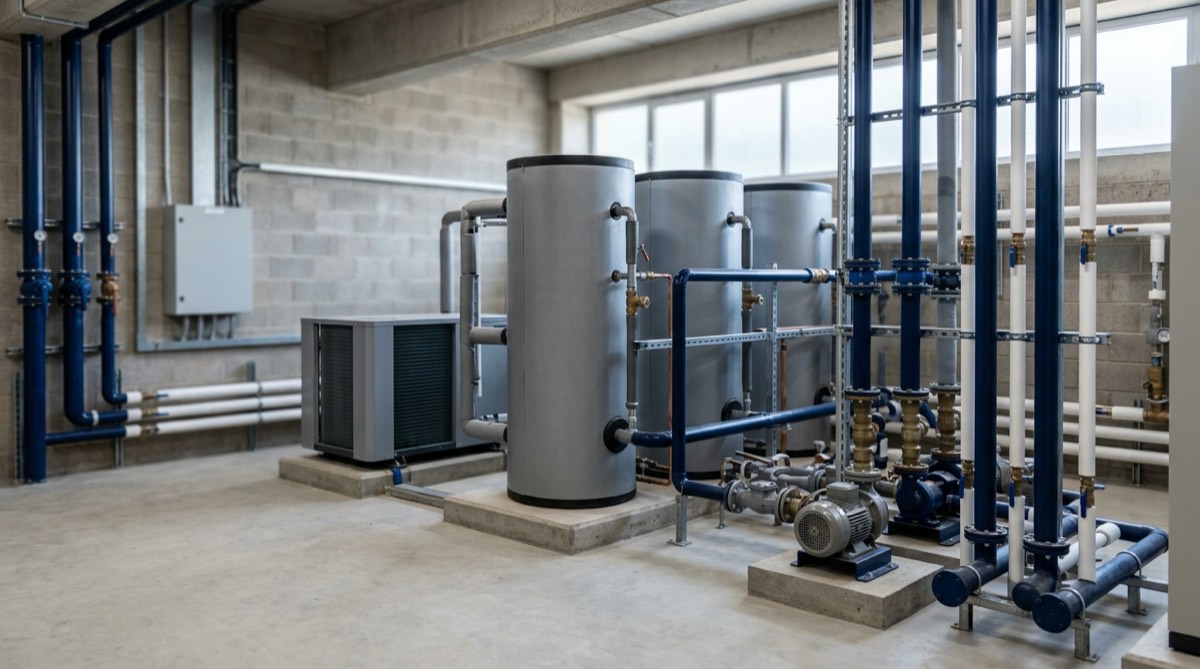
A 200-room resort property in India moved its guest hot water, laundry and pool heating onto a Tetra Heat Pump system, cutting heating cost by 70% and avoiding 250 tonnes of CO2 a year. The kitchen was never in scope, because cooking and tandoor heat sit above what any heat pump delivers. The design problem was not the size of the daily heat load but the shape of it. Demand collapses mid-morning and spikes at breakfast and again in the evening, which makes stored volume as much a sizing decision as installed kilowatts.
Which loads the heat pump took, and which it did not
Four hotel duties sit inside the range of an industrial heat pump, and between them they carry most of the fuel bill.
| Duty | Temperature | Served by the heat pump |
|---|---|---|
| Guest hot water | 45 to 70°C | Yes |
| Laundry | 60 to 85°C | Yes |
| Dishwash rinse | To 82°C | Yes |
| Pool water | 26 to 30°C | Yes |
| Cooking and tandoor | Above the range | No |
Tetra Heat Pump, a product of Promethean Energy Private Limited, builds units delivering continuous output up to 120°C with ±0.5°C control, which covers guest hot water at 45 to 70°C, laundry at 60 to 85°C, dishwash rinse to 82°C and pool water at 26 to 30°C, and none of the cooking load. Settle that split at survey, not at commissioning, here or at any property with a central hot water plant.
Why the peak sizes the system, not the average
A hotel’s heat demand has a shape process plant does not. Guest hot water draws hard through the early morning, falls to almost nothing by late morning, and climbs again through the evening. Laundry runs to its own clock, and the pool loses heat steadily all day.
Size on the breakfast peak and the plant spends most of the day at low part load, cycling, returning a worse average efficiency than its rating suggests. Size on daily energy alone and the peak must come from somewhere other than the compressor: stored volume, which costs less per useful kilowatt-hour than compressor capacity and holds its value at part load.
Storage is the other half of the sizing decision
Three decisions follow from this, and none of them concerns the machine itself.
Store temperature comes first. Guest hot water is delivered between 45 and 70°C, so storing at the upper end of that band and blending down at the outlet puts more usable heat in the same tank. Stratification is second: a store that mixes gives back a fraction of its rated volume, so the inlet and outlet arrangement matters as much as the litres. Third is the recovery window. The store must be back at temperature before the evening peak, and that window rather than the peak draw sets the minimum machine size.
Scheduling costs nothing: laundry moved into the mid-morning trough flattens the profile, and the pool absorbs output whenever the machine has it spare. Occupancy swings seasonally too, so ask about part load behaviour at selection.
Running it as a hotel, not as a factory
A resort has no shift engineer standing over a boiler. Tetra Heat Pump units tie into BMS, SCADA and PLC networks, including Siemens and Allen-Bradley controllers over Modbus and BACnet, so sequencing between machine, store and existing plant sits where the engineering team already looks. The published service response is 24 to 48 hours. Plant room location relative to guest rooms belongs in the layout before the order. More on tie-in and controls.
A hot water circuit below 100°C is also outside the Indian Boiler Regulations, so the certified attendant on every shift and the annual inspection shutdown leave with the boiler.
What changed
Heating cost across the converted duties fell by 70%, and the installation avoids 250 tonnes of CO2 a year.
That 70% is the top of the 40 to 70% band Tetra Heat Pump installations deliver against gas, LPG, furnace oil, LDO and diesel, and hospitality is where that top end is reachable. The reason is temperature. COP depends on the lift: Tetra Heat Pump water source units reach COP 4.5 to 5.2 at 60°C output, and performance falls as output temperature rises toward the 120°C ceiling. Guest hot water and pool water sit at the favourable end of that curve, and the breakeven COP against gas and furnace oil is 1.0 to 1.2.
Where a heat pump does not fit a hotel
The kitchen stays as it is, so a property expecting the gas connection to disappear will be disappointed. The cost argument is also about fuel rather than about technology. Against gas, LPG, furnace oil, LDO and diesel it holds on any working machine. A property burning solid fuel is in a different position, where the case rests on compliance, air quality, labour and what a corporate audit will accept, not on running cost. Other installed projects sit in the same frame.
Working it out on your own property
Start with the load shape, not the room count. Log hot water draw against time of day for a week in season and again out of season, and the storage question largely answers itself. The calculator takes the fuel you burn today and the output temperature you need. The duties are set out on the hotels and resorts page, the equipment on high temperature heat pumps. To have your own profile looked at, start here.
Frequently asked questions
- Can an industrial heat pump run a hotel kitchen?
- No. Cooking and tandoor heat sit above the range of an industrial heat pump and stay on their existing fuel. The hotel duties that are in range are guest hot water at 45 to 70°C, laundry at 60 to 85°C, dishwash rinse to 82°C and pool water at 26 to 30°C.
- How much can a hotel save by moving hot water to a heat pump?
- Tetra Heat Pump installations displacing gas, LPG, furnace oil, LDO or diesel cut heating cost by 40 to 70%. A 200-room resort property in India reached 70% across guest hot water, laundry and pool heating. Against solid fuel the argument is compliance, air quality and labour rather than cost.
- How is a heat pump sized for a hotel?
- On the daily heat energy and the recovery window between peaks, not on the breakfast draw. Hotel demand peaks at breakfast and again in the evening and collapses through the middle of the morning, so stored hot water covers the peak while the machine is sized to refill the store before the next one.
- What COP does a heat pump reach on hotel hot water?
- COP depends on the lift. Tetra Heat Pump water source units reach COP 4.5 to 5.2 at 60°C output, and performance falls as output temperature rises toward the 120°C ceiling. Guest hot water at 45 to 70°C sits at the favourable end of that curve, which is why hospitality does better on the same machine than a process running at 110°C or above.
- Does a hot water heat pump need boiler registration in India?
- A hot water circuit operating below 100°C is not a registered boiler under the Indian Boiler Regulations, so the certified attendant on every shift and the annual inspection shutdown do not apply to it. Above 100°C they do, so scope the exemption against the duty being moved.
Is your plant a fit?
The output temperature of the duty you want to move, the fuel you burn now and your landed electricity tariff decide it.