What to require from an industrial heat pump supplier on service, spares and response
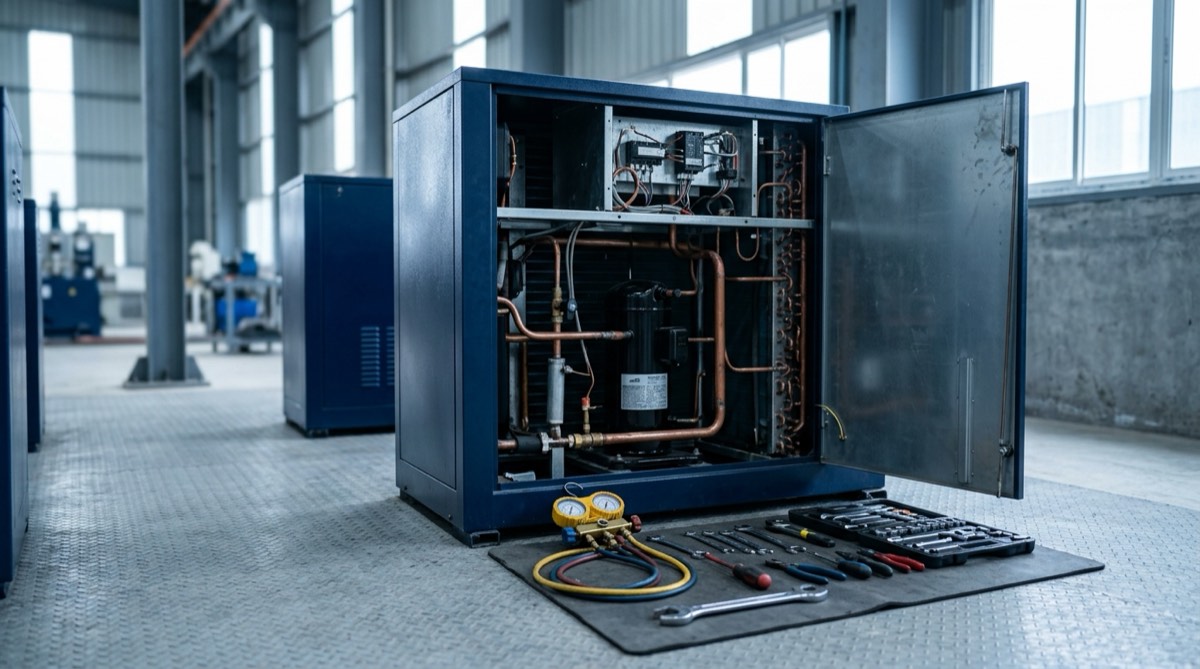
Service capability decides whether an industrial heat pump project delivers over ten years, and it is the item most often left out of the purchase order. Treat it as a specification line rather than an after-sales question: spares held in India, a defined response time, a documented service interval and scope, a named escalation path, and a performance test you can repeat in year three. Tetra Heat Pump, a product of Promethean Energy Private Limited, publishes a service response of 24 to 48 hours and has 200+ installations in the field. The sections below set out what else to require from any supplier, including us.
Why maintenance, and not the machine, is the usual failure mode
An industrial heat pump is a refrigeration circuit working in the useful direction, and the faults that take one out of service are refrigeration faults: loss of charge, a failing expansion device, fouled heat exchangers, drifted sensors, a tripped drive. None of them is exotic. All of them sit outside the trade skills most Indian factory maintenance departments hold, because those departments were built around boilers, pumps and motors.
That gap produces four failure mechanisms, and not one of them is a fault of the technology.
The first is diagnostic. A boiler fitter can maintain a boiler. Reading superheat and subcooling, recovering and recharging refrigerant safely, and telling a failing expansion valve from a fouled evaporator is refrigeration work. If neither the plant nor the supplier has that skill within reach of the site, a small fault becomes a long outage.
The second is logistical. If the compressor, the expansion valve or the controller has to be imported when it fails, the machine is down for the slowest of the manufacturer’s stock position, shipping and customs clearance. A part that is a week away in Europe can be a quarter away at your gate, and no response time commitment survives that.
The third is organisational, and it never appears on a risk register. A heat pump is usually bought by one person who understood the case for it. When they move on, the machine loses the only person in the plant with a reason to defend it. The first awkward fault becomes something nobody has authority to spend on, the bypass gets opened, the boiler is fired, and the heat pump is quietly never restarted.
The fourth is arithmetic. A World Bank study across 224 Indian MSMEs found a realised payback of 44 months on energy efficiency investment, against a stated buyer preference of one to three years. Nearly four years is how long the asset has to keep running before it has paid for itself. A machine that stops in year two returned nothing, whatever the model said.
All four are closable in the purchase order. None of them is closable afterwards.
What to require from any supplier, in the purchase order
Take this into the negotiation and require an answer to each line in writing, from us and from everyone else on your list.
| Requirement | Why it matters | What to write into the purchase order | How to verify it before you sign |
|---|---|---|---|
| Response time | The number quoted in a meeting is usually a response to an email, not an engineer on site | Attendance on site within a stated number of hours from the logged fault, measured to arrival and not to acknowledgement | Ask for the definition in writing, then ask what the contract says happens when the window is missed |
| Spares held in India | An imported part turns a two-day repair into a customs problem you cannot escalate | A named list of parts held in stock inside India, with the stock location stated | Ask where the stock physically sits and how many other machines it is committed to |
| Service engineers and their base | A national response commitment means nothing if it depends on one person flying | Named engineers, their base locations, and named cover for when they are unavailable | Ask how many installed machines each engineer covers today |
| Service interval and scope | An interval with no scope is a visit, not a service | A stated number of visits a year, each covering a listed set of checks, with a signed report on a fixed template | Ask to see a blank report template and a completed one with the customer details removed |
| Escalation path | The failure you care about is the one where the normal channel has already stopped answering | A named escalation contact at defined intervals, with authority to release parts and travel | Call the number before you sign the order, not after |
| Warranty term and exclusions | The exclusions decide what the warranty is worth, and they are rarely read | The term, what is covered, what voids it, and whether third party servicing voids it | Ask directly whether using your own refrigeration contractor voids cover |
| Remote monitoring and who watches it | A dashboard nobody reads is not a reliability measure | The parameters logged, the polling interval, who monitors them and what threshold triggers a call to you | Ask to see live trend data from an existing installation |
| Commissioning performance test | Without a repeatable test you cannot prove degradation, so you cannot claim against it | The test method, the metering, the operating point, the measurement period and the tolerance | Agree the method before the order is placed, never at commissioning |
| Position at end of contract | Losing controller access at the end of an AMC is how a plant gets locked in | On termination the buyer receives the service history, controller access credentials and the full parts list | Ask what you receive if you move to a different maintainer |
Two rows do more work than the rest. The response time definition, because almost every argument about service starts with two parties who meant different things by one number. And the end of contract position, because it is the only row that costs a supplier something to concede, which is what makes the answer informative.
What spares actually matter
Not everything on the skid is worth stocking. There are five items that decide whether a fault costs you a day or a quarter.
| Component | What happens when it fails | What to ask your supplier |
|---|---|---|
| Compressor | Total loss of output. The longest and most expensive repair on the machine | Is a service exchange unit held in India, and what is the process for getting one released |
| Expansion device | The circuit runs badly or trips repeatedly rather than stopping cleanly, so it is often diagnosed late | Is the valve and its controller stocked, and is it a proprietary part or a standard one |
| Refrigerant charge | The machine loses capacity gradually and then trips. Recharging needs both the gas and someone qualified to handle it | Which refrigerant, is it available in India in cylinder quantities, and who recovers and recharges it |
| Sensors and transmitters | The controller acts on wrong information, which is worse than no information | Are pressure and temperature transmitters standard parts you can source locally |
| Controller, drive and contactors | The machine is mechanically sound and will not start | Is the controller a proprietary board, and can it be replaced without the supplier on site |
Heat exchanger fouling belongs in the same conversation but is not a spare. It is a consumable and a procedure: cleaning chemicals, the water quality that decides how fast fouling happens, and a scheduled clean instead of a reactive one. On a water source machine, water treatment quietly determines the performance you still have in year four.
Tetra Heat Pump systems use refrigerants including R1234ze and R245fa. Whoever you buy from, get the refrigerant named in the contract rather than in a brochure, because it decides who in your state is able to work on the machine at all.
What your own team can cover, and what it cannot
Splitting the work honestly at the start is what stops a plant from either paying a supplier to change filters or attempting a refrigerant recovery it is not equipped for.
Your own maintenance team can reasonably own the water side and the housekeeping: strainer and filter cleaning, pump seals and glands, checking flow rates against the design figures, valve and actuator operation, insulation, and logging the temperatures the controller already displays. Scheduled heat exchanger cleaning and the water treatment behind it belong here too. None of that needs the supplier on site, and all of it is the work most often skipped.
What your team should not own is the refrigerant circuit. Charge recovery and recharge, superheat and subcooling diagnosis, compressor internals, and anything requiring the circuit to be opened belong to a refrigeration technician, whether that is the supplier’s or a contractor you retain. Decide which before commissioning, and if it is a contractor of your own, confirm in writing that using them does not void the warranty. That question has an unwelcome answer often enough to be worth asking early.
What a commissioning test should look like
Ask for a performance test you can repeat yourself in year three. Most commissioning tests fail that requirement, not because the machine underperforms but because the test was a single reading taken by the supplier on a good day with a clamp meter.
Five things to settle before the order is placed.
Meter the electrical input to the whole package, meaning the compressor plus the pumps, fans and controls, not the compressor alone, and take thermal output at flow and return on a permanently installed meter. Temporary metering gives you a number and no baseline to argue from later.
Run the test long enough to cover your real load profile, including the hours when the machine is off full load. A figure taken at steady full load describes an operating condition your plant may rarely see.
Fix the operating point, which is the decision that determines whether the test means anything at all. COP depends on the lift. Tetra Heat Pump water source units reach COP 4.5 to 5.2 at 60°C output, and performance falls as the output temperature rises toward the 120°C ceiling; independently measured performance in Indian conditions is about 2.26 at 110°C output and about 2.0 at 120°C. Those are two ends of one curve. A test run at 60°C therefore proves nothing about a 110°C duty, so specify the test at the output temperature your process needs.
Capture the baseline before the machine arrives: your metered fuel consumption for the same duty, plus the production output over both periods so the comparison survives a heavier month. Nobody can reconstruct it afterwards.
Agree the acceptance band, and the remedy for falling outside it, at order stage. If the process needs stability as well as heat, put the control tolerance in the test; Tetra Heat Pump units hold output to ±0.5°C, and that is a testable claim.
Leave the metering installed once the test is finished. It costs very little at project stage and it is the only thing that later separates a fouled heat exchanger from a busier production quarter.
Remote monitoring is a reliability mechanism, not a dashboard
Almost every heat pump failure announces itself first. Compressor discharge and suction pressures drift, superheat wanders, approach temperature on either heat exchanger climbs as it fouls, motor current rises, start counts increase as the machine short cycles. Each of those is visible weeks before the trip that stops production.
Tetra Heat Pump systems integrate with BMS, SCADA and PLC networks, including Siemens and Allen-Bradley controllers, over Modbus and BACnet, so those parameters can be trended on the system your plant already watches rather than on a separate portal nobody opens. Details of the interfaces and the commissioning scope are on the system integration page.
The technical capability is the easy half. Governance is the half that fails. Settle three questions with any supplier: which parameters are actually logged and at what interval, who is looking at the trend, and what threshold obliges them to pick up the phone before you do. A monitoring system with no named watcher and no trigger is a data feed, and data feeds do not prevent outages.
The electrical side of staying reliable
Moving a thermal load onto electricity changes your relationship with the DISCOM, and two consequences are routinely missed at budget stage.
Your sanctioned load goes up. Exceeding sanctioned demand is charged every month it happens, so check your headroom while the project is still being costed, not after the first bill lands. The security deposit moves too: Maharashtra sets it at twice the average billing cycle and recalculates annually, so a higher monthly bill pulls a larger deposit through at the next revision. Gujarat is harsher, computing the deposit as though the entire load were a new service and not just the increment. Neither item is large beside the machine itself, and both land at an awkward point in the project cash flow if nobody has modelled them.
Power factor is the second one, and it is the one a heat pump makes worse. Maharashtra bills HT-I consumers per kVAh rather than per kWh, at ₹8.44 per kVAh in FY2026-27 on a declining approved path to ₹7.45 by FY2029-30, plus ₹650 per kVA per month of demand charge. Roughly a quarter of consumers above 200 kVA run power factor below 0.90 and under 0.5% actively manage it. Adding a large compressor to a plant already sitting below 0.90 makes the reactive component worse, and on kVAh billing you pay for it every month for the life of the machine. Sizing APFC alongside the heat pump, and not as a follow-up project, is one of the few line items here that pays back a share of its own cost.
One thing genuinely gets easier. A hot water circuit operating below 100°C is not a registered boiler under the Indian Boiler Regulations, so the certified attendant on every shift and the annual inspection shutdown leave with the boiler. Above 100°C that relief does not apply, so scope it against the duty you are actually moving.
What Tetra Heat Pump publishes today
Holding ourselves to the same table, this is what we have on record.
A service response of 24 to 48 hours, published and not conditional on your location. An installed base of 200+ installations, which matters here for a practical reason: spares move because there are machines to move them for, and a supplier with a large installed base has a commercial reason to hold stock that a supplier with a handful of projects does not. Air source, water source and cascade configurations, with refrigerants including R1234ze and R245fa. Integration to BMS, SCADA and PLC networks over Modbus and BACnet. An annual maintenance structure published in tiers, covering scheduled visits, inspection, remote support and parts, with the coverage differing by tier; read the tiers against what an hour of downtime costs your line, and the maintenance programmes are set out here.
Where a figure is not published, ask for it and hold the answer to the table above. That applies to us as much as to anyone else you are evaluating. A supplier who will not put a service commitment into the order has told you something worth knowing.
Working through it on your own project
If you are at the shortlisting stage, the manufacturer evaluation guide covers what else to check before a supplier gets onto the list, and the high temperature systems page sets out where the output ceiling actually sits, which is the other half of whether a machine will still be serving your duty in year five. Worked examples of installed projects are collected on the case studies page.
When you want the service terms for a specific duty and site, send us the load and ask for the answers to the nine rows above in writing.
Frequently asked questions
- How fast should an industrial heat pump supplier respond to a breakdown?
- Fast enough that the answer is written into the purchase order rather than described in a sales meeting, and defined as time from the logged fault to an engineer on site, not to an acknowledgement email. Tetra Heat Pump publishes a service response of 24 to 48 hours. Whoever you buy from, ask what happens contractually when the stated window is missed.
- Which heat pump spares should be held in India?
- The parts whose absence stops the machine: the compressor or a service exchange unit for it, the expansion device, pressure and temperature transmitters, the controller and its display, contactors and the variable frequency drive, and the refrigerant charge itself. Ask your supplier for the list in writing, ask where the stock physically sits, and ask which other customers that same stock is committed to.
- Can our own maintenance team service an industrial heat pump?
- It can be covered in part. A plant team can handle water side work, strainer and filter cleaning, sensor checks and heat exchanger cleaning on a schedule. The refrigerant circuit needs a refrigeration technician who can read superheat and subcooling and recover and recharge the charge safely, which most Indian factory maintenance departments are not staffed for because they were built around boilers, pumps and motors.
- What voids an industrial heat pump warranty?
- That depends entirely on the supplier and it is the single clause buyers most often fail to read. Ask three specific questions before signing: whether using your own refrigeration contractor voids cover, whether a missed scheduled service voids cover retrospectively, and whether operating outside a stated temperature or flow envelope voids cover. Get the answers in the contract rather than in an email.
- How do I check a heat pump is still performing three years after commissioning?
- By repeating the commissioning test, which means the commissioning test has to be repeatable in the first place. Specify permanent metering of electrical input to the whole package and thermal output at flow and return, agree the operating point and the measurement period before the order, and record the result at handover so there is a baseline to compare against. Without permanent metering there is no way to tell a fouled heat exchanger from a heavier production month.
- Does remote monitoring actually prevent breakdowns?
- It prevents the ones that announce themselves, which is most of them. Compressor discharge pressure, superheat, heat exchanger approach temperatures, motor current and start counts all drift before they fail. The value is not the dashboard but the arrangement behind it: someone has to be watching the trend and be obliged to call you. Ask who that is and what threshold triggers the call.