Air source vs water source heat pump for industrial use in India
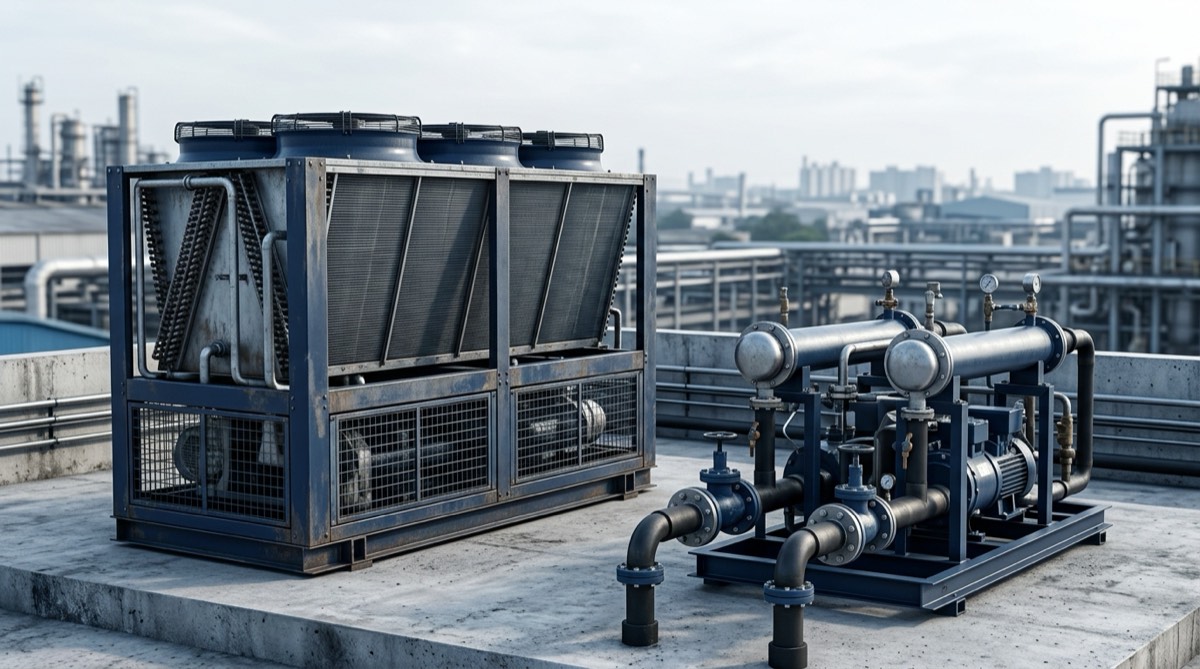
For industrial duty in India a water source heat pump is the better machine wherever a usable liquid stream already exists, because a stable source temperature gives a higher and more predictable coefficient of performance and removes defrost losses entirely. Tetra Heat Pump water source units reach COP 4.5 to 5.2 at 60°C output, while independently measured performance in Indian conditions at the top of the range is about 2.26 at 110°C output and about 2.0 at 120°C. That gap is the whole point of this page: the source temperature and the lift decide the number, so any single headline COP quoted without its operating point tells you nothing about what your plant will get. An air source unit wins on installation simplicity, and on any site with no liquid stream, no abstraction approval and no room for a water side.
Air source or water source: the short answer
Choose a water source machine wherever a usable liquid stream already exists on site, and an air source machine everywhere else. A cascade arrangement becomes necessary when the output temperature you need is higher than what a single compression stage can reach from your source.
Cascade sits in the third column below because buyers keep asking where it fits, but it is a stage arrangement rather than a source. A cascade machine is still fed by air or by water, and the column describes what the second stage changes.
| Parameter | Air source | Water source | Cascade |
|---|---|---|---|
| What it takes heat from | Ambient air, available at every site with no preparation | A liquid stream: process water, cooling tower return, refrigeration condenser rejection, effluent, condensate, or a borewell | Whichever of the two feeds the bottom stage |
| Source temperature stability | Moves with the hour and the season. The same machine sees a different source at 3 pm in May and at 4 am in January | Steady. A process stream at a controlled temperature is the most stable source a plant has | Inherits the stability of the bottom stage |
| COP at 60°C output | No figure is published at a stated operating point, because there is no single operating point. It tracks ambient | COP 4.5 to 5.2 for Tetra Heat Pump water source units at 60°C output | Not the arrangement you would use at 60°C. A single stage covers that duty |
| Performance at the top of the range | Independently measured performance in Indian conditions is about 2.26 at 110°C output and about 2.0 at 120°C. At that lift the compression work dominates and the source matters less | As left. The advantage of a warm source narrows as the output temperature rises | As left. Cascade is what makes the top of the range reachable at all, not what makes it efficient |
| Seasonal and diurnal variation | Large, and in both directions. Output and efficiency both move | Small, and set by your process rather than by the weather | Follows the bottom stage |
| Defrost losses | Present wherever the coil runs below the dew point of the incoming air | None. There is no air coil to frost | None on a water-fed bottom stage |
| Water side | None. There is no water side to design, treat or maintain | A real one. Strainers, treatment, a flow you can guarantee and a pressure drop the pumps have to carry. The limits are set at design against your actual water, not read off a catalogue | Whatever the bottom stage needs |
| Footprint and siting | Outdoors, with clear airflow on the intake and discharge and enough separation to stop the unit rebreathing its own exhaust | Compressor skid indoors in a plant room, plus pipework and treatment to the source. Less outdoor area, more indoor area | Two circuits, so more machine and more plant room than a single stage on the same duty |
| Noise | The fan array usually sets the boundary noise, not the compressor. It is the configuration that puts a fan bank outdoors | No fan array. The skid sits in a plant room, which is a room you can treat | Two compressor circuits, in a plant room. Same principle as water source |
| Permitting burden | None beyond the electrical connection | None on a process stream. Real, and worth confirming first, on a borewell | Same as its source |
| Where it is the right answer | No liquid stream on site, a retrofit with no plant room, a load that runs mostly in the cooler part of the day, or a first project you want to keep simple | Any plant already rejecting heat: refrigeration, cooling towers, hot effluent, condensate return. Highest COP of the three configurations | An output the single stage cannot reach from your source, typically toward the 120°C ceiling |
| Where it is the wrong answer | A continuous load through an Indian summer afternoon on a site that has a perfectly good warm effluent stream running to drain | A site with no stream, no approval and no appetite for a water treatment routine | Any duty a single stage already covers. You are paying for a stage you do not need |
Two rows in that table point in opposite directions. The COP row is strongly source dependent; the row below it much less so, because at 110°C and 120°C output the compression work dominates and a warm source has less left to give. Choosing the source buys you most at the bottom of the temperature range and least at the top.
Why does the heat source change COP so much?
The reason is that a heat pump does not consume energy in proportion to the quantity of heat it moves. It consumes energy in proportion to the lift, which is the temperature gap between the source it draws from and the output your process requires.
The compressor has to raise the refrigerant from the temperature at which it can absorb heat from your source to the temperature at which it can give that heat up to your process. The wider that gap, the more pressure ratio the compressor develops, the more electrical work it takes, and the lower the coefficient of performance. Two identical units, one taking heat from warm effluent and one from cool night air, do measurably different amounts of work to land the same hot water at the same temperature.
That is why a COP quoted on its own is a number to distrust, and why the honest form always carries two temperatures. Tetra Heat Pump water source units reach COP 4.5 to 5.2 at 60°C output, and performance falls as the output temperature rises toward the 120°C ceiling. Independently measured performance in Indian conditions at the high end is about 2.26 at 110°C output and about 2.0 at 120°C. Both are true and they are not in conflict, but a vendor quoting only the first against a 120°C duty is selling you the wrong end of the curve.
The size of the effect shows up on real plants. A 2026 peer-reviewed study of an Indian dairy plant reports a 344 kW heat pump at COP 2.29 and a 4.93 year payback. Raising the coupling temperature on the source side to 50°C moved the same installation to COP 3.08 and a 3.07 year payback. Nothing about the machine changed. The source did, and the payback shortened by nearly two years.
Tetra Heat Pump, a product of Promethean Energy Private Limited, builds air source, water source and cascade configurations across more than 200 installations, delivering continuous output up to 120°C with ±0.5°C control, at up to 1,450 kW in a single machine and up to 5 MW across a multi-unit project, using refrigerants including R1234ze and R245fa. Which of the three configurations you get is a consequence of your source and your output temperature, not a menu choice. There is more on the equipment and the temperature envelope on the high temperature heat pumps page, and the fundamentals of how the cycle works if you want the mechanism first.
What can you actually use as a water source?
Far more is available than most plants realise, and almost none of it is surface water from a lake or a river.
The framing on European pages, which puts surface water from lakes and rivers alongside groundwater, does not describe Indian industry. Here the realistic sources are process streams first, cooling tower and condenser rejection second, and a borewell last. The test: any liquid leaving your plant warmer than ambient, at a flow you can measure and a temperature you can predict, is a candidate.
| Stream | Where it exists | Why it beats ambient air | Watch out for |
|---|---|---|---|
| Refrigeration condenser rejection | Any plant with cold storage, chilling or process refrigeration. Indian dairies spend 19% of plant energy on refrigeration, rejecting that heat continuously while pasteurisation takes 38% | Warm, continuous, and already being paid for once. Recovering it improves the chiller’s own condensing conditions as well | Availability follows the refrigeration load, so a seasonal cold store gives a seasonal source |
| Cooling tower return | Almost every plant with compressors, chillers or jacketed vessels | Warmer than air for most of the year and far steadier hour to hour | Open circuit, so the water carries whatever the tower has scrubbed out of the air. Treat it as a fouling duty from the start |
| Compressor jacket and aftercooler water | Any plant with reciprocating or screw air compressors, which is most of them | Continuously available whenever the compressor runs, and its temperature is set by the compressor rather than the weather | The stream is usually small. Good for a hot water loop, rarely enough on its own for a plant-wide duty |
| Hot process effluent | Dye houses, food and beverage plants, metal finishing lines, clean-in-place drains | Often the warmest thing on site and currently going to drain. Free heat with a disposal problem attached | Solids, fibre, oil and pH. This is the stream that most needs a plate exchanger between it and the machine |
| Quench and wash water | Metal finishing, component washing, heat treatment shops | Warm, and the plant usually wants it cooled anyway, so the heat pump serves both duties | Intermittent on a batch line. Size on the profile, not on the peak |
| Steam condensate return | Any plant still running a boiler for part of the load | Hot, clean and already piped | If the condensate is genuinely hot, ask first whether the answer is better condensate recovery rather than a heat pump |
| Process bath cooling duties | Automotive paint shops hold the electrodeposition bath at 28 to 32°C, which is a cooling load, not a heating one | The machine gets a paid cooling duty at one end and a paid heating duty at the other. Best economics available | Only works where the two loads overlap in time. Storage bridges a short mismatch, not a shift-long one |
| Borewell water | Sites with an existing permitted abstraction | Stable year round, which is exactly what an air source unit is not | Abstraction is regulated, and confirming that it is permitted at your site is a project in itself rather than a line item. Assume nothing here |
The commercial point is the first row, and it is the one that gets missed. A plant already running refrigeration has already bought the source. Food, dairy, cold storage and anything rejecting heat at a condenser can reach the highest COP configuration for the cost of pipework, because the machine takes heat from a warm, continuous, indoor stream instead of from the weather. It is also where the same unit earns twice, cooling on one side and heating on the other. There is more in the piece on heat pump water heating across industries and on the food and beverage page.
Against the fuels a heat pump actually displaces, which are PNG, LPG, furnace oil, LDO and diesel, the confirmed saving band is 40 to 70%. Against gas and furnace oil the breakeven COP is only 1.0 to 1.2, so the source question is not about whether the machine wins. It is about how much margin you leave on the table by taking heat from air when you had a warm stream running to drain.
What the Indian climate does to an air source unit
The Indian climate affects an air source unit in three distinct ways, and only one of those three is the effect that buyers normally expect.
The obvious one is that the source temperature moves. An air source unit sees a different source at three in the afternoon in May than at four in the morning in January, and the COP moves with it. That is the definition of the configuration rather than a fault, but it means a single quoted figure for an air source machine is a design point figure. If the load runs around the clock, size on the worst hour you will meet, not the average.
The second is the air side itself. Coils in Indian industrial settings collect dust, and in cement, foundry, textile and grinding environments they collect it quickly. A fouled coil raises the approach temperature, which is functionally the same as the source getting colder. Coil cleaning is an energy task rather than a housekeeping one, and it belongs in the maintenance schedule with a named interval.
The third is siting. An air source unit needs clear intake and discharge, and enough separation from walls, other units and its own exhaust to stop it recirculating air it has already cooled. Tuck one into a courtyard and you have quietly built yourself a colder source.
None of this makes air source the wrong answer. It makes it the answer that has to be sized on the worst case rather than on the datasheet.
What the water side asks of you in return
A water source machine trades a dependence on the weather for a maintenance obligation. That trade is usually worth making, provided you enter into it knowing that it is a trade.
Indian source water, whether borewell, cooling tower return or process effluent, carries hardness, dissolved solids and often suspended matter, and all three end up on the heat exchanger surface behaving as insulation. Scale and fouling rarely cause a dramatic failure. They cause a slow, invisible loss of performance, which is worse: the machine keeps running while the COP drops and nobody attributes the extra units on the bill to the exchanger.
The answer is not exotic. A plate exchanger separating the dirty stream from the machine, filtration sized for what the stream actually carries, treatment appropriate to your water analysis, and an inspection interval set from that analysis rather than from a generic table. The limits that matter, on hardness, dissolved solids, flow rate and allowable pressure drop, are set at design against a sample of your water. Any vendor quoting them before seeing your analysis is quoting somebody else’s water.
Flow is the constraint buyers underestimate. A stream is only a source if the flow is there when the heating load is there, and a stream that runs two shifts against a load that runs three is not a match. Establish the flow profile and the temperature profile together, over a normal week, before anyone sizes anything.
Borewell water is a separate decision. Abstraction for industrial use in India is regulated, so the question is not whether you can drill, it is whether you are permitted to draw. Confirm that first, because it sets the project timeline in a way equipment lead time does not, and it is the reason water source is quietly not viable at a good number of sites that assume it is.
Where cascade comes in, and the 100°C line
A cascade machine runs two refrigerant circuits in series. The first lifts heat from your source to an intermediate temperature, and the second takes it from there to final output. Each circuit then works at a pressure ratio it can actually handle, which is what makes the top of the range reachable at all. Tetra Heat Pump units deliver continuous output up to 120°C with ±0.5°C control.
The efficiency reality has to travel with that. Extending the range does not extend the COP, and the measured Indian figures at the top, about 2.26 at 110°C and about 2.0 at 120°C, are the honest expectation. Against gas and furnace oil, where breakeven sits at 1.0 to 1.2, that is still a comfortable win. Against coal or biomass, where breakeven is 3.3 to 6.5, it is not a cost argument at all, and the reasons to switch there are compliance, air quality, labour and customer audit rather than the fuel bill.
One regulatory line is worth knowing before you fix the output temperature. A hot water circuit below 100°C is not a registered boiler under the Indian Boiler Regulations, so the certified attendant on every shift and the annual inspection shutdown do not apply. Rounding a duty up above 100°C because it sounds safer costs you COP and can cost you that exemption. Specify the temperature the process needs and no more.
What the electrical connection costs, either way
Shifting a thermal load onto electricity raises your sanctioned load, and almost no vendor page in India mentions this. It applies to both configurations, and it has a real effect on the project budget.
Under the MSEDCL Schedule of Charges effective 1 April 2023, GST extra, application and processing for an HT connection up to 33 kV is ₹2,660, and the annexure names load enhancement explicitly, so it is not only a new-connection charge. An HT 11 kV service connection up to 1,000 kVA is ₹2,38,110 overhead or ₹2,73,820 underground, and an 11 kV metering cubicle with CT and PT is ₹91,500.
The security deposit is the cash flow item nobody models. Maharashtra sets security at twice the average billing cycle and recalculates it annually, so a heat pump that raises the monthly bill pulls a proportionate deposit increase through at the next revision. Gujarat is harsher: where additional demand is sanctioned, the deposit is computed as though it were a new service covering the entire load rather than the increment.
Power factor is where the two configurations genuinely differ. Maharashtra moved HT consumers to kVAh billing in 2020, so reactive power is billed rather than merely penalised. A quarter of consumers above 200 kVA run power factor below 0.90 and under 0.5% actively manage it, and a large compressor makes that worse. An air source unit adds a fan array on top of the compressor; a water source unit adds source pumps instead. Both are auxiliary motor load and both belong in the power factor calculation rather than on the bill. Sizing automatic power factor correction alongside the heat pump can pay for part of the installation and is cheaper to specify now than to retrofit. The integration page covers how the unit ties into BMS, SCADA and PLC networks over Modbus and BACnet, which is where the run-hour and load data for that calculation comes from.
How to decide, in five questions
Each of the five questions below ends in a clear recommendation rather than in a request for a consultation.
| Question | If yes | If no |
|---|---|---|
| Is there a liquid stream leaving your plant warmer than ambient, at a flow you can measure? | Water source, and design around that stream first. It is the highest COP configuration available to you | Air source, unless you are prepared to treat groundwater abstraction as its own project |
| Does the duty need output above 100°C? | Cascade, and budget on the measured 2.0 to 2.26 band rather than on a 60°C figure. You also lose the sub-100°C boiler regulation exemption | Single stage. The source question is now purely economic, and the answer is the warmest stream you have |
| Is groundwater abstraction already permitted at this site? | The borewell is a genuine candidate, with a stable year round source temperature | Do not design around it. Use a process stream or use air, and keep the abstraction question out of the project timeline |
| Do you have indoor plant room space and a water treatment routine already running? | Water source. You already own the two things it asks for | Air source. It puts the heat exchanger outdoors and has no water side to maintain |
| Does the load run through the hottest afternoons and the coolest nights alike? | Size the air source option on the worst hour, or move to a process stream and stop guessing | Air source variation matters much less. Match the unit to the hours you actually run |
Answer the first two honestly and the configuration is usually decided. The remaining three tell you whether the site can support that answer.
Working it out on your plant
Start with two measurements rather than a quotation. The first is the temperature and flow of every liquid stream leaving your plant warmer than ambient, logged across a normal week rather than sampled once. The second is the output temperature the duty genuinely needs, which is often lower than what the current boiler happens to deliver.
With those, the calculator gives you the running cost comparison against your existing fuel, and the manufacturers page covers how systems get designed around Indian process and utility conditions. To have the two measurements turned into a configuration, get that started here.
Frequently asked questions
- Is an air source or a water source heat pump better for industrial use?
- A water source heat pump is better wherever a usable liquid stream already exists on site, because a stable source temperature gives a higher and more predictable coefficient of performance and removes defrost losses. An air source unit is better where there is no liquid stream, no groundwater approval and no space for a water side, because it needs neither.
- What COP does a water source heat pump reach?
- Tetra Heat Pump water source units reach a COP of 4.5 to 5.2 at 60°C output. That figure belongs to that operating point and to no other. Performance falls as output temperature rises toward the 120°C ceiling, and independently measured performance in Indian conditions is about 2.26 at 110°C output and about 2.0 at 120°C.
- Can an air source heat pump reach 120°C?
- Tetra Heat Pump units deliver continuous output up to 120°C with plus or minus 0.5°C control. Reaching the top of that range usually calls for a cascade arrangement of two refrigerant circuits in series, because a single compression stage runs out of pressure ratio, and the efficiency at that output is far lower than at 60°C whichever source feeds it.
- What can I use as a water source in an Indian factory?
- In Indian industry the realistic sources are process streams first, cooling tower return and refrigeration condenser rejection second, and a borewell last. Any liquid stream leaving the plant warmer than ambient is a candidate, including hot effluent, clean-in-place drain, quench and wash water, compressor jacket water and steam condensate. Surface water from lakes and rivers is a European framing and rarely applies here.
- When do you need a cascade heat pump instead of a single stage?
- When the output temperature is above what one compression stage can lift to from your source. A cascade runs two refrigerant circuits in series, the first taking the source up to an intermediate level and the second taking that to final output, so each circuit works at a pressure ratio it can handle. It is the arrangement used at the top of the range rather than a different source.