Boiler feed water preheating with a heat pump: keep the boiler, burn less fuel per tonne of steam
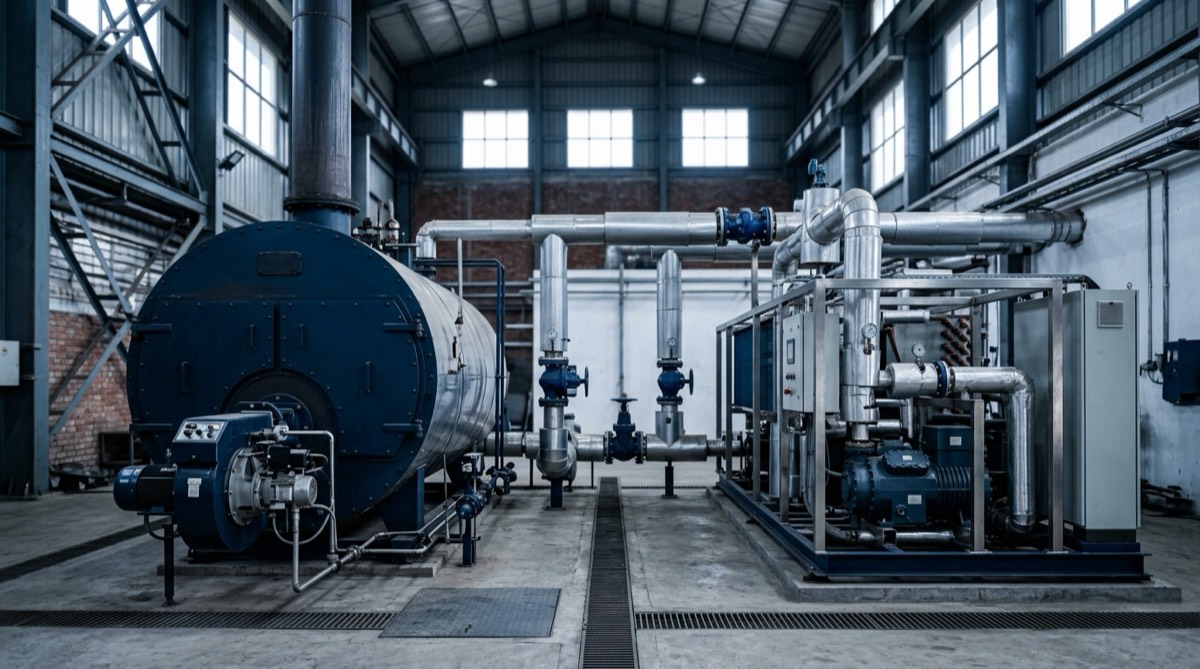
Yes, an industrial heat pump can be added to an existing steam boiler as a feed water heater, and the boiler itself does not have to change. The heat pump takes heat from a stream your plant already throws away, such as compressor cooling water, refrigeration condenser heat or warm effluent, and warms the water going into the boiler. Hence the boiler burns less fuel for every tonne of steam, and the steam mains, traps and IBR registration stay as they are.
Tetra Heat Pump, made by Promethean Energy, builds water source heat pumps that lift low-grade heat like this to hot water at up to 120°C, in single machines of up to 1,450 kW; a feed water duty needs only a small part of that. The full envelope is on our high temperature heat pump page. In case you want to know what it would do for your boiler, send us a week of your boiler log sheets and our team will work out the saving for your plant.
This is the route for a plant whose retort, autoclave or dryer needs steam at pressure, where taking the boiler out is not an option.
How does feed water temperature change the fuel a boiler burns?
A boiler heats every kilogram of water from the feed tank temperature up to saturation at its working pressure, and then evaporates it. Every degree of that first job is paid for in fuel, so when the feed comes in warmer the burner or grate fires less for the same steam, and nothing on the process side changes.
How much does it save? A worked example
The method is a plain sensible heat sum. The figures below are round assumptions so that you can follow each step, and are not readings from any plant.
| Step | Assumption or working | Result |
|---|---|---|
| Steam output | Assumed 2 TPH, with the feed flow taken as equal to the steam output (blowdown ignored) | 2,000 kg/hr of feed |
| Rise in feed temperature | Assumed 30°C, with the heat pump delivering in the 60 to 70°C band | 30°C |
| Heat added to the feed | 2,000 kg/hr × 30°C × 1 kcal/kg°C = 60,000 kcal/hr, at 860 kcal per kWh | approx. 70 kW |
| Boiler output, for scale | 2 TPH at approx. 583 kW per TPH | approx. 1,166 kW |
The 583 kW per TPH is our own approximation, from 1,000 kg/hr at roughly 2,100 kJ/kg enthalpy rise, and is there only for scale: a feed duty of approx. 70 kW against approx. 1,166 kW of boiler output is a small machine, and it adds far less to your electrical load than one sized to replace the boiler.
Now put a price on those 70 kW for each hour the boiler runs.
| Where the 70 kW comes from | Cost per useful kWh | Cost per running hour |
|---|---|---|
| Light diesel oil boiler, ₹107.65/litre | ₹12.58 | approx. ₹881 |
| Furnace oil boiler, ₹71.99/kg | ₹7.70 | approx. ₹539 |
| PNG boiler, Gujarat industrial, ₹68/SCM | ₹7.24 | approx. ₹507 |
| Heat pump at COP 3.5, Maharashtra HT-I, ₹8.44/kVAh | ₹2.41 | approx. ₹169 |
On a furnace oil boiler the heat pump saves about ₹370 for every hour the boiler runs, on industrial PNG about ₹338 and on LDO about ₹712. Multiply by your running hours for the annual figure.
Please note the cost column is our own calculation from published prices, LDO and furnace oil as of 1 August 2026 and PNG as of June 2026. We take 1 kWh as 860 kcal, oil boilers at 80% and gas boilers at 85%, furnace oil at 10,050 kcal/kg and gas at 9,500 kcal/SCM; LDO at 10,700 kcal/kg is indicative and was not independently verified. The heat pump row treats one kVAh as one kWh, i.e. unity power factor. A COP near 3.5 is plausible on a 60 to 70°C duty. Tetra Heat Pump water source units reach COP 4.5 to 5.2 at 60°C output, so the example does not lean on the best figure. Breakeven COP is 1.0 to 1.2 against PNG and furnace oil and 0.56 to 0.67 against LDO; see our diesel, furnace oil and PNG boiler comparisons.
Your own figure will move with two things. An economiser, if fitted, recovers less from the flue once the feed is warmer, and a plant with poor condensate return heats more cold make-up water, so it has more to gain. Send us your log sheets with the fuel price and our team will work out the figure for your boiler, allowing for both.
Where does the feed water get its heat today?
Start at the feed tank: note the gauge temperature over a shift, and ask the boiler operator how much condensate actually comes back.
| Stream into the feed tank | What it does to the tank temperature | What to check |
|---|---|---|
| Condensate return | Raises it; returned condensate is hot | How much goes to drain from failed traps, missing return lines or fear of contamination |
| Make-up water from the softener or RO plant | Pulls it down; it arrives at raw water temperature | The make-up flow on the softener meter |
| Economiser, where fitted | Heats the feed after the pump, using flue gas | Whether it is in service and clean |
| Live steam injected into the tank | Holds the tank temperature, at the cost of steam | Whether this is happening at all; it is the boiler heating its own feed |
So get the condensate back first, since it costs nothing to reheat, and recover any stream hot enough to warm the feed through a plain exchanger. The heat pump takes what is left, usually the cold make-up water.
Which waste streams can the heat pump draw on?
Any stream the plant rejects that is warm but too cool to heat feed water on its own. On most sites that means cooling water from air and refrigeration compressors, refrigeration condenser heat and cooling tower return, reactor jacket and condenser cooling water in a paint or chemical plant, and hot effluent in a dye house. The heat pump lifts that heat to the temperature the feed needs, and the stream goes back cooler, which takes load off whatever cools it today.
We already run heat pumps on sources of this kind. Our 900 kW dairy installation draws its source heat from refrigeration the plant was already rejecting and delivers it to the 85 to 90°C hot water loop feeding the pasteuriser. On our 1.5 MW automotive paint shop installation, heat taken out of the electrodeposition bath, which has to be held at 28 to 32°C, goes into the pre-treatment baths. Neither of these heats boiler feed water, but the source side is the same work; on a feed water project only the delivery end changes.
At the survey our team checks that each source runs whenever the boiler runs, is close enough to the feed tank to be worth piping, and is clean enough for the exchanger. There is more on our waste heat recovery page. Where no water stream is usable, an air source unit can work from ambient air at a lower COP.
What feed water temperature should the heat pump deliver?
Every extra degree on the feed saves fuel and also brings the COP down, so we set the delivery temperature by costing the fuel each degree saves against the electricity it takes. That is why the example above stays in the 60 to 70°C band: at the top of our range, independent measurement under Indian conditions gives approx. 2.26 at 110°C output and approx. 2.0 at 120°C.
Two limits apply on the feed side, and our team checks both with you. A hotter tank leaves the feed pump less margin against cavitation, so we confirm the suction head with your pump supplier first. And we keep the heat pump circuit below 100°C wherever the duty allows. Below 100°C it is a hot water generator under the Indian Boiler Regulations and needs no registration, as with any electric hot water generator, while above that your state Boiler Directorate decides (more on the IBR threshold).
What about a coal or briquette fired boiler?
On grid power a heat pump does not beat delivered coal on running cost: approx. ₹2.41 per useful kWh at COP 3.5 on the Maharashtra HT-I tariff against approx. ₹1.94 from coal at ₹6,000 a tonne (3,800 kcal/kg, solid fuel boiler at 70 to 72%). Against briquette at ₹8,500 a tonne, approx. ₹2.54 on an indicative 4,000 kcal/kg, the two are roughly level, and with captive renewable power the heat pump comes out clearly ahead of coal on a levelised basis.
Where the push is a stack emission condition or a customer audit, a feed water heat pump cuts the solid fuel burned per tonne of steam. Send us your delivered fuel price and power tariff and we will tell you plainly which side of the line your plant is on.
What changes in the boiler house, and what does not?
We add an exchanger on the make-up line or feed tank, a source loop, an electrical feeder and the controls. All of it is built while the boiler runs, and only the final tie-in needs a scheduled shutdown. The boiler stays registered, with its attendant and annual inspection. Taking it out altogether means moving the steam duties to hot water, which we cover in replacing a boiler with a heat pump. Our team checks your sanctioned load headroom at the same survey.
What do we need from you to work out your saving?
Send us these and our team will come back with the duty, the machine size and the running cost on both sides:
- a week of boiler log sheets, with steam output and feed tank temperature;
- the make-up flow from the softener meter, and how much condensate comes back;
- the boiler pressure, the fuel fired and its delivered price;
- the warm streams near the boiler house, with temperature, flow and running hours;
- the feed pump make and model, and a recent electricity bill.
You can share them with us here. For a first figure, our calculator gives the breakeven on your own fuel price and tariff.
Frequently asked questions
- Can an industrial heat pump be retrofitted into an existing factory boiler system?
- Yes. The heat pump is added as a feed water heater. It takes heat from a stream the plant already rejects, such as compressor cooling water, refrigeration condenser heat or warm effluent, and uses it to warm the make-up water or the feed tank. The boiler, steam mains, traps and process stay as they are, and the boiler burns less fuel for every tonne of steam.
- How much fuel does boiler feed water preheating save?
- It depends on the degrees added, the feed flow and the fuel. As our own illustration, raising the feed of a 2 TPH boiler by 30°C takes approx. 70 kW of heat, which costs approx. ₹539 an hour from a furnace oil boiler and approx. ₹169 an hour from a heat pump at COP 3.5 on the Maharashtra HT-I tariff. Send Tetra Heat Pump a week of your boiler log sheets and our team will work out the figure for your plant.
- Is a feed water heat pump cheaper to run than a coal or briquette boiler?
- Against delivered coal on grid power, generally no: coal at ₹6,000 a tonne gives useful heat at approx. ₹1.94 per kWh, against approx. ₹2.41 from a heat pump at COP 3.5 on the Maharashtra HT-I tariff. Against briquette at ₹8,500 a tonne the two are roughly level, and with captive renewable power the heat pump comes out clearly ahead of coal on a levelised basis.
- What is the best heat source for a feed water heat pump?
- The warmest stream that runs whenever the boiler runs and is close to the boiler house, such as compressor cooling water, refrigeration condenser heat or hot effluent. Tetra Heat Pump's 900 kW dairy installation, for example, draws its source heat from refrigeration the plant was already rejecting.