High-Temperature Industrial Heat Pumps: Continuous Output to 120°C
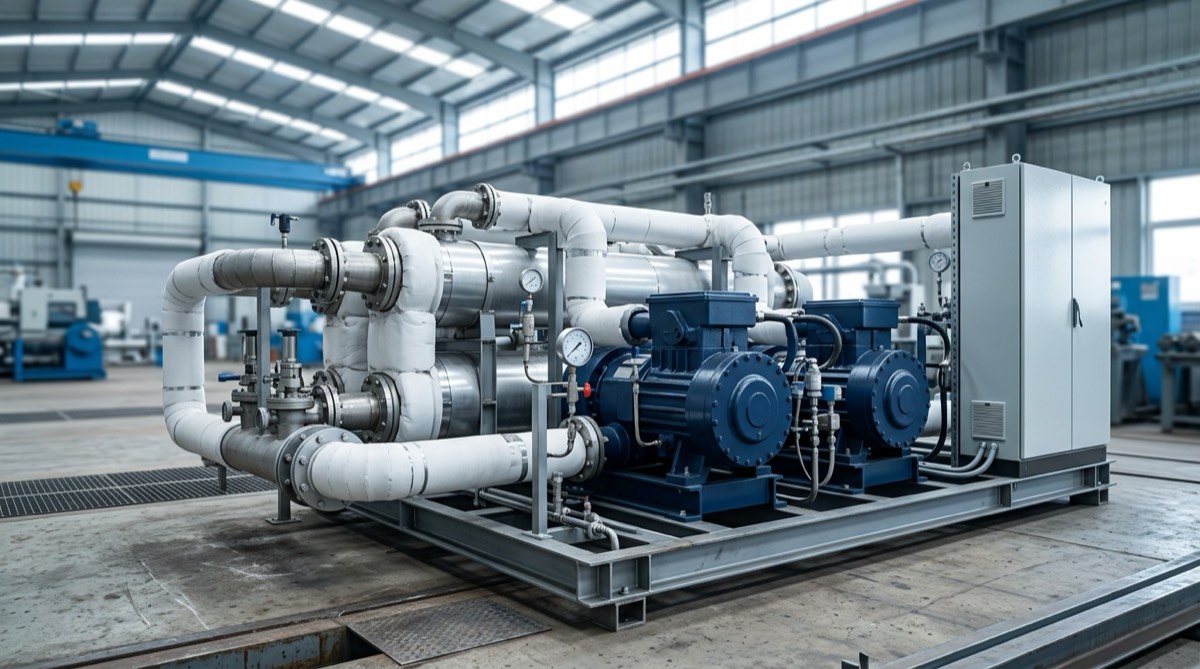
Tetra Heat Pump high-temperature systems deliver continuous process heat up to 120°C in air source, water source and cascade configurations, at up to 1,450 kW in a single unit and up to 5 MW across a multi-unit project, with output temperature held to ±0.5°C. Tetra Heat Pump is a product of Promethean Energy Private Limited, manufactured in India, with more than 200 installations in service, and the machines use refrigerants including R1234ze and R245fa. Coefficient of performance depends on the lift between your heat source and your required output: water source units reach COP 4.5 to 5.2 at 60°C output, and performance falls as output temperature rises toward the 120°C ceiling, with independent measurement in Indian conditions putting real-world performance at about 2.26 at 110°C and about 2.0 at 120°C. A heat pump replaces a fuel-fired boiler economically wherever the COP achieved at your duty exceeds the breakeven against your incumbent fuel, which is 1.0 to 1.2 against gas and furnace oil and 3.3 to 6.5 against coal.
What is a high-temperature industrial heat pump?
A high-temperature industrial heat pump is one designed to deliver process heat well above the hot water duties a standard industrial unit is built for, up to a stated ceiling that the manufacturer should publish with the conditions it was measured at. For Tetra Heat Pump systems that ceiling is 120°C. The definition earns its keep because the in-range duties set out further down this page run from wash baths in the 50s to aqueous drying at 120°C, and almost all of that heat is currently made by burning something.
The physics is the same as any heat pump. A compressor raises the pressure of a refrigerant so that heat picked up at a low temperature can be released at a higher one, and the electricity goes into moving heat rather than creating it. What separates a high-temperature machine is the refrigerant, the pressure class of the circuit and the compressor arrangement, all chosen so the cycle stays stable at a lift that would take a standard unit outside its envelope.
The band matters in India for a reason that has nothing to do with the machine. Below 100°C a hot water circuit is not a registered boiler under the Indian Boiler Regulations, so the certified attendant on every shift and the annual inspection shutdown do not apply to it. A plant that moves a duty off steam and onto hot water below 100°C removes a compliance obligation as well as a fuel bill, and almost nobody in this market is selling that.
Tetra Heat Pump high-temperature specification
Every performance line below carries the conditions it was measured at. A performance figure without its conditions is not a specification.
| Parameter | Value | Conditions |
|---|---|---|
| Maximum output temperature | 120°C | Continuous duty. Heat source and configuration selected for the lift |
| Coefficient of performance, rated | 4.5 to 5.2 | Water source, 60°C output |
| Coefficient of performance, measured in the field | About 2.26, and about 2.0 | 110°C output, and 120°C output. Independent measurement in Indian conditions |
| Capacity, single unit | Up to 1,450 kW | One machine |
| Capacity, project | Up to 5 MW | Multiple units combined on one installation |
| Output temperature control | ±0.5°C | At the controlled output |
| Refrigerants | Including R1234ze and R245fa | Selected against the output temperature required |
| Heat source configurations | Air source, water source, cascade | Selected against the source available on site |
| Integration protocols | Modbus and BACnet | To BMS, SCADA and PLC networks, Siemens and Allen-Bradley included |
| Energy cost reduction | 40 to 70% | Against PNG, LPG, furnace oil, LDO and diesel. Not applicable against coal or biomass |
| Footprint, weight, electrical supply and water side | Issued per project | Against the duty, the source and the site |
Footprint and electrical requirement move with the configuration and the source temperature, so a single published figure would be wrong for most enquiries. Both are issued against a stated duty.
What temperature can a Tetra Heat Pump reach?
120°C, in continuous duty. That is the ceiling, and it is a real one rather than a peak figure taken at a favourable ambient.
The more useful question is which of your loads sit under it. The table below maps output temperature against duties whose temperatures are independently documented, so you can locate your own process rather than reading a marketing band.
Guest and staff hot water 45 to 70°C, sulphuric pickling 30 to 50°C, zinc phosphating 50 to 60°C, hot rinses
The efficient end of the envelope. Water source rated COP 4.5 to 5.2 sits at 60°C output
HTST pasteurisation 72 to 75°C, CIP caustic 70 to 85°C, alkaline degrease 55 to 80°C, galvanising degrease 60 to 80°C, flux tank 80°C, laundry 60 to 85°C, component washing 55 to 80°C
The largest single block of Indian process heat, and the easiest retrofit
Dairy hot water loop 85 to 90°C, aqueous jacketed reactors to 88°C, purified water and WFI loop sanitisation 80 to 95°C, blanching to 98°C, clean-in-place to 100°C
Still outside the Indian Boiler Regulations. COP is lower than the rated point and should be quoted against your source
Low-boiler reboilers 60 to 110°C, aqueous drying 60 to 120°C
The high-lift end. Measured Indian performance is about 2.26 at 110°C and about 2.0 at 120°C
Read the last row against the first. The same machine family covers both, and the number that decides your project is the one at your output temperature, not the one at the top of the page.
What COP should you expect at your output temperature?
COP is a ratio: the heat delivered divided by the electricity consumed. It falls as the gap between your heat source and your required output widens. That gap is the lift, and it is the single variable that governs whether the project pays.
Both ends of that table describe the same technology. Publishing only the first would be the more flattering choice and the less useful one, because an engineer who sizes a 120°C duty on a 60°C figure gets a project that misses its payback and a supplier who is not asked again.
A datasheet COP is measured at one steady operating point with the source at a stated temperature. A plant runs at part load, with a source that varies through the shift and through the year, and with distribution losses between the machine and the process. The plant-level number is the one that shows up on the electricity bill, so ask for performance at your source temperature and your output temperature, and ask what happens to both at part load.
The threshold that matters is lower than most buyers assume. Breakeven COP is your electricity price per kWh divided by your incumbent fuel's cost per useful kWh of heat, and against PNG, LPG, furnace oil, LDO and diesel it lands between 1.0 and 1.2. Any working machine clears that, which is why the honest question for a gas-fired or oil-fired plant is not whether a heat pump wins but by how much. Against coal the breakeven is 3.3 to 6.5, which no 120°C machine reaches, and that case is set out plainly further down this page. The full arithmetic against a boiler is here, and the calculator will do the division against your own tariff.
What capacity is available per unit, and how do systems scale?
Up to 1,450 kW in a single machine, and up to 5 MW across a project built from several of them.
Keep those two figures apart, because vendors routinely blur them. 1,450 kW is the largest single unit. 5 MW is the largest total installation, made up of multiple machines on one site. The distinction changes your plant room layout, your electrical connection and your redundancy strategy, so settle it at the enquiry stage rather than at the drawing stage.
Multiple units are the better answer for most large duties anyway. A single machine sized for peak load runs badly at part load, and industrial heat demand is rarely flat. Several smaller machines staged against demand each run nearer their design point, and one can be taken out for service without stopping the process. Where a duty is genuinely critical, that redundancy is worth more than the capital efficiency of a single large unit.
The constraint that catches plants is electrical, not thermal. Moving a duty from fuel to electricity raises sanctioned load, and in several states the security deposit is recalculated against the new average billing, so a larger monthly bill pulls through a larger deposit at the next revision. Check your supply headroom before the project is budgeted rather than after it is approved.
Air source, water source or cascade: which fits your site?
The configuration is chosen by what your site can offer as a heat source, and it is the decision with the largest effect on the COP you will actually see.
Air source
- Heat source
- Ambient air
- Best fit
- Sites with no continuous waste heat stream, and retrofits where the plant room has no spare pipework routes
- Weaker fit
- The top of the output range, because the lift from ambient is the largest lift on offer
- Balance-of-plant consequence
- Outdoor space and a clear air path. Performance moves with ambient temperature through the day and the season
Water source
- Heat source
- Process water, warm effluent, condenser water, cooling water already being rejected
- Best fit
- Any site already throwing warm water away. The rated COP of 4.5 to 5.2 at 60°C output belongs to this configuration
- Weaker fit
- Sites with no continuous liquid stream available when the load runs
- Balance-of-plant consequence
- Pipework and filtration to and from the source, and a source flow that stays available across the shift
Cascade
- Heat source
- Either, in two linked stages
- Best fit
- The top of the range, where a single stage cannot make the lift efficiently
- Weaker fit
- Small duties, where a second stage is not worth the added complexity
- Balance-of-plant consequence
- Two refrigerant circuits and an intermediate exchanger, so more to commission and more to service
The water source row hides the best opportunity on most sites. A plant that heats and cools at the same time is paying twice: once to reject heat from a chiller or a condenser, and again to make heat in a boiler. A water source machine placed between the two duties does both jobs with one unit of electricity. This is common in dairy and food plants, where refrigeration runs alongside pasteurisation, and in automotive paint shops, where the electrodeposition bath at 28 to 32°C needs cooling while the degrease and phosphate baths at 50 to 80°C need heat.
Dual source arrangements appear on some vendor pages, including our own older material. The configurations in current production are air source, water source and cascade. There is a longer comparison of air source against water source if you are still choosing.
Which refrigerants are used and why?
Refrigerants including R1234ze and R245fa, selected against the output temperature the machine has to reach.
On a high-temperature machine the refrigerant drives most of the design. It sets the practical output ceiling, because every fluid has a temperature above which the cycle stops being workable. It sets the pressure class of the circuit and therefore the compressor and the vessels. And it sets what your service contractor needs to hold in stock.
One question is worth asking of any supplier, ours included. High global warming potential fluids are being phased down worldwide, and a machine bought today stays in service long enough for that to matter. Ask what it is charged with, and ask what it can be re-charged with later in its life.
How does it integrate with an existing boiler?
In most retrofits the boiler stays. The heat pump takes the loads below its output ceiling, the boiler is retained for the duties above it and for backup through the first year, and the fuel bill falls rather than disappearing. That is the normal outcome, and it keeps the commissioning risk small.
The tie-in point is usually the hot water circuit rather than the process itself. The heat pump makes hot water into a buffer, the buffer feeds the existing plate exchanger or jacket, and the process side is untouched. In food, dairy and pharmaceutical plants this is the answer to the hygiene objection as well: the machine never contacts product, so the qualified side of the plant does not change.
On the control side, Tetra Heat Pump systems integrate with BMS, SCADA and PLC networks over Modbus and BACnet, including Siemens and Allen-Bradley platforms, so the machine appears on the same screen as the rest of the utility plant and sequences against the boiler rather than fighting it. Output is held to ±0.5°C, which is what makes it usable on duties where bath temperature drives quality rather than just comfort. There is more on system integration and on maintenance and support, which on a machine of this kind decides whether the saving survives past year three.
Where does a heat pump stop being the right answer?
Five places. Naming them is the point of a specification page.
High-pressure steam.
A heat pump on its own does not make saturated steam at pressure and should not be sold as though it does. Where a plant genuinely needs steam, the heat pump is applied to boiler feedwater pre-heating, which cuts fuel materially without touching the steam system or its certification.
Anything above 120°C.
The ceiling is hard, and a long list of real industrial duties sits above it. Retort sterilisation runs at 121°C on saturated steam. Autoclave and sterilise-in-place duties run 121 to 134°C. Automotive cure ovens are far out of reach: electrodeposition cure at 190°C, bake at 140 to 200°C, powder cure at 177 to 204°C, and the same applies to a textile stenter at 130 to 210°C. Alkyd polycondensation in a resin plant holds 150 to 280°C, spray dryer inlets run 180 to 200°C, and frying and baking run 160 to 220°C. Steel heat treatment is further away still, with annealing at 650 to 850°C and tempering across 150 to 700°C. None of these is a heat pump duty on its own. Where a requirement sits above 120°C, we take it up using additional technology working along with the heat pump, which delivers steam at up to 5 bar and brings the lower duties on that list within reach. This is a separate stage engineered for the particular duty rather than a property of the heat pump itself, so it is scoped case by case. The cure ovens, spray dryers and heat treatment duties higher up the range stay on their existing fired plant.
No usable heat source.
An air source machine works anywhere, but at the top of the output range the lift from ambient is punishing. A site with no warm effluent, no condenser rejection and a 120°C requirement is the hardest case in this catalogue, and the honest answer may be that only part of the load moves.
Very intermittent duty.
A machine sized for a peak that occurs twice a week spends most of its life at low load, where COP is worse and the payback stretches. Buffer storage fixes some of this and not all of it. A batch plant should be assessed on its load profile, not on its connected load, and this is a design objection rather than a price one.
Coal-fired sites on cheap power.
Against solid fuel the breakeven COP is 3.3 to 6.5, and a 120°C machine does not get there. A heat pump does not beat delivered coal on running cost, and any page claiming it does will be caught by the first competent energy manager who reads it. The case against coal is real but it is a different case: no stack and no particulate emissions, no ash and no fuel handling labour, no exposure to coal availability, and a clean answer when a customer audits your scope 1 emissions. It is a compliance and air quality argument, not a cost argument, and it should be made as one.
Which processes need 90°C and above?
Fewer than the category usually claims, and that is worth stating on the page where the specification lives. Above 90°C the documented duty list narrows to three sectors.
| Process | Duty temperature | Sector |
|---|---|---|
| Low-boiler reboiler heating | 60 to 110°C | Chemical |
| Aqueous drying | 60 to 120°C | Chemical |
| Clean-in-place circuits | To 100°C | Pharmaceutical |
| Purified water and WFI loop sanitisation | 80 to 95°C | Pharmaceutical |
| Blanching | To 98°C | Food and beverage |
| Hot water loop serving pasteurisation | 85 to 90°C | Food and beverage |
Most of the value in this market is below 90°C rather than above it, which is the opposite of how the category is marketed. Pre-treatment and component washing in automotive, degrease and flux tanks in metal finishing, drum washing and resin thinning in paint manufacturing, and hot water and laundry in hospitality all sit between 50 and 85°C, where the COP is higher, the payback is shorter and the retrofit is simpler. The full set of industry pages covers each in detail.
Tetra Heat Pump units deliver continuous output to 120°C with ±0.5°C control at up to 1,450 kW per machine, which covers every duty in the table above and every duty in the paragraph below it, and none of the cure ovens, retorts or heat treatment furnaces listed in the limits section.
Frequently asked questions
What is a high-temperature industrial heat pump?
It is a heat pump built to deliver process heat well above the hot water duties a standard industrial unit is built for. Tetra Heat Pump high-temperature systems deliver continuous output up to 120°C, which covers hot water loops, clean-in-place circuits, aqueous reactor jackets and low-boiler reboiler duties that would otherwise sit on a fuel-fired boiler.
How hot can a Tetra Heat Pump run?
Up to 120°C continuous output. The heat source and the configuration are selected against that lift: water source and cascade arrangements are used at the top of the range, and air source is normally applied to lower output temperatures where the lift from ambient is smaller.
What COP should I expect at 120°C output?
Not the rated figure. Tetra Heat Pump water source units reach COP 4.5 to 5.2 at 60°C output, and performance falls as the output temperature rises. Independent measurement of heat pumps in Indian conditions puts real-world performance at about 2.26 at 110°C output and about 2.0 at 120°C. Both ends belong to the same machine, and the number that matters is the one at the duty you are actually moving.
What is the largest Tetra Heat Pump available?
Up to 1,450 kW in a single machine. Larger duties are met by combining units, and total project capacity runs to 5 MW. A 5 MW installation is a multi-unit system, not a single 5 MW machine, and the distinction matters for plant room space, electrical supply and redundancy.
Can a high-temperature heat pump replace my steam boiler?
It replaces the hot water and low-temperature process duties the steam boiler is currently serving, which in most plants is a larger share of the fuel bill than expected. For high-pressure steam it does not replace the boiler. In that case a heat pump is used to pre-heat boiler feedwater, which cuts fuel without touching the steam system itself.
Which refrigerants do Tetra Heat Pump systems use?
Refrigerants including R1234ze and R245fa. The choice is made against the output temperature required, because the refrigerant sets the practical output ceiling, the pressure class of the circuit and what the machine can be re-charged with over its service life.
Working it out on your plant
Three numbers decide this, and you already hold two of them: the output temperature of the duty you want to move, the heat source available on site, and your landed electricity tariff. Put them into the calculator to get the breakeven COP against your incumbent fuel, and compare it with what the machine achieves at your output temperature rather than at its best point.
If the duty clears, the next step is a look at your load profile and your source stream, not a quotation. You can see how the specification compares against other manufacturers in India, read installed project outcomes, or start an enquiry with your duty temperature and heat demand and have the sizing done against them.
Start an enquiry