What an industrial heat pump costs in India, and what actually drives the number
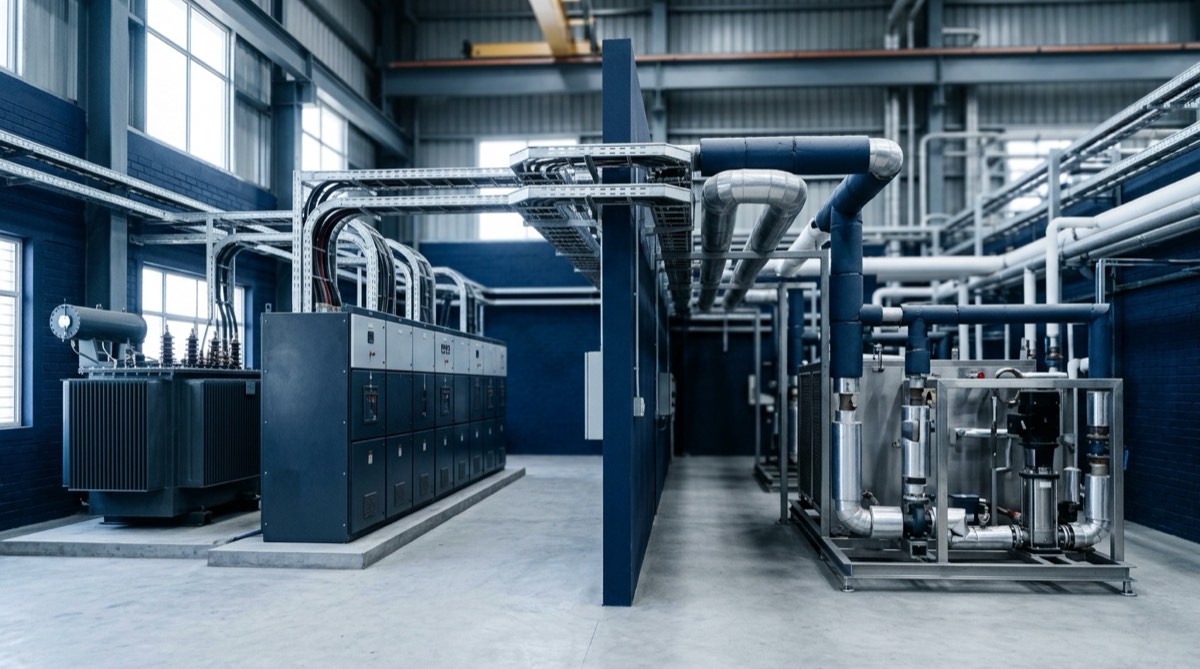
The capital cost of an industrial heat pump in India is set by four things: the heat duty in kW, the temperature lift between your heat source and your process, the balance of plant needed to connect it, and the electrical work needed to supply it. Two plants buying the same heat duty can receive quotes that are nowhere near each other, and the difference is almost never the machine. What decides the investment is the delivered cost of heat rather than the capital cost: an industrial heat pump beats PNG, furnace oil and light diesel oil at any coefficient of performance above roughly 1.0 to 1.2, and beats coal only above roughly 3.3 to 6.5, which for a factory on grid power means it does not.
What does an industrial heat pump cost in India?
We do not publish a rupee-per-kW figure, and it is worth being direct about why. A credible number needs the duty defined first. Anyone quoting a per-kW price without knowing your output temperature and your heat source is guessing, because those two inputs set the machine's efficiency, its configuration and much of what is built around it.
Most of the pricing that surfaces for this search on Indian trade directories is domestic water-heater pricing listed against an industrial term. It describes a different product, which is why the published figures sit so far apart.
What is worth publishing is the structure of the number. An installed industrial heat pump is the machine, the plant needed to connect it to your process, the electrical supply work and the commissioning. The machine varies least between suppliers. Everything else is a function of your site.
What is actually in the quote?
| Line item | What it covers | What makes it swing |
|---|---|---|
| The heat pump | Compressors, heat exchangers, the refrigerant circuit and the on-skid controls | Heat duty, output temperature, whether the configuration is air source, water source or cascade, and whether the duty is met by one machine or several |
| Buffer or storage vessel | Decouples an intermittent process draw from a machine that would rather run steadily | Batch versus continuous load, how peaky the draw is, and whether the plant already has usable storage |
| Pumps, valves and instrumentation | The source and load circuits either side of the machine | Flow rates, and whether the heat source is clean enough to run through a heat exchanger without filtration |
| Piping and insulation | The run between the plant room and the point of use | Distance, and how congested the routing is in a working brownfield plant |
| Controls and integration | Sequencing, interlocks, trending and the link into BMS, SCADA or PLC | Whether the plant runs Siemens or Allen-Bradley, whether the protocol is Modbus or BACnet, and whether the heat pump has to hand over to an existing boiler on a setpoint |
| Electrical | Cabling, switchgear, protection and power factor correction | How much spare capacity the board already has |
| Civil and structural | Foundation, plant room space, access for maintenance and lifting | Whether there is room, and whether anything has to move to make room |
| Commissioning and handover | Witnessed performance test, operator training, documentation | Whether performance is being demonstrated against a contractual duty or simply started up |
Tetra Heat Pump, a product of Promethean Energy Private Limited, builds air source, water source and cascade units delivering continuous output up to 120°C with ±0.5°C temperature control, in single machines up to 1,450 kW and in multi-unit projects up to 5 MW, across an installed base of more than 200 installations. The quote is built per project because, on the list above, the machine is one line and the other seven are your plant. The industrial heat pump manufacturers page covers the equipment range and how to assess a supplier.
Why two quotes for the same heat duty come out so far apart
Output temperature is the largest single driver, and it is the one buyers most often leave out of the enquiry. COP depends on the lift. Tetra Heat Pump water source units reach COP 4.5 to 5.2 at 60°C output, while independently measured performance in Indian conditions is about 2.26 at 110°C output and about 2.0 at 120°C. A duty at the top of that range needs more electrical input for the same delivered heat, often a cascade arrangement rather than a single circuit, and a larger electrical supply. That gap is what the high temperature range costs.
Heat source quality matters as much as heat source temperature. A plant with warm effluent, condenser rejection or a simultaneous cooling load already has a source at a useful temperature, which shortens the lift and raises the COP. A plant with only ambient air does not. A fouling stream also needs filtration and a cleaning regime that a clean loop does not.
A retrofit costs more than a new build for reasons that have nothing to do with the machine. In a new plant room the pipe runs are short and the routing is chosen. In a retrofit the routing is whatever is left, and the distance to the process is money.
Electrical headroom catches people out. A plant with spare sanctioned load and a healthy power factor absorbs a heat pump on the existing connection. A plant without either pays the difference, covered below.
Unit count changes the shape of the cost. A single machine sized for the peak runs badly at part load, which matters on batch processes where the profile is nothing like flat. Splitting the duty across units costs more at the outset and less to run.
What will it cost to run?
Running cost is what decides the purchase, and it needs no capital figure.
| Heat source | Price and date | Cost per useful Mkcal | Cost per useful kWh thermal | Saving from a heat pump at COP 3.5 |
|---|---|---|---|---|
| PNG at the crisis peak | ₹119 per SCM | ₹14,737 | ₹12.67 | 81% |
| Light diesel oil | ₹107.65 per litre, 1 August 2026 | ₹14,623 | ₹12.58 | Not calculated |
| Electric resistance heating | ₹8.44 per kVAh, Maharashtra HT-I FY2026-27 | ₹10,117 | ₹8.70 | Not calculated |
| PNG, Morbi ceramic cluster | ₹75 per SCM, June 2026 | ₹9,288 | ₹7.99 | Not calculated |
| Furnace oil | ₹71.99 per kg, 1 August 2026 | ₹8,954 | ₹7.70 | 69% |
| PNG, Gujarat industrial today | ₹68 per SCM, June 2026 | ₹8,421 | ₹7.24 | 67% |
| PNG, Morbi pre-crisis | ₹41.60 per SCM, July 2024 | ₹5,152 | ₹4.43 | 46% |
| Heat pump, COP 2.5 | ₹8.44 per kVAh, Maharashtra HT-I | ₹3,926 | ₹3.38 | Not applicable |
| Heat pump, COP 3.0 | ₹8.44 per kVAh, Maharashtra HT-I | ₹3,271 | ₹2.81 | Not applicable |
| Heat pump, COP 3.5 | ₹8.44 per kVAh, Maharashtra HT-I | ₹2,804 | ₹2.41 | The reference row |
| Heat pump, COP 3.5 | ₹7.05 per unit, Karnataka HT-2(a) | ₹2,342 | ₹2.01 | Not applicable |
| Biomass briquette | ₹8,500 per tonne, 2026 trade pricing | ₹2,951 | ₹2.54 | 5% |
| Coal, delivered | ₹6,000 per tonne | ₹2,256 | ₹1.94 | Minus 24%, the heat pump loses |
Assumptions, because this is our arithmetic rather than a published index: 1 kWh is taken as 860 kcal; gas gross calorific value 9,500 kcal per SCM; furnace oil 10,050 kcal per kg; coal 3,800 kcal per kg; boiler efficiency 85% on gas, 80% on oil, 70 to 72% on solid fuel and 97% on electric resistance. Light diesel oil at 10,700 kcal per kg and briquette at 4,000 kcal per kg are indicative and were not independently verified. Maharashtra bills HT-I per kVAh rather than per kWh, so a plant with poor power factor pays more per useful unit than ₹8.44 suggests. The coal row uses a delivered price, not the pithead notified price, because a factory buys coal delivered.
The saving is a function of the COP, and the COP is a function of the output temperature. At a 60 to 70°C duty a COP near 3.5 is plausible and the 67% figure holds. At a 120°C duty, measured Indian performance is nearer 2.0 to 2.26, and at COP 2.5 the saving against today's gas is around 53%. So the honest answer to "how much will I save" is never one percentage. It is two questions: which fuel are you displacing, and at what output temperature.
Across the fuels a heat pump actually beats, which are PNG, LPG, furnace oil, light diesel oil and diesel, the energy saving runs 40 to 70%, and the arithmetic above sits inside that band. It does not extend to coal or biomass, where the argument is compliance, air quality, labour and customer audit rather than cost. The breakeven point is the cleanest way to test your own plant: divide your landed electricity price per kWh by your fuel cost per useful kWh of heat. Against gas and furnace oil that ratio lands at 1.0 to 1.2, so almost any working machine wins. Against coal it lands at 3.3 to 6.5, which a 120°C machine does not reach on grid power. The same arithmetic applied to boilers generally is set out separately, and the calculator will do the division.
What does the electrical connection add?
Switching a load from fuel to electricity raises your sanctioned load, and the charges that follow are a real part of the project cost that most vendor pages ignore. The figures below are the MSEDCL Schedule of Charges effective 1 April 2023, GST extra. They are Maharashtra and are not a national schedule.
| Item | Charge | Note |
|---|---|---|
| Application and processing, HT up to 33 kV | ₹2,660 | The annexure names load enhancement explicitly, so an existing consumer adding load pays this too |
| Application and processing, three phase LT | ₹170 | |
| Service connection, HT 11 kV up to 1,000 kVA, overhead | ₹2,38,110 | |
| Service connection, HT 11 kV up to 1,000 kVA, underground | ₹2,73,820 | Trenching is the difference |
| Service connection, HT 33 kV up to 20,000 kVA, overhead | ₹3,98,290 | |
| Metering cubicle with CT and PT, 11 kV | ₹91,500 |
The security deposit is the cash-flow hit nobody models. Maharashtra sets security at twice the average billing cycle and recalculates it annually, so a heat pump raising the monthly bill by ₹6 lakh triggers roughly ₹12 lakh of additional deposit at the next recalculation. Gujarat is harsher: where additional demand is sanctioned, the deposit is computed as if it were a new service covering the entire load rather than the increment. Neither is large against a capital project, and both arrive where nobody budgeted for them.
Two further points belong in the same budget line. Exceeding your sanctioned demand attracts a penal rate that varies by state, so read your own tariff order rather than a general figure. And Maharashtra moved HT consumers to kVAh billing in 2020, where a quarter of consumers above 200 kVA run power factor below 0.90 and under 0.5% actively manage it. A large compressor pulls that down further, so sizing automatic power factor correction alongside the heat pump can recover part of the installation cost from the bill.
On timing, MERC's Supply Code requires the licensee to endeavour to release a connection within 7 working days where no right of way is needed and 15 where it is. The word in the regulation is endeavour, so treat it as a soft target. The same code requires the consumer to provide land or a room on lease where a distribution transformer has to sit on site, which buyers rarely anticipate.
What reduces the net cost?
Accelerated depreciation applies to everybody and is claimed in the same year. Heat pumps are named explicitly in Appendix I item 8(ix) of the Income Tax rules, at 40%. Where your unit is eligible, GST on plant and machinery is recoverable as input tax credit, so the tax-inclusive quote is not the tax-inclusive cost.
ADEETIE, the Assistance for Deployment of Energy Efficient Technologies in Industries and Establishments, runs from FY2025-26 to FY2027-28 under the Ministry of Power with BEE, with the portal operated by EESL. It offers 5% interest subvention to micro and small enterprises and 3% to medium, and funds the investment-grade energy audit, the detailed project report, and monitoring and verification. Eligibility is an MSME with a Udyam ID in one of 60 notified clusters across 14 sectors, demonstrating a 10% energy saving. Five of those sectors are chemical, food processing, pharma, paper and textile. The scheme is available to the sector; whether its approved technology list covers industrial heat pumps is worth confirming on the portal before it goes into a business case. Around 71% of the funds under the predecessor TEQUP scheme went unused, so treat a subvention as a reason to talk rather than a reason to buy.
PAT and ESCerts come up in most incentive conversations and apply only above the Designated Consumer threshold of 30,000 MTOE, which excludes most plants reading this. The rest of the stack is in the piece on government incentives for heat pumps in India.
What is the total cost of ownership over ten years?
| Cost line | Heat pump | Fired boiler | Where the difference sits |
|---|---|---|---|
| Capital | Machine, balance of plant, electrical supply work, commissioning | Boiler, fuel connection or storage, flue and stack, water treatment | The electrical supply work, which is usually missing from both sides of the comparison |
| Annual energy | Landed electricity tariff divided by the COP achieved at your output temperature | Delivered fuel price divided by boiler efficiency | The whole case, and the table above sizes it |
| Maintenance | Compressor and heat exchanger service, refrigerant circuit checks, water side cleaning | Burner service, tube cleaning, water treatment and chemical dosing, and ash handling on solid fuel | Solid fuel carries a labour cost the fuel price does not show |
| Statutory compliance | A hot water circuit below 100°C is outside the Indian Boiler Regulations | Registration, annual inspection shutdown, certified attendant | A recurring saving that almost nobody puts in the model |
| Operator cost | Runs unattended, sequenced from the plant BMS or PLC | Attendant cover across every shift the boiler runs | Shift cover, priced at your own rates |
| Mid-life overhaul | Compressor overhaul | Retubing or burner replacement | Both real, both site-specific |
| Residual position | Electrical plant, unaffected by stack emission limits | Exposed to tightening emission limits and fuel-switch mandates | Policy risk sits on the fired side |
The Indian Boiler Regulations row is worth pulling out, because it is a recurring saving no vendor in this market is claiming. A hot water loop below 100°C is not a registered boiler, so the annual inspection shutdown and the certified attendant on every shift go with it. Above 100°C it does not apply, so scope it against the duty you are actually moving.
The policy risk row is not theoretical. Coal has been banned in the NCR industrial belt since 1 January 2023, and biomass cannot meet the 50 mg per Nm³ particulate limit that replaced it. A fired asset carries the risk of the next such notification. A heat pump, having no stack, does not.
Every line in that table is site-specific. A supplier who fills all seven with round numbers before seeing your plant is selling you a spreadsheet. The service side sits on the maintenance page.
What payback should you actually plan for?
Indian industrial buyers usually state a preference for 1 to 3 years. A World Bank study across 224 Indian MSMEs found a realised payback of 44 months. Both are true, and the gap between them is where most projects die. Treat the stated preference as a screening filter rather than a hurdle rate.
Whether it is worth doing at all is a narrower question than it looks. An industrial heat pump is worth it for an Indian factory when the duty sits below 120°C, when the fuel being displaced is PNG, LPG, furnace oil, light diesel oil or diesel, and when the site has a usable waste heat source or a simultaneous cooling load to shorten the lift. It is not worth it when the process needs saturated steam at pressure, when the duty runs above 120°C, or when the plant burns coal or biomass on grid power, where the heat pump loses on running cost by roughly a quarter against delivered coal and the case has to be made on compliance and air quality instead.
If your plant sits in the first group, the numbers that matter are your landed electricity tariff, your delivered fuel cost per useful kWh, and the output temperature of the duty you want to move. The ROI method assembles those into a case an approver will sign, and there are worked examples in the case studies.
Frequently asked questions
How much does an industrial heat pump cost in India?
What does an industrial heat pump cost to run compared with a gas boiler?
Does switching to a heat pump increase my electricity connection cost?
What payback should I plan for on an industrial heat pump in India?
Are there subsidies or tax benefits for industrial heat pumps in India?
Getting a number for your plant
Start with the calculator, which needs your fuel rate, your electricity tariff and your output temperature and returns the running cost comparison without a site visit. If that clears your threshold, the next step is a look at your load profile, your heat source and your electrical headroom rather than a quotation, and you can get that started here.