Industrial electric boiler: split the duties that need steam from the ones that only need a temperature
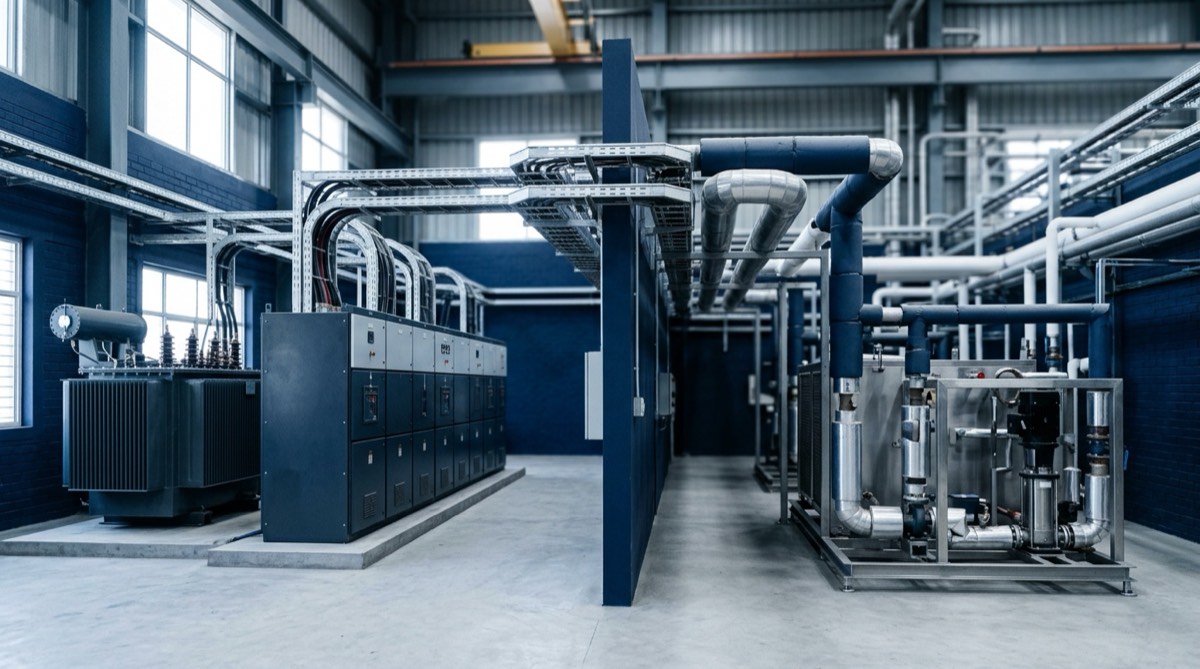
If you are pricing an industrial electric boiler, split your duties first: the ones that need steam and the ones that only need a temperature. On the Maharashtra HT-I energy charge of ₹8.44/kVAh, an electric boiler gives useful heat at approx. ₹8.70/kWh and draws close to one kW of electricity for every kW of heat. For the duties below 120°C, a Tetra Heat Pump gives the same heat for approx. ₹2.41 to ₹3.38/kWh, i.e. roughly a third of the electricity, and at COP 3.0 it adds about one kW to your connection for every three kW of heat.
per useful kWh of heat from an electric boiler, Maharashtra HT-I
per useful kWh from a heat pump at COP 3.5 to 2.5, same tariff
kW drawn for each kW of heat by an electric boiler
kW drawn for each kW of heat by a heat pump at COP 3.0
Tetra Heat Pump, made by Promethean Energy, builds industrial heat pumps for hot water and process heat up to 120°C with ±0.5°C control, in single machines of up to 1,450 kW, so a plant electrifying its heat can size the boiler for its steam duties alone. In case you are comparing quotes, send us your duty list and our team will tell you which duties need a boiler and what the rest would cost on a heat pump.
Which duties need a boiler, and which need only a temperature?
A heat pump does not raise steam and its output stops at 120°C. Hence steam at pressure, retort sterilisation at 121°C, SIP and autoclave cycles, and anything else above 120°C stay on a boiler, electric or fired.
The rest of the list is usually longer than the plant expects. In most plants a good part of the steam header is heating water or a bath through a coil or a plate exchanger, and every one of those duties needs only a temperature. Those are the duties we take.
| Duty | Temperature | Where we have done it |
|---|---|---|
| Alkaline degrease and component washing, automotive | 55 to 80°C | 1.5 MW paint shop installation, energy cost for the duty down 65%, payback 18 months |
| Zinc phosphating | 50 to 60°C | Same paint shop |
| Dairy pasteuriser heating-section hot water loop | 85 to 90°C | 900 kW dairy installation, running with heat recovery |
| CIP caustic | 70 to 85°C | Same dairy loop |
| Hotel guest hot water | 45 to 70°C | 200-room resort, heating cost down 70% |
| Laundry | 60 to 85°C | Same resort |
| Purified water and WFI loop sanitisation | 80 to 95°C | |
| Steam at pressure, retort, SIP and autoclave | 121°C and above | Stays on a boiler |
Please note those results were measured against the fuel each plant fired before, not against an element, so take them as proof that the duty runs on a heat pump. The cost against an electric boiler is worked out below. Our guide to replacing steam with hot water goes through how to sort a steam header duty by duty.
What does an electric boiler cost to run against a heat pump?
Approx. ₹8.70 per useful kWh for the electric boiler on Maharashtra HT-I, against approx. ₹2.41 to ₹3.38 for a heat pump on the same tariff.
| Heat source, Maharashtra HT-I at ₹8.44/kVAh | Electricity per kW of heat | Cost per useful kWh of heat |
|---|---|---|
| Electric boiler, 97% efficient | 1.03 kW | ₹8.70 |
| Heat pump at COP 2.5 | 0.40 kW | ₹3.38 |
| Heat pump at COP 3.0 | 0.33 kW | ₹2.81 |
| Heat pump at COP 3.5 | 0.29 kW | ₹2.41 |
The element turns almost all the electricity it draws into heat, so an electric boiler's running cost is practically your tariff divided by 0.97. A heat pump divides the same tariff by its COP, and the COP depends on the output temperature. Tetra Heat Pump water source units reach COP 4.5 to 5.2 at 60°C output, and performance falls as the output rises toward 120°C, where independent measurement in Indian conditions gives approx. 2.26 at 110°C and 2.0 at 120°C. So even at the top of its range a heat pump uses about half the electricity of an element, and at lower hot water temperatures, toward 60°C, the gap is wider.
What the electric boiler replaces also matters. Against LDO at ₹12.58 per useful kWh it brings the cost down, but against furnace oil at ₹7.70 or Gujarat industrial PNG at ₹7.24 each unit of heat costs more than before. A heat pump is cheaper to run than all three. On grid power, neither electric machine beats delivered coal on running cost, and there the case for moving is compliance and air quality.
These are our own figures, taking 1 kWh as 860 kcal, oil boilers at 80% and gas at 85% efficiency, LDO at an indicative 10,700 kcal/kg, and one kVAh as one kWh, i.e. unity power factor; a plant running at poor PF pays more per useful unit on both machines. The same working for oil, gas and solid fuel is in our article on the cost of industrial heat in India.
How much does an electric boiler add to your connected load?
Almost one kW of demand for every kW of heat, since the element has no multiplier. A heat pump at COP 3.0 adds about one kW for every three.
In Maharashtra every kVA of billing demand is charged at ₹650/kVA/month, so the difference appears on every monthly bill as well as in the load application. Before you apply for an enhancement, our team reads twelve months of your bills against the sanctioned figure with you, because many plants already have the headroom for a heat pump that they would not have for an element. The details are in our article on sanctioned load and heat pump retrofits, and the same load comparison for a smaller resistance heater is in our article on heat pumps and electric heaters.
A worked example: the 583 kW behind a 1 TPH electric boiler
Take a plant pricing a 1 TPH electric boiler, i.e. approx. 583 kW of heat, worked out from 1,000 kg/hr at roughly 2,100 kJ/kg enthalpy rise. That is our own approximation and should be treated as one. Suppose all of that heat is going into hot water duties below 120°C, and take the heat pump at COP 3.0, the middle of the band in the table above.
| All figures approx. | Electric boiler | Heat pump at COP 3.0 |
|---|---|---|
| Heat delivered | 583 kW | 583 kW |
| Electrical demand at full output | 601 kW | 194 kW |
| Running cost per hour at full output | ₹5,072 | ₹1,638 |
| Running cost per 1,000 running hours | ₹50.7 lakh | ₹16.4 lakh |
| Demand charge per month, at ₹650/kVA | ₹3.91 lakh | ₹1.26 lakh |
So on this duty the heat pump saves about ₹3,434 for every hour it runs, and about ₹2.6 lakh a month on demand charges, before any saving on the cables, switchgear and transformer that the extra 407 kW would have needed. The demand rows treat one kVA as one kW, i.e. unity power factor.
Most plants are not all hot water. If half of the 583 kW is steam, the electric boiler is sized for that half, and the heat pump takes the other half on the same arithmetic. Multiply the per-hour figures by your own running hours, or send us your duty list and we will work out the split for your plant.
Can an electric boiler and a heat pump work together?
Yes, and for a plant electrifying its heat this is usually the most economical arrangement.
The electric boiler is sized only for the duties that need steam, and the heat pump takes the hot water and process heat duties up to 120°C. The heat pump can also preheat the make-up and feed water going into the boiler, so the element provides only the last part of the temperature rise, as we explain in our article on boiler feed water preheating. Both cut the boiler's running hours and the kVA it needs from your connection.
Where the plant also rejects heat, the heat pump can use it. On our paint shop installation, heat taken out of the electrodeposition bath, which has to be held at 28 to 32°C, goes into the pre-treatment baths; on the dairy, the source is refrigeration heat the plant was already rejecting. An element has no way to recover either.
On controls, Tetra Heat Pump units integrate with BMS, SCADA and PLC networks, including Siemens and Allen-Bradley systems over Modbus and BACnet, so the heat pump carries the base load and hands over to the boiler on a set point. If you are moving off a diesel-fired boiler, our heat pump vs diesel boiler comparison works through that fuel.
What about IBR, and the NCR fuel rules?
An electric steam boiler is registered and inspected under the Indian Boiler Regulations like any other boiler, since registration goes by pressure and temperature whatever the heat source. A circuit heating water below 100°C is a hot water generator and needs no registration, as with any electric hot water generator, and above 100°C the view of your state Boiler Directorate decides.
In Delhi NCR, where the Commission for Air Quality Management has banned coal, furnace oil and LDO since 1 January 2023, gas and LPG are on the approved list along with electricity, but a gas conversion keeps a burner and a stack, and an electric route removes both; the rules are in our article on CAQM fuel rules for NCR factories.
Frequently asked questions
How much does an industrial electric boiler cost to run in India?
Industrial heat pump vs electric boiler for process heat: which costs less to run?
Can an electric boiler replace a diesel boiler?
How much will an electric boiler add to my sanctioned load?
Does an electric steam boiler need IBR registration?
Pricing the electric option for your plant
Send us your duty list with the temperature each duty needs, the steam pressure where steam is needed, and a recent electricity bill showing your sanctioned load. Our team will split the load between the two machines and come back with the boiler size, the heat pump size and the running cost on both. Write the duties in the form below. For a first figure on your own fuel price and tariff, our calculator compares your present fuel with a heat pump.