Heat pump COP: why the datasheet number is not the one on your electricity bill
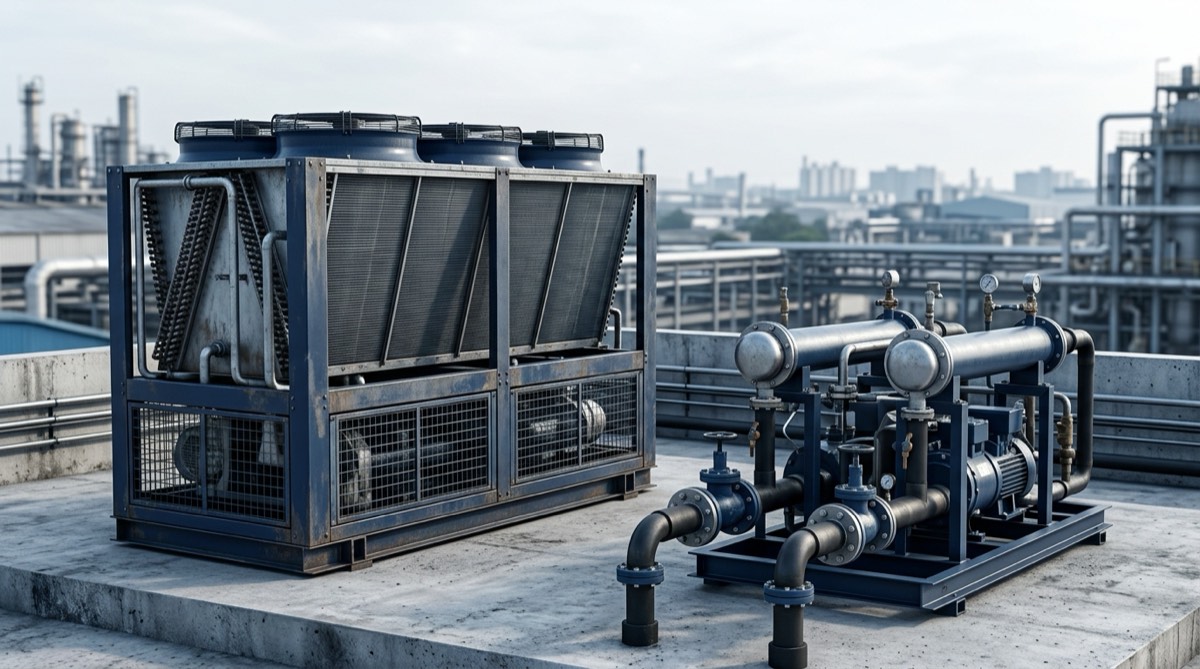
Coefficient of performance is the useful heat a machine delivers divided by the electricity it consumes, both measured in the same units. A COP of 3 means three kilowatt-hours of heat for every kilowatt-hour drawn. The number is greater than one because a heat pump does not make heat. It moves heat that already exists from a source into your process.
COP is not a fixed property of the machine. It falls as the gap between the source temperature and the output temperature widens. That is why a single headline COP describes no real duty. Tetra Heat Pump water source units reach COP 4.5 to 5.2 at 60°C output. Performance falls as the output temperature rises toward the 120°C ceiling.
What is the machine actually doing?
It moves heat uphill, using a working fluid that changes state.
A refrigerant is chosen so that it boils at a low temperature and condenses at a high one. In the evaporator, the refrigerant is held at a pressure low enough that it boils while absorbing heat from your source. That source might be ambient air, cooling tower return, effluent, or the condenser rejection from your refrigeration plant. The refrigerant leaves as a vapour carrying that heat.
The compressor then raises its pressure. Raising the pressure of a vapour raises the temperature at which it will condense. That is the whole trick: the same heat is now available at a higher temperature than it was at the source.
In the condenser the refrigerant gives that heat up to your process water, returning to liquid. An expansion device drops the pressure again, and the cycle repeats.
For the electricity bill, this means you pay for the compressor work. The heat you receive is the source heat plus that compressor work. So the machine is not creating energy. It buys a small amount of high-grade energy to relocate a larger amount of low-grade energy. That is why the ratio comes out above one.
Why is the datasheet COP not the one on your bill?
A datasheet figure is quoted at one operating point, and your plant runs at a different one.
Every published COP should carry two temperatures: the source it draws from and the output it delivers. Without both, the number is unusable. Take a machine quoted at COP 5 from a 35°C source to 60°C output. That figure makes no claim at all about a 15°C source and 95°C output.
This is the single fastest way for a buyer to sort serious suppliers from the rest. Ask for the COP at your source and output temperatures, and ask for it at part load as well as full load. A supplier who will put that figure in the purchase order is telling you something. A supplier who will only reference a brochure is telling you something else.
The second reason the bill differs is that plants rarely run at design conditions. Source temperature moves with the season and the shift. Output setpoint drifts. The machine spends part of its life at part load, where the compressor is less efficient. A seasonal figure is always below the point figure.
Why temperature lift matters most
Lift is the gap between the source temperature and the output temperature, and it is the variable that dominates all the others.
The compressor has to take the refrigerant from the pressure at which it absorbs source heat to a higher one. At that higher pressure it gives the heat up to your process. The wider that gap, the higher the pressure ratio, the more electrical work, and the lower the COP. Consider two identical machines, one taking heat from warm effluent and one from cool night air. They do measurably different amounts of work to deliver the same hot water.
| Output temperature | Indicative COP | Where this sits |
|---|---|---|
| 60°C, water source | 4.5 to 5.2 at the rated point | Hot water, wash baths, CIP rinse |
| 110°C | About 2.26, measured in Indian conditions | Near the top of the envelope |
| 120°C | About 2.0, measured in Indian conditions | The ceiling |
Both ends belong to the same machine.
The practical consequence is that a project’s economics are decided by two choices made before any equipment is selected. Lower the output temperature wherever the process allows, because most setpoints were chosen with margin that nobody has revisited. And raise the source temperature by finding a warm stream on site. A source at 35°C instead of 15°C removes twenty degrees of lift for free.
The cycle types, and when each is used
Three arrangements cover industrial practice. The choice follows from the source and the required output.
Single stage. The machine has one compression stage and one refrigerant circuit. It covers most duties up to the point where the pressure ratio becomes more than one stage can handle. If a single stage reaches your output from your source, that is the machine to buy: fewer components, less to maintain, less to go wrong.
Cascade. Two refrigerant circuits run in series. The first lifts from the source to an intermediate temperature. The second lifts from there to final output, so each circuit works at a pressure ratio it can manage. Cascade makes the top of the range reachable. It does not make it efficient, so use cascade only when the temperature needs it.
Heat recovery arrangements. The machine serves a cooling duty and a heating duty at the same time. The source side takes heat out of a loop that needs cooling. The sink side puts it into a loop that needs heating, so one electricity input does two jobs. An automotive paint line with an electrocoat bath to cool and pre-treatment tanks to heat is the textbook case.
Configuration follows from your source and sink temperatures. The comparison of air source and water source works through what each costs you in footprint, noise, water treatment and seasonal variation.
What does the refrigerant determine?
It determines the pressure at which the cycle operates, the temperature it can reach, and the environmental position of the installation.
Different refrigerants boil and condense at different pressures for a given temperature. So the choice sets what output the machine can reach from a given source. It also sets how hard the compressor has to work to reach that output. Our units use refrigerants including R1234ze and R245fa.
A buyer should ask about two things, and neither is usually in a brochure. The first is the refrigerant’s global warming potential, because a customer sustainability audit will eventually ask. The second is the regulatory trajectory for that refrigerant. A refrigerant being phased down elsewhere affects whether a charge is available in ten years. That is inside the life of the asset.
Neither question changes the physics. Both change what it is like to own the machine in year eight.
How does an industrial machine differ from a hotel one?
The cycle is identical. Almost nothing else is.
| Residential or light commercial | Industrial | |
|---|---|---|
| Duty cycle | Intermittent, following demand | Continuous at a held setpoint |
| Heat source | Ambient air, usually the only option | Air, or any process stream: cooling water, condenser rejection, effluent, condensate |
| Controls and integration | Standalone controller | BMS, SCADA and PLC networks, including Siemens and Allen-Bradley, over Modbus and BACnet |
| Service model | Replaced at end of life | Maintained under contract, with parts and remote support |
| Typical delivery form | Packaged unit | Skid, integrated into existing plant hydraulics |
The distinction that matters commercially is the source. A residential machine has to take what the weather gives it. An industrial machine can be pointed at a stream the plant is already throwing away. That single difference is usually worth more to the COP than any component in the machine.
Where is a heat pump the wrong answer?
There are four cases.
Above the temperature range. An industrial heat pump delivers to 120°C. Cure ovens, spray dryers, resin reactors and every furnace are above that, and no engineering closes the gap.
Anything needing saturated steam at pressure. Retort sterilisation, autoclave and sterilise-in-place need saturated steam itself. Which duties need steam is worth settling first.
Small or occasional duties. Capital equipment earns its return on running hours. A load that runs an annual campaign will not repay the machine whatever the COP.
Against delivered coal, on grid power. The breakeven COP against coal is 3.3 to 6.5, so on grid power a heat pump generally loses. The case against solid fuel is compliance, air quality, fuel handling labour and customer audit.
What to do with this
Two numbers decide whether the rest of the arithmetic is worth doing. The first is the temperature your process needs at the point of use. The second is the temperature of the warmest stream you are currently throwing away. Take them both from instruments, not from drawings.
With those, the savings calculator puts a running cost against the duty. The cost of industrial heat by fuel shows what you are paying now. The specification page sets out the envelope and where it stops. When you have the two temperatures, send them to us.
Frequently asked questions
- What is COP in a heat pump?
- Coefficient of performance is the useful heat delivered divided by the electricity consumed, both in the same units. A COP of 3 means three kilowatt-hours of heat for every kilowatt-hour of electricity. It is greater than one because the machine moves existing heat and does not create it. So a COP above one is not a violation of anything.
- Why is the datasheet COP not the COP I get?
- A datasheet figure is quoted at one operating point, usually a favourable one, and your duty is a different operating point. COP falls as the gap between your heat source temperature and your required output temperature widens. A figure quoted without both temperatures attached describes nothing.
- What is a good COP for an industrial heat pump?
- It depends entirely on the lift. Tetra Heat Pump water source units reach COP 4.5 to 5.2 at 60°C output. Independent measurement in Indian conditions puts performance at about 2.26 at 110°C output and about 2.0 at 120°C. Both belong to the same machine. Ask for the COP at your own duty.
- How is an industrial heat pump different from the one in a hotel?
- They differ in duty cycle, source options, controls and service model. An industrial machine is built for continuous operation at a held setpoint. It can take its heat from a process stream as well as from ambient air. It integrates into BMS, SCADA or PLC networks. It is maintained under contract for its whole life. The physics is the same and almost nothing else is.
- Where is a heat pump the wrong answer?
- It is the wrong answer above its temperature range, which for an industrial machine is 120°C. It is also wrong on any duty that needs saturated steam at pressure. Very small loads, and loads that run a few hours a year, cannot repay the capital. Against delivered coal on grid power, it costs more to run.