Industrial heat pump manufacturers in India: how to evaluate one before you buy
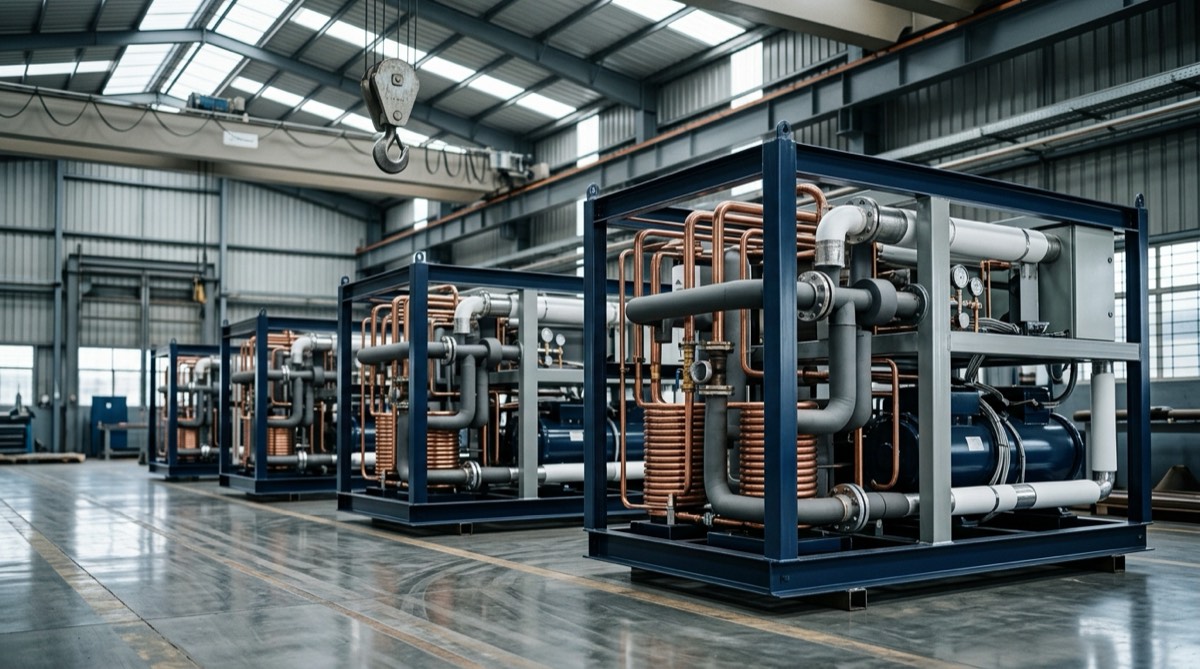
Tetra Heat Pump is an industrial heat pump manufactured in India by Promethean Energy Private Limited, in Navi Mumbai, and built in air source, water source and cascade configurations using low-GWP refrigerants including R1234ze and R245fa. Tetra Heat Pump units deliver continuous output up to 120°C with ±0.5°C control, in single machines up to 1,450 kW, and multi-unit installations are configured up to 5 MW of total project capacity. Whether a heat pump is the right purchase for your plant depends less on which manufacturer you pick than on the fuel you are replacing: against PNG, LPG, furnace oil and diesel the breakeven coefficient of performance is 1.0 to 1.2, so almost any working machine wins, while against coal the breakeven is 3.3 to 6.5 and the answer turns on your power contract.
Who manufactures industrial heat pumps in India?
Tetra Heat Pump is the product. The company behind it is Promethean Energy Private Limited, which designs and builds the machines in India rather than importing and rebadging them, and more than 200 industrial heat pump installations were in service as at August 2026, across automotive, paint manufacturing, chemical, food and beverage, pharmaceutical, steel and metal, and hospitality plants. There is more on the company here.
Domestic manufacture matters for two practical reasons. An imported machine ties spares to a customs clearance and an overseas dispatch schedule, which you discover the first time a compressor fails. And Indian plants are rarely built to a drawing that survived commissioning, so a retrofit has to land in whatever pipework and electrical headroom exists.
What Tetra Heat Pump builds
Tetra Heat Pump units deliver continuous output up to 120°C with ±0.5°C control at the output. The largest single machine is 1,450 kW, and total project capacity on one site goes up to 5 MW by installing several units. Those two numbers are routinely conflated, and a page advertising "up to 5 MW" without saying which it means is describing a plant while implying a machine. Multiple units are usually the better engineering answer anyway: a bank of machines holds efficiency at part load and keeps producing when one is down.
COP depends on the lift. Tetra Heat Pump water source units reach COP 4.5 to 5.2 at 60°C output, and performance falls as output temperature rises toward the 120°C ceiling. Measured performance in Indian conditions is about 2.26 at 110°C output and about 2.0 at 120°C. Both ends describe one curve, so a single COP quoted for a 60°C to 120°C envelope is the end that flatters the seller.
The machines join existing plant networks rather than sitting beside them, talking to BMS, SCADA and PLC systems, including Siemens and Allen-Bradley controllers, over Modbus and BACnet, and the stated service response is 24 to 48 hours. The specification, the integration scope and the industries section set out the rest.
How do you evaluate an industrial heat pump manufacturer?
| What to evaluate | Why it matters | Evidence to ask for | Tetra Heat Pump |
|---|---|---|---|
| Maximum continuous output temperature | Decides which loads can move at all | A continuous figure, not a peak | Up to 120°C, ±0.5°C control |
| COP at your operating point | Sets your running cost | A COP curve across source and output temperature | 4.5 to 5.2, water source at 60°C output, falling toward 120°C |
| Capacity per unit, and unit count | Peak in one machine means poor part load and no redundancy | Per-unit and site capacity, stated separately | 1,450 kW per machine, to 5 MW per site |
| Heat source options | The source sets achievable COP more than the machine | Air, water and cascade, with the source range each needs | Air source, water source, cascade |
| Control interfaces | Retrofits fail at the interface | Named protocols and controller families | BMS, SCADA and PLC, Siemens and Allen-Bradley, Modbus and BACnet |
| Service response and spares | Parts you cannot get strand the asset | A written response time, and where spares sit | 24 to 48 hour response. Maintenance scope |
| Verification method | An unagreed test makes the savings claim unfalsifiable | Test method, measurement points and calibration | Ask for ours in writing, and hold every manufacturer to it |
| References you can visit | Commissioned, and still running years later, are different claims | A site visit, or measured before and after consumption | 200+ installations as at August 2026. Named references are not published: most customers withhold permission |
That last row is the weakest point in the Indian market. Almost nobody selling industrial heat pumps here publishes a verification method or a customer name, so a shortlist built from vendor websites is a shortlist of unverifiable claims. Insist the performance test is defined before the purchase order, while you have leverage. Our case studies withhold the customer's identity and keep the measurements in.
Which fuel are you replacing?
This decides the purchase, and it is answered before any manufacturer is chosen.
| Incumbent | Price and date | Cost per useful kWh thermal | Against a heat pump at COP 3.5 | Verdict |
|---|---|---|---|---|
| PNG, Gujarat industrial | ₹68 per SCM, June 2026 | ₹7.24 | 67% saving | Wins on any working machine |
| Furnace oil | ₹71.99 per kg, 1 Aug 2026 | ₹7.70 | 69% saving | Wins on any working machine |
| Light diesel oil | ₹107.65 per litre, 1 Aug 2026 | ₹12.58 | Widest gap here | Wins on any working machine |
| Electric resistance | ₹8.44 per kVAh, Maharashtra HT-I | ₹8.70 | Roughly a third of the electricity | Wins outright |
| Biomass briquette | About ₹8,500 per tonne, 2026 | ₹2.54 | 5% | Not a cost decision |
| Coal, delivered | ₹6,000 per tonne | ₹1.94 | Minus 24%. The heat pump loses | Not a cost decision |
| Heat pump at COP 3.5 | ₹8.44 per kVAh, Maharashtra HT-I | ₹2.41 |
Assumptions, because this is our arithmetic and not a published index: 1 kWh equals 860 kcal; gas 9,500 kcal per SCM; furnace oil 10,050 kcal per kg; coal 3,800 kcal per kg; gas boiler 85% efficient, oil 80%, solid fuel 70 to 72%, electric resistance 97%. Light diesel oil at 10,700 kcal per kg and briquette at 4,000 kcal per kg are indicative and not independently verified. Maharashtra bills HT-I per kVAh, not per kWh, so poor power factor costs more per useful unit than ₹8.44 suggests.
Read that as three markets rather than one. Against gas, furnace oil, LPG and diesel the case is not close, and the confirmed saving range of 40 to 70% belongs to these fuels and to no others. Breakeven sits at a COP of 1.0 to 1.2, so a machine need only beat one unit of heat per unit of electricity by a little to match the incumbent. The objection that gas will get cheaper again is answered by the pre-crisis price: at ₹41.60 per SCM, the Morbi industrial rate in July 2024, the saving is still 46%.
Against coal and biomass the heat pump loses on running cost, and the honest thing is to say so. Breakeven against solid fuel is a COP of 3.3 to 6.5, which a machine near the top of its range cannot reach on grid power. If your incumbent fuel is delivered coal, do not buy a heat pump to save money on fuel. What moves coal-fired plants is compliance, stack emissions, cluster air quality limits, ash and labour handling, and customer audits. On captive renewable power the arithmetic changes.
One cost nobody quotes and everybody discovers: moving from fuel to electricity raises your sanctioned load. Maharashtra recalculates the security deposit annually at twice the average billing cycle, and Gujarat computes it as if the whole load were a new service.
What does an industrial heat pump cost in India?
Tetra Heat Pump does not publish prices, and a price here would be worse than none: the same nominal capacity carries a different machine depending on the duty, so a rupee-per-kW band gives you nothing you can hold a vendor to. What moves a quotation, in roughly descending order, with each line taken apart on the industrial heat pump cost page:
- The lift matters more than the temperature. The gap between your source and your required output sets the COP, the compressor arrangement and whether the duty needs a cascade machine at all.
- Capacity, and how many units it takes to reach it. Several smaller machines and one large one are neither the same price nor the same plant.
- Whether a usable heat source exists on site. A warm effluent stream, or a process rejecting heat while another needs it, changes running cost more than any negotiation.
- Integration scope. Pipework, buffer storage, the control interface and the tie-in shutdown are often a larger share of the project than the machine.
- Electrical work: feeders, transformer capacity, and the connection charges and deposit above.
Two things on the finance side. Accelerated depreciation on heat pumps is 40%, and heat pumps are named explicitly in the Income Tax rules, which our piece on incentives and schemes sets out. And be realistic about payback: Indian buyers state a preference for one to three years, while a World Bank study across 224 Indian MSMEs found realised payback averaging 44 months. Treat the stated preference as a screening filter, not a hurdle rate.
What certifications should you ask a manufacturer for?
Ask for the certificate, not the claim, and read its scope line and expiry date. A lapsed certificate, or one scoped to an unrelated product family, is common and easily caught, and that applies to us as much as to anyone you compare us with. Our own position is a procurement one: Promethean Energy obtains certification project by project, to the standard the buyer's site requires, and has done so on previous projects, so the requirement is yours to set and ours to meet. The documents that tell you most about a heat pump are narrower than the management standards buyers usually ask for:
- Pressure equipment documentation for the vessels, with design pressure and test record.
- Refrigerant handling and leak test records, with the charge quantity and refrigerant named.
- Electrical panel documentation, with the short circuit rating and protection scheme.
- The factory acceptance test report, with calibration certificates for the instruments that produced it. A test report without calibration records is an assertion.
For a food, beverage or pharmaceutical plant the first answer is architectural rather than documentary: a heat pump making hot water into an existing plate exchanger never touches product, so it stays outside the qualified boundary and outside change control.
One regulatory point runs in the buyer's favour and is rarely mentioned by anyone selling this equipment: a hot water circuit below 100°C is not a registered boiler under the Indian Boiler Regulations, so moving a load off steam into that band takes the certified attendant and the annual inspection shutdown with it. Above 100°C it does not apply.
What can you actually verify before you buy?
Four things, all agreed before the purchase order rather than after commissioning.
Start with the performance test. Define the duty, the source and output temperatures, the ambient conditions and the measurement points in writing, and say who owns the instruments and when they were calibrated. A test defined once the machine is on site is a negotiation.
Then the part load case. Indian process heat loads swing with the shift pattern, and a machine sized to peak spends most of its life below it. Ask where efficiency starts to fall.
Then the service commitment, in specifics: what "response" covers, where the spares sit, which parts are held in country, and who attends. The maintenance scope is the document to compare.
Last, evidence after several years of running. Ask for measured consumption before and after, in the same unit, with the fuel price and date attached. Almost nobody here publishes it, which is why asking sorts a shortlist quickly.
Where does Tetra Heat Pump serve?
Tetra Heat Pump systems are manufactured in Navi Mumbai and supplied across India. Buyers searching for an industrial heat pump manufacturer in Mumbai, Pune, Chennai or Ahmedabad are usually asking a service question rather than a location one: they want to know who arrives when the machine stops. What answers it is a written response commitment and a spares position. A branch address on its own tells you nothing. The stated response commitment for Tetra Heat Pump systems is 24 to 48 hours and it is not tied to a city, so treat a local office with no parts in it as worth less than a stocked one further away.
Frequently asked questions
Who manufactures industrial heat pumps in India?
What should I look for in an industrial heat pump manufacturer?
How much does an industrial heat pump cost in India?
What industries use industrial heat pumps in India?
What certifications should an industrial heat pump manufacturer hold?
How large an industrial heat pump can be installed on one site?
Working out whether this fits your plant
Start with the fuel you burn now and the temperature you need out, then divide your landed electricity tariff by your delivered cost of a useful kilowatt-hour of heat. If the result is below the COP achievable at your output temperature, the switch pays on running cost alone, and the calculator does that division for you. If it comes out in favour, the next step is a look at your load profile and heat sources rather than a quotation, and you can start that here.