Heat pumps in steel and metal plants: the degrease, pickling, flux and phosphating baths
A heat pump cannot heat a furnace. What it can heat is the finishing shop. That means galvanising degrease at 60 to 80°C and the flux tank at 80°C. It also means pickling baths at 30 to 50°C and phosphating at 50 to 60°C. See the full heat pump specification →
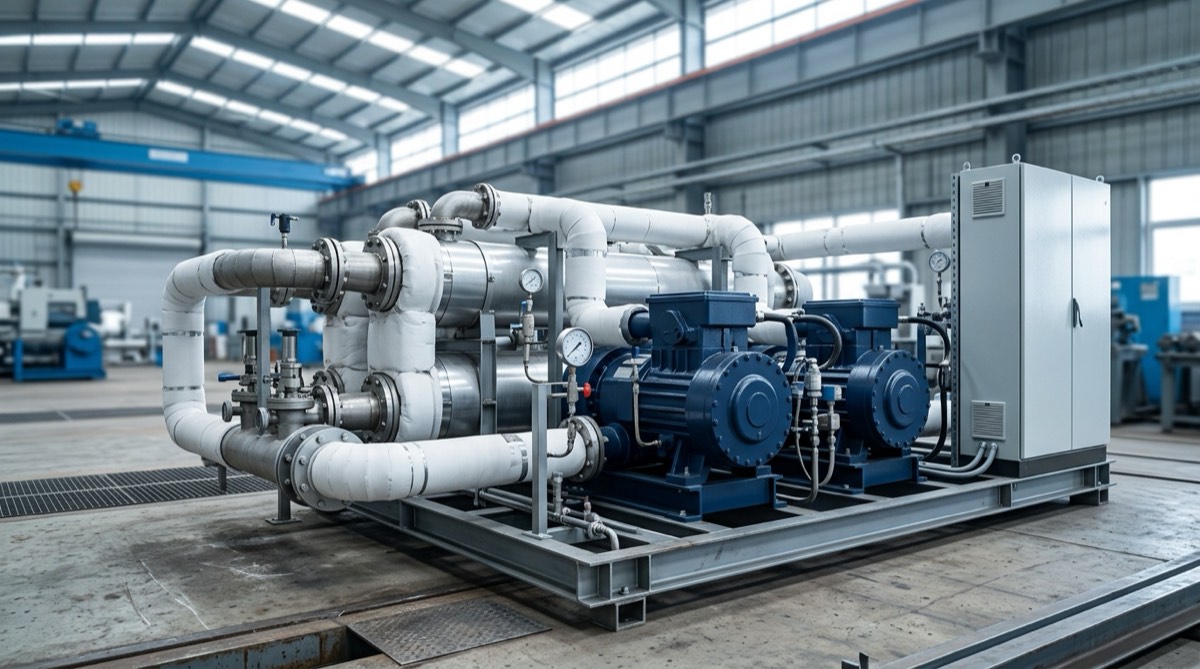
Applications
- →
Galvanising degrease tanks
Held at 60 to 80°C through the shift, usually the largest hot water demand on a galvanising line.
- →
Flux tank heating
Held at 80°C, continuous while the line runs.
- →
Sulphuric pickling baths
30 to 50°C, a small lift and therefore an efficient duty.
- →
Phosphating and passivation baths
50 to 60°C, off the same circuit at a lower setpoint.
- →
Cooling water heat recovery
A metal plant rejects heat all day, and that rejection is the heat pump's source.
Industry Benefits
- Galvanising degrease at 60 to 80°C and flux at 80°C served directly
- Pickling and phosphating baths in range at 30 to 60°C
- Existing cooling water rejection used as the heat source
- Hot water below 100°C, outside the Indian Boiler Regulations
- Supply temperature held to ±0.5°C
Process temperatures
| Process | Temperature | Heat pump |
|---|---|---|
| Galvanising degrease | 60 to 80°C | In range |
| Flux tank | 80°C | In range |
| Sulphuric pickling | 30 to 50°C | In range |
| Phosphating | 50 to 60°C | In range |
| Zinc bath, galvanising kettle | 445 to 465°C | Not served |
| Reheat furnace | 1,200°C | Not served |
| Annealing | 650 to 850°C | Not served |
| Tempering | 150 to 700°C | Not served |
| Blast furnace, DRI kiln and electric arc furnace | Far above the range | Not served |
A heat pump cannot heat a furnace. It can heat the finishing shop. Galvanising degrease runs at 60 to 80°C and the flux tank at 80°C. Sulphuric pickling runs at 30 to 50°C and phosphating at 50 to 60°C. All of them are hot water duties below 100°C. In most Indian plants they are fired today by PNG, furnace oil or diesel.
Our Tetra Heat Pump units deliver continuous output to 120°C with ±0.5°C control. A single machine delivers up to 1,450 kW, and a multi-unit project up to 5 MW. That covers every bath on the list above and none of the furnaces.
Which processes in a metal plant can a heat pump heat?
It can heat the bath line, and nothing hotter. The process temperature table above gives every duty with its band and marks the ones that are out.
The split is unusually wide here, so the answer is easy to state. The in-range duties top out at 80°C. The next duty up, the zinc bath in a galvanising kettle, runs at 445 to 465°C. There is nothing in between on a metal plant. So there is no grey area.
Taken in line order, one hot water circuit does the work. The degrease tank takes heat pump hot water into the coil already fitted. The rinse stages after it run off the same loop. Pickling and phosphating run off that loop at lower setpoints, and the flux tank at a higher one. The kettle, the furnaces and the mill stay exactly as they are.
How much of the heating bill is actually addressable?
That depends on what kind of plant you run.
| Plant type | Where the thermal bill goes | Addressable share |
|---|---|---|
| Integrated steelworks | Blast furnace, DRI kiln, electric arc furnace, reheat furnace | Small. The bill is furnaces |
| Rolling mill with heat treatment | Reheat and annealing furnaces, some bath work | Small to moderate, and confined to the bath line |
| Hot dip galvanising plant | Degrease, pickling, flux and rinse tanks, plus the kettle | Large. Most of the non-kettle load is in range |
| Pickling and surface treatment line | Acid baths, rinses, phosphating | Large. Nearly all of it is in range |
| General metal finishing and plating | Degrease, plating baths, hot rinses, drying | Large |
Work out your own share before anyone quotes. Take the fuel bill, split it between furnace duty and bath duty, and the bath duty is the number a heat pump project applies to. A supplier who quotes a saving against the whole bill is quoting against a load that is not there.
For a standalone finishing plant, that share is usually most of the thermal load, and the case is strong. For an integrated works, the bath line is a useful project on its own terms. It will not move the plant’s total energy figure much.
Is there already a heat source on site?
There almost always is. That is why a metal plant often gets a better coefficient of performance than the sector average suggests.
A metal plant rejects heat continuously. Cooling water circuits on the mill and on the kettle reject it, and so do compressor aftercoolers. So does warm effluent leaving the bath line and the rinses. Each of those is a stream that has already been paid for once and is being thrown away. A water source machine taking its source from one of them does less compression work than an air source machine on the same duty. That is because the lift from source to output is shorter.
Two practical constraints decide which stream to use. The first is proximity, because pipe runs, pumping and heat loss all cost money. A warm stream on the other side of the plant is usually worth less than a cooler one next door. The second is cleanliness, because effluent from a pickling line needs a cleanable exchanger and a strainer regime that maintenance will follow.
Which fuel are you displacing, and does the arithmetic work?
The saving is the gap between what a useful kilowatt-hour of heat costs you today and what it costs from a heat pump.
| Incumbent fuel | Price and date | Per useful kWh thermal | Breakeven COP | Verdict |
|---|---|---|---|---|
| PNG, Gujarat industrial | ₹68 per SCM, June 2026 | ₹7.24 | 1.17 | Wins comfortably |
| Furnace oil | ₹71.99 per kg, 1 August 2026 | ₹7.70 | 1.10 | Wins comfortably |
| Light diesel oil | ₹107.65 per litre, 1 August 2026 | ₹12.58 | 0.67 | Widest margin here |
| Electric resistance | ₹8.44 per kVAh, Maharashtra HT-I | ₹8.70 | Just under 1 | Wins by definition |
| Biomass briquette | about ₹8,500 per tonne, 2026 | ₹2.54 | 3.33 | Close. Cost is not the argument |
| Coal, delivered | ₹6,000 per tonne | ₹1.94 | 4.35 | Heat pump loses on running cost |
The middle column is our own arithmetic. It takes 1 kWh as 860 kcal and gas at 9,500 kcal per SCM. Furnace oil is 10,050 kcal per kg and coal is 3,800 kcal per kg. A gas boiler is taken as 85% efficient, oil as 80%, solid fuel as 70 to 72% and electric resistance as 97%. Light diesel oil and briquette calorific values are indicative.
Maharashtra bills HT-I per kVAh, not per kWh. So poor power factor costs more per useful unit than ₹8.44 suggests.
Against PNG, LPG, furnace oil, LDO and diesel, the saving lands in a 40 to 70% band at the bath temperatures on this page. The breakeven against those fuels is low enough for any working machine to clear it.
Coal and biomass are a different conversation, and a lot of Indian metal finishing still runs on solid fuel. Delivered coal costs about ₹1.94 per useful kWh thermal. A heat pump costs ₹2.41 at COP 3.5 on the Maharashtra tariff. So the heat pump is about 24% dearer to run. Against solid fuel, the case rests on compliance, air quality, labour and customer audit.
The full boiler comparison method is set out here, and the calculator does the division on your own tariff.
Where a heat pump is the wrong answer here
Four duties are out of range.
The zinc bath in a galvanising kettle runs at 445 to 465°C and is nowhere near the range. Reheat furnaces run at 1,200°C. Annealing runs at 650 to 850°C, and higher for stainless. Tempering runs across 150 to 700°C, so even its bottom end is above the 120°C ceiling.
Heat treatment is worth spelling out because it is the duty most often misdescribed in this sector. A 120°C machine is off by a factor of six or seven against an annealing furnace. Precision temperature control at 120°C does not transfer to 800°C. Any page offering heat pumps for annealing and tempering is describing a machine that does not exist.
How it retrofits into a running line
The tie-in is on the water side. The heat pump feeds the existing hot water header, and the tanks, coils, pumps and controls that touch the process stay where they are. Bath chemistry does not change, because only the way the water is heated changes.
Most plants keep the incumbent boiler for peak and backup and run the two in lead and lag, with the heat pump on base load. That buys a first year of data before anything irreversible happens to the boiler. Our units connect to BMS, SCADA and PLC networks, including Siemens and Allen-Bradley, over Modbus and BACnet. So changeover and alarms sit inside the system your shift engineer already watches. There is more on integration here.
Two consequences of the fuel switch are under-budgeted often enough to be worth naming. Sanctioned load goes up, so check the headroom and the connection charges before the capital request. And the security deposit follows the bill, at twice the average billing cycle in Maharashtra, recalculated annually.
Working it out on your plant
There are three steps, and none of them needs a site visit. Split your fuel bill between furnace duty and bath duty, and keep only the bath duty. List each bath at the temperature it actually holds, not the design figure. Then find the rejected heat, starting with the cooling water circuits.
With those three, the calculator will tell you where breakeven lands on your tariff. If the finishing shop is where your heat goes, the case is usually straightforward. The full temperature envelope sets out what the equipment delivers and where it stops. The component washing duties on an automotive line are close enough to a metal finishing shop to be worth reading alongside this. To start from your own process list, get in touch.
Related industries
Automotive
Which automotive heating duties an industrial heat pump serves and which it cannot. Pre-treatment at 55 to 80°C is in range. Every cure oven is out.
Read the Automotive page →Chemical
Which chemical plant duties a heat pump serves. Aqueous reactor jackets to 88°C, reboilers 60 to 110°C, drying to 120°C, and sizing for a batch load.
Read the Chemical page →Technology Specifications
Output temperature, capacity and configuration for the industrial heat pump range.
View Specifications →System Integration
How a unit ties into the pipework, the controls and the plant you already run.
Learn About Integration →Maintenance & Support
Servicing, spares and support once the unit is running.
Explore Support Options →Frequently asked questions
- Can a heat pump heat an annealing or tempering furnace?
- No. Annealing runs at 650 to 850°C and tempering across 150 to 700°C, against an industrial heat pump ceiling of 120°C. Annealing sits a factor of six or seven above that ceiling, and even the coolest tempering duty is above it. Heat treatment stays on its existing fired plant.
- Which steel and metal duties are actually in range?
- The finishing shop is in range. Galvanising degrease runs at 60 to 80°C and the flux tank at 80°C. Sulphuric pickling runs at 30 to 50°C and phosphating at 50 to 60°C. All of them are hot water duties below 100°C. In most plants they are fired today by PNG, furnace oil or diesel.
- How much of a steel plant's energy bill can this address?
- It addresses only the share spent on bath heating below 100°C. In an integrated steelworks that share is small, because the bill is dominated by furnaces above 800°C. In a standalone galvanising, pickling or finishing plant it is most of the thermal load. So the fit depends on what kind of plant you run.
- Is there already a heat source on a metal plant?
- Usually there is. Cooling water circuits, compressor aftercoolers and warm effluent leaving the bath line are all rejecting heat while something else burns fuel to make it. A water source machine coupled to one of those runs at a higher coefficient of performance than an air source machine on the same duty.
- Does a heat pump hot water loop need a boiler licence in India?
- A hot water circuit below 100°C is not a registered boiler under the Indian Boiler Regulations. Every in-range duty on this page sits below that line. So the certified attendant on every shift and the annual inspection shutdown do not apply to the loop you convert.
Can a heat pump carry this duty in your plant?
Send us the output temperature, the flow or heat demand, the hours it runs and the fuel it burns today. Our engineers will size a unit against those figures and tell you which part of the load it can take and which part stays on the heating you run today.