Industrial heat pumps for automotive manufacturing: which duties they serve, and which they do not
Which duties in an automotive plant an industrial heat pump serves, why every cure oven stays on its existing fuel, and how one machine can heat the pre-treatment line while cooling the electrocoat bath. See the full heat pump specification →
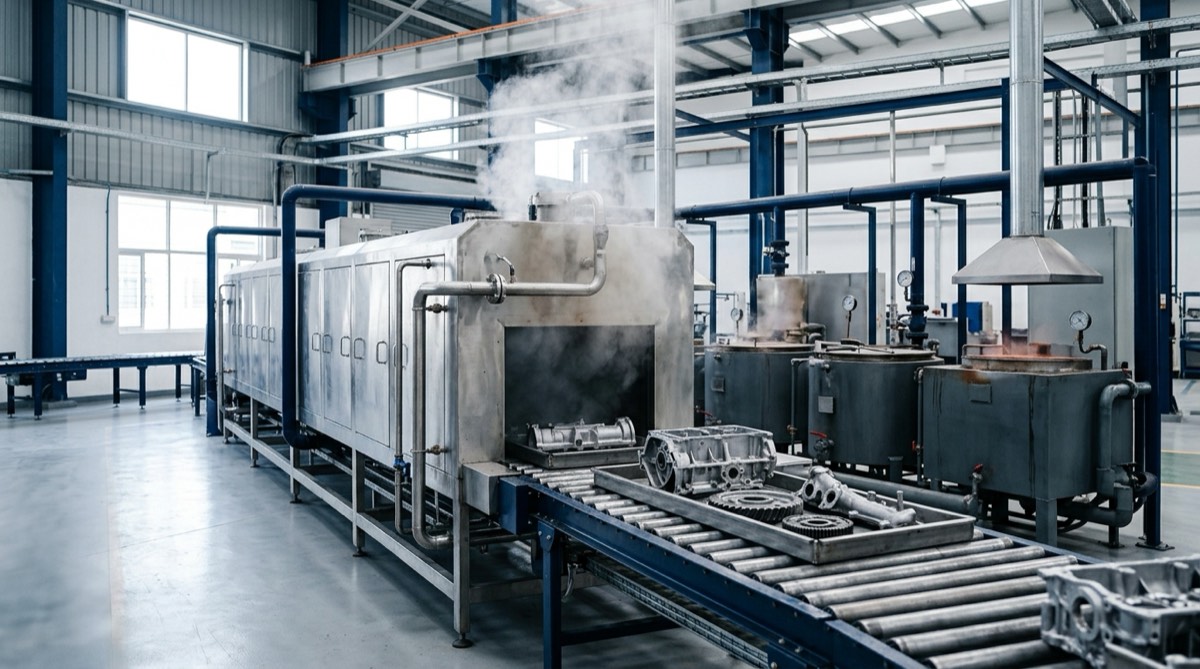
Applications
- →
Alkaline degrease tanks in the pre-treatment tunnel
Usually the largest single hot water demand on the line, held at 55 to 80°C through the shift.
- →
Zinc phosphating and passivation baths
Runs cooler at 50 to 60°C, off the same circuit at a lower setpoint.
- →
Hot rinse stages between pre-treatment steps
Ordinary hot water between the chemical stages, served by the same loop.
- →
Component and parts washing lines
Batch loads at 55 to 80°C, spread across the machine shop rather than sitting in one building.
- →
Electrocoat bath cooling
The bath is held at 28 to 32°C and has to be cooled, so it becomes the heat source for the tanks upstream.
- →
Paint shop air handling unit reheat
Reheat coils downstream of the booths, taking the same hot water circuit.
Industry Benefits
- Pre-treatment, rinse and washing duties served at 55 to 80°C
- Bath cooling and tank heating done by one machine on one input
- Hot water below 100°C, outside the Indian Boiler Regulations
- Tie-in on the water side, so the line keeps running
- Existing boiler kept for peak and backup, on lead and lag
- BMS, SCADA and PLC connection over Modbus and BACnet
Process temperatures
| Process | Temperature | Heat pump |
|---|---|---|
| Alkaline degrease | 55 to 80°C | In range |
| Zinc phosphating | 50 to 60°C | In range |
| Hot rinses | Hot water, below 100°C | In range |
| Component washing | 55 to 80°C | In range |
| Paint shop AHU reheat | Hot water coil, below 100°C | In range |
| Electrocoat bath (cooling duty, not heating) | 28 to 32°C | Not served |
| Electrocoat cure oven | 190°C | Not served |
| Bake oven | 140 to 200°C | Not served |
| Powder cure oven | 177 to 204°C | Not served |
An automotive plant runs several distinct heating duties at different temperatures, and an industrial heat pump serves some of them and not others. Alkaline degrease at 55 to 80°C, zinc phosphating at 50 to 60°C, the hot rinses between them, component washing at 55 to 80°C and paint shop air handling unit reheat all sit in the band a heat pump supplies directly, replacing PNG, furnace oil or diesel firing. The ovens do not: electrocoat cure at 190°C, bake at 140 to 200°C and powder cure at 177 to 204°C are all above the 120°C ceiling of an industrial heat pump, and a supplier who tells you otherwise is selling you a problem. The duty most plants miss is the electrocoat bath itself, held at 28 to 32°C and therefore needing cooling while the tanks upstream of it need heating, so one paint line carries a heat source and a heat sink running at the same time.
Which automotive heating duties can a heat pump serve?
The paint shop holds the degrease and phosphate tanks, the rinse stages, the electrocoat bath, the ovens and the air handling plant, so it is where a vehicle plant’s thermal load concentrates. It splits cleanly by temperature, and the process temperature section above sets out every duty with its band.
Taken in line order, one hot water circuit does most of the work. Alkaline degrease takes heat pump hot water into the tank coil that is already fitted; the rinse stages after it run off the same loop; zinc phosphating runs off that loop at a lower setpoint. Component washing sits in the same band and takes the same hot water, and at the end of the line the paint shop air handling units take it into their reheat coils. The electrocoat bath is the exception, and it runs the other way: it is a cooling duty, so it is where the heat pump takes heat out rather than putting it in. The three ovens, electrocoat cure, bake and powder cure, sit above the ceiling and stay on the fuel they burn today.
Read that as two machines rather than one. Everything above 140°C is a combustion duty and stays that way. Everything below 100°C is a hot water duty, and a hot water duty is what a heat pump is for.
The split is also why automotive is better placed than most applications: efficiency falls as output temperature climbs, so an industry whose in-range loads all sit between 50 and 80°C is working at the comfortable end of the curve rather than at the ceiling. Tetra Heat Pump, a product of Promethean Energy Private Limited, builds air source, water source and cascade units delivering continuous output up to 120°C with ±0.5°C control, which covers every pre-treatment, rinse and washing duty named above and none of the ovens. The specification page carries the full envelope.
Paint shop: which stages are in range, and which are not
Alkaline degrease at 55 to 80°C is usually the largest single hot water demand on the line, because the tank is large, it is held at setpoint through the shift, and it loses heat to evaporation and to the bodies passing through it. Zinc phosphating runs cooler at 50 to 60°C, the rinses between the chemical stages are ordinary hot water, and downstream of the booths the air handling units carry reheat coils. One circuit at one setpoint can serve all of them, which is the simplest kind of retrofit: change what heats the water and leave the process alone.
Then the part that gets misrepresented. Electrocoat cure runs at 190°C, bake ovens at 140 to 200°C and powder cure at 177 to 204°C, all above 120°C by a wide margin, and no industrial heat pump reaches them. Any page offering heat pumps for paint curing is either describing a different machine or has not read the oven schedule. The burners stay, and the honest project scope on a paint line is the wet end, not the dry end. Saying so early settles the credibility question with the person who has to sign that schedule off.
The electrocoat bath is a cooling load, and that is the opportunity
The electrocoat bath is held at 28 to 32°C. It gains heat continuously from the direct current passing through it and from the paint circulation pumps, so it is fitted with a chiller, and in most plants that heat goes up a cooling tower. A few metres upstream in the same tunnel, the degrease tank needs 55 to 80°C and the phosphate tank needs 50 to 60°C, and something is burning fuel to supply them.
A water source heat pump takes heat out of one loop and delivers it into another at a higher temperature. Point its source side at the electrocoat bath cooling loop and its sink side at the pre-treatment hot water circuit, and the same machine does both jobs on one electricity input: it holds the bath at temperature and it heats the tanks. The cooling duty stops being a parasitic load and becomes the heat source.
That is the strongest technical argument available on an automotive paint line, and it needs the process read as a whole rather than tank by tank. Settle it before you order a replacement chiller: a chiller rejecting heat and a boiler making heat in the same building at the same hour are two halves of one machine. Two conditions apply. The pipe run between the loops has to be sensible, which in a paint shop it usually is, and the loads have to coincide in time, which on a running line they do.
Component washing and surface treatment
Component washing is the other concentrated hot water load in an automotive plant, and the one most often left off the energy review because it is spread across the machine shop rather than sitting in one building. Setpoints run at 55 to 80°C, the same band as the pre-treatment tunnel, so one circuit can serve both where the geography allows. If your work is metal finishing rather than vehicle assembly, the duty list is close enough that the steel and metal finishing page is the better starting point.
Sizing is what goes wrong here. Washing machines are batch loads: each draws heat hard for a few minutes to recover its tank, then draws almost nothing. Average the demand across the washing machines and you get a small number; work out what happens when half of them recover together at shift start and you get a much larger one. Size on the simultaneous peak against the storage you actually have, or the line runs cold in the first hour of every shift and the machine gets blamed for it. Buffer volume is cheap next to oversizing the compressor and lets a smaller unit run steadily instead of chasing peaks.
What fuel are you replacing?
The saving is not a property of the heat pump itself. It is the gap between what a useful kilowatt-hour of heat costs you today and what the same kilowatt-hour costs through a heat pump on your tariff, and it therefore changes with the fuel you are burning at present.
| Incumbent | Price and date | Per useful kWh thermal | Breakeven COP, Maharashtra | Verdict |
|---|---|---|---|---|
| PNG, Gujarat industrial | ₹68 per SCM, June 2026 | ₹7.24 | 1.17 | Wins comfortably |
| Furnace oil | ₹71.99 per kg, 1 August 2026 | ₹7.70 | 1.10 | Wins comfortably |
| Light diesel oil | ₹107.65 per litre, 1 August 2026 | ₹12.58 | 0.67 | Widest margin here |
| Electric resistance | ₹8.44 per kVAh, FY2026-27 | ₹8.70 | Just under 1 | Wins by definition |
| Biomass briquette | about ₹8,500 per tonne, 2026 | ₹2.54 | 3.33 | Close. Cost is not the argument |
| Coal, delivered | ₹6,000 per tonne | ₹1.94 | 4.35 | Heat pump loses on running cost |
The assumptions, because the middle column is our arithmetic rather than a published index: 1 kWh is 860 kcal; gas 9,500 kcal per SCM; furnace oil 10,050 kcal per kg; coal 3,800 kcal per kg; gas boiler 85% efficient, oil 80%, solid fuel 70 to 72%, electric resistance 97%. Light diesel oil at 10,700 kcal per kg and briquette at 4,000 kcal per kg are indicative and were not independently verified, so treat those two rows as directional. Maharashtra bills HT-I per kVAh rather than per kWh, so a plant with poor power factor pays more per useful unit than ₹8.44 suggests.
Against gas and furnace oil the breakeven sits at 1.0 to 1.2, which any working machine clears, so there is no sensitivity analysis to lose. Against coal and biomass it is 3.3 to 6.5, which is a different matter. At COP 3.5 on the Maharashtra tariff the saving is about 67% against PNG at today’s price, about 69% against furnace oil and about 46% against pre-crisis gas at ₹41.60 per SCM. Keep that last figure: the case survives gas getting cheaper again. Across PNG, LPG, furnace oil, light diesel oil and diesel the saving lands in a 40 to 70% band, and COP 3.5 is a working assumption for a 50 to 80°C duty rather than a best case: Tetra Heat Pump water source units reach COP 4.5 to 5.2 at 60°C output, and performance falls as output temperature rises toward the 120°C ceiling.
Coal and biomass are a different conversation and the table says so. Delivered coal costs about ₹1.94 per useful kWh thermal against ₹2.41 for a heat pump at COP 3.5 on the Maharashtra tariff, so the heat pump is about 24% dearer to run. Against solid fuel this is a compliance, air quality, labour and customer-audit sale, not a cost sale, and a vendor quoting fuel savings against coal gets caught by the first competent energy manager who reads the quotation. The full boiler comparison method is set out here and the calculator does the division on your own numbers.
How does it retrofit into a running plant?
The tie-in is on the water side, not the process side, which is why this can be done around a live line. The heat pump feeds the existing hot water header; the tanks, coils, pumps and controls that touch the process stay where they are. That keeps the paint quality question off the table, because nothing in the chemistry or the tank hardware changes, only what heats the water going into it. Most plants keep the incumbent boiler for peak and backup and run the two in lead and lag with the heat pump on base load, which buys a first year to prove the machine before anything irreversible happens to the boiler. Tetra Heat Pump units connect to BMS, SCADA and PLC networks, including Siemens and Allen-Bradley, over Modbus and BACnet, so setpoint, changeover and alarm handling sit inside the system your shift engineer already watches. There is more on integration here.
| Item | What to confirm before ordering | Who owns it |
|---|---|---|
| Tie-in point | Where the unit joins the header, and whether it feeds a buffer or the header directly | Utilities, with the supplier |
| Header temperature and flow | The setpoint each tank actually holds, the return temperature and the flow, measured rather than taken off the drawing | Utilities |
| Electrical headroom | Spare sanctioned load, transformer capacity, cable route, power factor at the switchboard | Plant electrical |
| Control interface | Which protocol the BMS speaks, who writes the changeover logic, what happens on a trip | Automation, with the supplier |
| Space and access | Skid footprint, crane or trolley access, pipe route to the header | Project engineering |
| Shutdown window | What can be done live, what needs the line stopped, which planned shutdown it fits | Production planning |
Two consequences of the fuel switch that plants under-budget. Sanctioned load goes up, so check headroom and connection charges before the capital request, not after. And the security deposit follows the bill: Maharashtra sets it at twice the average billing cycle and recalculates annually, while Gujarat computes it as though the whole load were a new service when additional demand is sanctioned.
One item goes the other way. A hot water circuit below 100°C is not a registered boiler under the Indian Boiler Regulations, and every in-range duty here sits below that line, so the certified attendant on every shift and the annual inspection shutdown come off the loop you convert.
How we scope an automotive project
We read the load profile rather than the nameplate, which means the tank setpoints, the hold times, the shift pattern and the measured header temperature. This is necessary because in most plants the drawing and the actual installation diverged long ago.
Size on simultaneous peak, not the sum of averages. A unit sized for average demand runs out at shift start; one sized for the arithmetic sum of every connected load runs badly at part load. The gap between those numbers is where the engineering is.
Find the source. On a paint line the candidates are the electrocoat bath cooling loop, the chilled water plant, compressed air aftercoolers and warm effluent leaving the tunnel. A warmer source raises the delivered COP, and the ranking is rarely the expected one.
Fix the tie-in and the controls, using the checklist above, before anything is ordered. Most retrofit disappointments are control problems, not machine problems.
Choose the configuration last, once source and sink temperatures are known. Air source, water source and cascade suit different lifts and the refrigerant follows, including R1234ze and R245fa. Picking the configuration first and hunting for a source to justify it is the common failure.
If you make the paint rather than apply it the duties are different and the ovens are replaced by reactors, so start from the paint manufacturing page instead. The other industries we serve are listed here.
Working it out on your line
Start with the two numbers this page turns on: what a useful kilowatt-hour of heat costs you today, and your landed electricity tariff. The calculator does that division, and the table above says whether the result clears the breakeven for your fuel. If it does, the next step is a load profile rather than a quotation. Tetra Heat Pump has over 200 installations behind it and responds to service calls within 24 to 48 hours. You can see a paint shop pre-treatment retrofit in detail, what other installed projects look like, or start a scoping conversation here.
An installation in this sector
Automotive paint shop
A 1.5 MW heat pump installation on an automotive paint shop pre-treatment line
1.5 MW installation, multiple units
The plant is not named. Large industrial buyers rarely grant a supplier permission to use their name, so every study publishes the sector, the capacity, the duty and the result, and withholds only the identity.
Read the full case study →Related industries
Chemical
Which chemical plant duties a heat pump serves: aqueous reactor jackets to 88°C, reboilers 60 to 110°C, drying to 120°C, and how to size for a batch load.
Read the Chemical page →Food and Beverage
Which food and beverage duties a heat pump serves: HTST 72 to 75°C, LTLT 63°C, CIP caustic 70 to 85°C, blanching to 98°C, and what stays on steam.
Read the Food and Beverage page →Technology Specifications
Output temperature, capacity and configuration for the industrial heat pump range.
View Specifications →System Integration
How a unit ties into the pipework, the controls and the plant you already run.
Learn About Integration →Maintenance & Support
Servicing, spares and support once the unit is running.
Explore Support Options →Frequently asked questions
- Can an industrial heat pump heat a paint cure oven?
- No. Electrocoat cure runs at 190°C, bake ovens at 140 to 200°C and powder cure at 177 to 204°C, all above the 120°C ceiling of an industrial heat pump. Those ovens stay on their existing fuel. A heat pump serves the pre-treatment, rinse and washing duties, which sit below 100°C.
- Which automotive processes can an industrial heat pump serve?
- Alkaline degrease at 55 to 80°C, zinc phosphating at 50 to 60°C, the hot rinses between them, component washing at 55 to 80°C and paint shop air handling unit reheat. All of these are hot water duties below 100°C, and in most plants they are fired today by PNG, furnace oil or diesel.
- Why is the electrocoat bath a cooling load rather than a heating one?
- The electrocoat bath is held at 28 to 32°C and gains heat from the direct current passing through it and from the circulation pumps, so it has to be cooled. A water source heat pump can take that heat out of the bath loop and deliver it into the pre-treatment tanks upstream, which need 50 to 80°C at the same moment.
- How much does a heat pump save against a gas-fired pre-treatment line?
- It depends on the fuel displaced and the tariff. At COP 3.5 on the Maharashtra HT-I tariff of ₹8.44 per kVAh, the saving is about 67% against PNG at ₹68 per SCM in June 2026 and about 69% against furnace oil at ₹71.99 per kg in August 2026. Against delivered coal a heat pump running on grid power costs more, not less.
- Does a heat pump hot water loop need a boiler licence in India?
- A hot water circuit below 100°C is not a registered boiler under the Indian Boiler Regulations, so the certified attendant on every shift and the annual inspection shutdown do not apply to it. Every in-range automotive duty listed on this page sits below 100°C. Above 100°C the regulations apply as before.
Send us your load profile
The next step is a load profile rather than a quotation.
Start a scoping conversation