IBR boiler inspection: three points where an old boiler becomes a decision, and what a heat pump takes off it
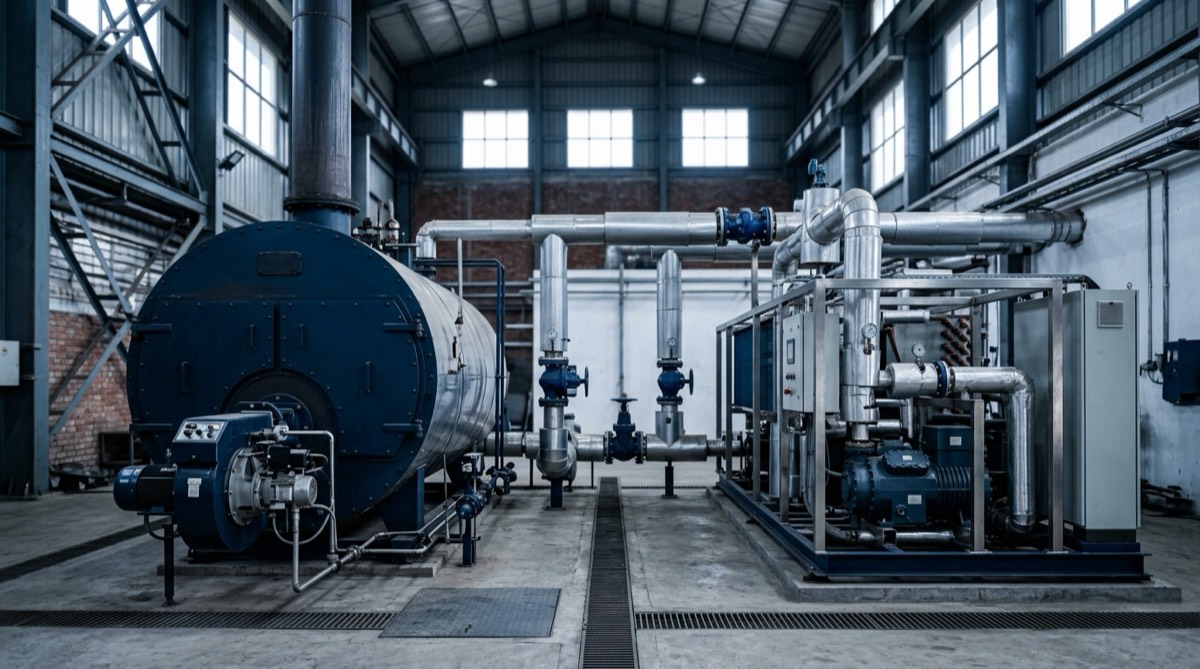
If you run a registered boiler in India, inspections come round on a fixed schedule. Every year the certificate needs renewing. In Maharashtra there’s a full bare inspection every ten years. Once a shell type boiler is past 25, the Indian Boiler Regulations 2026 start cutting the pressure it’s allowed to run at.
Each of these milestones makes you decide something. You can repair the boiler, run it at a lower pressure, or replace it. This guide goes through all three, and looks at one more option: moving your hot water duties (anything below 100°C) onto a heat pump, so the boiler only handles the jobs that really need steam.
Quick note before we start: hot water systems working below 100°C sit outside the Boilers Act altogether. If you’d like the detail on that, see our guide to non-IBR boilers.
1. The yearly renewal
Under section 12(6) of the Boilers Act 2025, a boiler certificate is valid for at most 12 months. There are two exceptions where it can run to 24 months: economisers, and unfired boilers in plants heated only by oil, asphalt or bitumen.
The routine goes like this. You apply for renewal, and a Competent Person inspects the boiler within 15 days. That usually means your annual shutdown.
The IBR 2026 regulations set out what the inspector expects to see:
- Regulation 295: the boiler empty and cleaned, manhole and hand hole doors open, fire bars and burners out, mounting valves and cocks opened up.
- Regulation 298: tubular boilers get a hydraulic test at every renewal, at 1.25 times design pressure, unless the Chief Inspector waives it.
What a heat pump changes. If your hot water duties are on a heat pump, they keep running while the boiler is down for inspection. Think of a pasteuriser loop, a phosphating bath or a washing line. Only the steam duties stop.
If every duty in the plant can move below 100°C, the renewal date is a natural point to retire the boiler, once the heat pump has proven itself. The attendant rota and the yearly inspection go with it.
What it doesn’t change. A boiler that raises steam for even one duty stays registered. It still needs an attendant every shift and a yearly renewal. The paperwork attaches to the boiler, not to how much load it carries.
2. The ten-year bare inspection (Maharashtra)
The Directorate of Steam Boilers, Maharashtra, requires a bare inspection 10 years after manufacture, then every 10 years after that. The insulation and lagging come off so the inspector can see the shell itself.
Two regulations give the Competent Person room to dig deeper:
- Regulation 311: they can order insulation, brickwork or fixed parts removed if the boiler’s age suggests a defect underneath.
- Regulation 312: where a part looks wasted, small holes are drilled, the remaining thickness is measured and the allowable pressure is recalculated.
The result can be a lower allowable pressure, a repair, or both. Either way, plan for a longer shutdown than a routine renewal.
What a heat pump changes. If the inspection ends in a replacement, you’re choosing the boiler you’ll live with for the next 25 years. Older boilers are often sized for a single steam header feeding every load in the plant. Move the hot water duties off first, and the new boiler only needs sizing for the steam you actually use.
If the outcome is only a repair, moving the hot water duties still takes load off an ageing boiler.
What it doesn’t change. The bare inspection still happens on any registered boiler, wherever the state requires it.
3. Derating past 25 years
Regulation 313 of IBR 2026 reduces the design pressure of a shell type boiler by age:
| Age exceeding | 25 years | 35 years | 45 years | 50 years | 60 years |
|---|---|---|---|---|---|
| Design pressure allowed | 95% | 90% | 85% | 80% | 70% |
The scale keeps going down, to 30% for boilers past 100 years.
Say your boiler was designed for 10 kg/cm². Past 25 years it’s allowed 9.5 kg/cm², past 35 it’s allowed 9, and past 50 it’s allowed 8.
Boilers whose plates have been cut and tested follow a separate table. It starts at 90% ten years after the test and falls to 30% at 50 years.
There’s also a remnant life assessment, carried out by an organisation approved by the Central Boilers Board. It can extend a boiler’s life by up to 12 years at a time, and it may recommend a lower working pressure.
IBR 2026 was published in the Gazette of India on 1 October 2026 and replaces the 1950 regulations. The old regulation 391-A had an earlier version of this table, so if your plant planning still uses the old figures, it’s worth checking them again. For the full replacement picture, see boiler replacement with a heat pump.
What a heat pump changes. Derating only hurts when a duty needs more pressure than the boiler is now allowed. A pasteuriser loop at 85 to 90°C or a degreasing bath at 55 to 80°C doesn’t need steam pressure from the header at all. Move those across, and the derated boiler is left with steam duties that can often live with the lower pressure.
What it doesn’t change. A 121°C retort, or an autoclave that needs more pressure than the derated boiler allows, still means replacing or reassessing the boiler. A heat pump is the wrong machine for that job. What it can do is preheat the boiler feed water, which cuts fuel use on the steam that’s left.
4. Duties that have come off the boiler
Here’s what moved in three of our installations, and what stayed:
| Installation | Moved to heat pump | Stayed on existing system |
|---|---|---|
| 1.5 MW automotive paint shop: duty energy cost down 65%, payback 18 months | Alkaline degrease, 55 to 80°C; zinc phosphating, 50 to 60°C | Curing ovens, 140 to 204°C |
| 200-room resort: heating cost down 70% | Guest hot water, 45 to 70°C; laundry, 60 to 85°C | Kitchen, on its own fuel |
| 900 kW dairy | 85 to 90°C pasteuriser loop, using source heat from refrigeration | Plate pasteuriser, product side unchanged |
In each case the high-temperature work stayed where it was, and everything below 100°C moved.
Will it cost less to run?
That depends on your fuel and your power tariff. The simplest way to compare is the breakeven COP: the heat pump efficiency above which it’s cheaper per unit of heat than the fuel it replaces.
On the Maharashtra HT-I tariff (₹9.25/kVAh at 11 to 33 kV):
| Fuel replaced | Breakeven COP |
|---|---|
| MGL Industrial A gas | 1.00 |
| Furnace oil | 1.20 |
| LDO | 0.74 |
On other states’ HT tariffs, LDO breaks even at a COP of 0.56 to 0.60. An industrial heat pump makes hot water at a COP well above every one of these figures.
To be honest about where it doesn’t pay: if your boiler burns coal or briquette and you’re on grid power, a heat pump will cost more to run. Plants still switch for other reasons, such as compliance, stack emissions and labour.
For the numbers behind these figures, see industrial fuel prices in India and industrial electricity tariffs in India. For the machine itself, see the Tetra hot water generator.
5. Fitting the work into your inspection calendar
The easiest approach is to plan against your next renewal date.
- Build while the boiler runs. The heat pump, piping and electrical feeder all go in while the plant is running as normal.
- Tie in during the shutdown you already have. The connection to your process happens during the inspection shutdown, so there’s no extra downtime.
- Check your sanctioned load early. We check headroom on your sanctioned load at the site survey. More on that in sanctioned load and heat pump retrofits.
- Keep the boiler as standby. Until it’s retired or resized, the boiler can sit on a set point as backup, controlled through your BMS, SCADA or PLC. See integration for how that works.
Tetra heat pumps deliver hot water up to 120°C, at up to 1,450 kW per unit, with 200+ installations behind them.
6. What to send us
To tell you which duties can come off the boiler, we’ll need:
- The boiler: age, working pressure and certificate expiry date
- Each duty: the temperature and pressure the process needs
- Load: flow or daily volume, and running hours for each duty
- Bills: 12 months of fuel bills, plus an electricity bill showing your tariff category
- Waste heat: any rejected warm water (from chillers, air compressors or effluent), with its temperature and flow
From that, we’ll come back with which duties can move, the heat pump size, the running cost, and what’s left for the boiler at its next inspection.
Send us your boiler and duty list
Want a quick first figure? Try the breakeven calculator to see where your fuel and tariff land.
Frequently asked questions
- How often does an IBR boiler need inspection?
- Every year. Under section 12(6) of the Boilers Act 2025, a boiler certificate is valid for 12 months at most, or 24 months for an economiser or an unfired boiler in a plant heated only by oil, asphalt or bitumen. You apply for renewal, and a Competent Person inspects the boiler within 15 days. In Maharashtra there's also a bare inspection 10 years after manufacture, then every 10 years after that.
- What happens at the ten-year bare inspection in Maharashtra?
- The insulation and lagging come off so the inspector can see the shell. Under regulation 311 of IBR 2026, the Competent Person can order insulation, brickwork or fixed parts removed if the boiler's age suggests a defect. Under regulation 312, a part that looks wasted is drilled with small holes, its remaining thickness is measured and the allowable pressure is worked out again. The result can be a lower allowable pressure, a repair, or both, and the shutdown runs longer than a routine renewal.
- What happens to a shell type boiler after 25 years?
- Regulation 313 of the Indian Boiler Regulations 2026 cuts the design pressure it's allowed by age: 95% past 25 years, 90% past 35, 85% past 45, 80% past 50 and 70% past 60, down to 30% past 100. So a boiler designed for 10 kg/cm² is allowed 9.5 kg/cm² once it's past 25. A remnant life assessment by an organisation approved by the Central Boilers Board can extend its life by up to 12 years at a time, and it may recommend a lower working pressure.
- Do the Indian Boiler Regulations 1950 still apply?
- No. IBR 2026 was published in the Gazette of India on 1 October 2026 and replaces the 1950 regulations. The old regulation 391-A had an earlier version of the ageing table that is now regulation 313, so if your plant planning still uses the old figures, it's worth checking them again.
- Does a heat pump remove the need for boiler inspection?
- Only for the duties it takes over. Hot water below 100°C sits outside the Boilers Act, so those duties keep running while the boiler is down for inspection. A boiler that raises steam for even one duty stays registered, with an attendant every shift and a yearly renewal. If every duty in the plant can move below 100°C, the renewal date is a natural point to retire the boiler, once the heat pump has proven itself.