Replacing a boiler with a heat pump: how the decision and the retrofit actually run
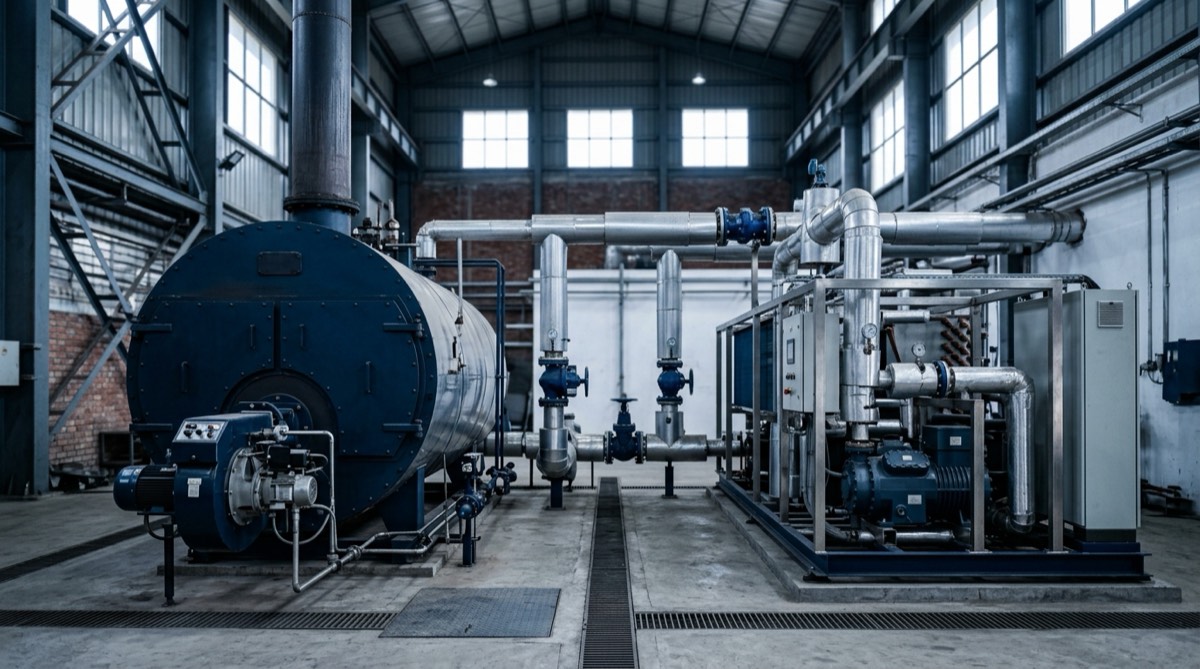
In almost every Indian factory, replacing a boiler with an industrial heat pump is a partial replacement. The heat pump takes the duties below 100°C. The fired boiler stays for anything hotter, and it is usually retained as backup through the first year. The tie-in is scheduled into a shutdown window the plant already has.
Whether it pays depends on the fuel being displaced. The breakeven COP is 1.0 to 1.2 against piped natural gas and furnace oil, and 3.3 to 6.5 against coal. So for a coal-fired plant on grid power, the reason to switch is compliance.
What usually forces this decision?
Very few plants wake up wanting to change how they make heat. Something forces it, and which thing it is shapes the whole project.
- A boiler certificate that will not renew, or a shell approaching the end of its economic life. Past twenty-five years, working-pressure derating on a shell-type boiler can leave it unable to serve the process it was bought for.
- A pollution control board direction on fuel, which removes the option of carrying on as before and sets a date.
- A customer or export audit asking for verified emissions data, which turns onsite combustion into a line item with a price attached.
- A capacity expansion that would otherwise mean buying a second boiler, with a second certificate and a second attendant rota.
- The annual capex window, the only one of the five that the plant chooses.
One thing has shifted underneath all of them. Operator certification requirements tightened under the current boiler legislation, even as some offences were decriminalised. So the burden of running a registered boiler went up. A plant that is already struggling to keep a certificated attendant on every shift feels that before it feels anything on the fuel bill.
Do I replace the boiler, or part of the load?
Almost always, you replace part of the load.
A factory does not have one heating duty. It has a dozen, at different temperatures, running for different hours. An industrial heat pump serves the ones below 100°C very well, and the ones above it not at all. So the sensible architecture is a split. The heat pump takes the base load, and the boiler takes the top end and the peaks.
| Duty | Temperature it actually needs | Moves to the heat pump? | What decides it |
|---|---|---|---|
| Hot water and wash tanks | Below 100°C | Yes | Delivery temperature and hours at load |
| Pre-treatment and phosphating baths | Below 100°C | Yes | Whether the bath is on a shared header |
| Clean-in-place circuits | Below 100°C | Yes | Whether storage can flatten the peak |
| Jacketed aqueous vessels | Below 100°C | Yes | Batch profile and part-load behaviour |
| Feedwater and process preheating | Below 100°C | Yes | Availability of a source stream |
| Low pressure steam duties | Around 100°C | Assess | Whether the duty needs steam or just the temperature |
| Drying and curing ovens | Above range | No | Temperature, by a wide margin |
| Saturated steam at pressure | Above range | No | Pressure and latent heat, not only temperature |
The sizing error that ruins these projects is sizing for peak. A machine bought to cover the worst fifteen minutes of the week spends the rest of the week at part load. At part load the coefficient of performance is worse, and the payback stretches. Size on the base load, put in buffer volume to carry the peak, and keep the boiler for what is left. The equipment page sets out the configurations that suit each duty.
What happens to the statutory burden?
Below 100°C, the loop is a hot water generator, which the Indian Boiler Regulations do not require to be registered. So for that circuit, the certificated attendant across shifts, the annual inspection and its shutdown all fall away.
The saving is fully realised only when the registered boiler goes entirely. The obligation attaches to the boiler itself. A boiler running at 20% carries the same attendant rota and the same annual certificate as one running flat out.
And above 100°C the exemption does not follow automatically. The position depends on vessel design and volume. Get a written view from your state Boiler Directorate. The full treatment of the threshold is here, including what a boiler actually costs to own once the fees are set aside.
Will this need a shutdown?
Only the final tie-in needs the boiler down, and that is less than most plant heads expect.
Foundations, plant room works, pipe runs, electrical work and the controls can all be built alongside a running boiler. Nothing about that phase touches the live system. The tie-in itself is the part that needs the boiler down. On most plants it fits an existing planned shutdown, so no new one has to be created.
Two things make that reliable. First, the tie-in scope should be written into the order as a defined list of connections and isolations. Agree that list before manufacture. Second, the sequence should be agreed with production planning against a specific window. The work then runs to a fixed schedule. Integration services cover the hydraulic and controls side of that.
What does it do to my electricity connection, and what does that cost?
This is where projects most often meet an unbudgeted number.
Switching a duty from fuel to electricity raises the plant’s electrical load. That has four consequences. Plants usually discover them in this order, and it is not the sensible one.
First, the application and connection charges. These are the Maharashtra schedule, MSEDCL, effective 1 April 2023, with GST extra. Other states publish their own and the shape is comparable, but the figures are not transferable.
| Item | Charge | When it applies |
|---|---|---|
| Application and processing, HT up to 33 kV | ₹2,660 | The annexure names load enhancement explicitly |
| Application and processing, three phase LT | ₹170 | Smaller plants on an LT supply |
| Service connection, HT 11 kV to 1,000 kVA, overhead | ₹2,38,110 | Where a new HT connection is required |
| Service connection, HT 11 kV to 1,000 kVA, underground | ₹2,73,820 | Where the route has to go underground |
| Service connection, HT 33 kV to 20,000 kVA, overhead | ₹3,98,290 | Larger loads at the higher voltage |
| Metering cubicle with CT and PT, 11 kV | ₹91,500 | Where new metering is needed |
Road opening, where it is required, is charged at actual. Exceeding sanctioned demand is penalised. Confirm the multiplier with your licensee in writing. Do not take it from any published summary, including this one.
Whether the licensee re-levies the full service connection charge on a load enhancement within the same voltage level is the item worth settling first. The application charge and the deposit revision are certain. The connection charge depends on whether the enhancement is treated as a new service, so get that in writing before the capital request goes in.
Second, the security deposit, which is the cash-flow hit nobody models. Maharashtra sets security at twice the average billing cycle and recalculates it annually. So a heat pump that raises the monthly bill by ₹6 lakh triggers roughly ₹12 lakh of additional deposit at the next recalculation. That deposit arrives a year after the project, when nobody is expecting it. Gujarat is harsher. Where additional demand is sanctioned, the deposit is computed as if it were a new service for the entire load, not for the increment.
Third, the headroom check, which often removes the problem. Contract demand is frequently set for a peak that no longer happens, because the line that needed it was reconfigured years ago. Read twelve months of your own billing, and compare recorded maximum demand against sanctioned demand. Find out what headroom you have before assuming the worst. Where an application is needed, start it in parallel with manufacture.
Fourth, power factor. Maharashtra moved HT consumers to kVAh billing in 2020. About a quarter of consumers above 200 kVA run power factor below 0.90, and under 0.5% actively manage it. A large new compressor makes an existing problem worse. Sizing automatic power factor correction alongside the heat pump can pay for part of the installation. Raise it with your electrical team at design stage.
What will the electricity itself cost?
| State and licensee | Category | Energy charge | Demand charge | Landed |
|---|---|---|---|---|
| Maharashtra, MSEDCL | HT-I | ₹8.44 per kVAh | ₹650 per kVA per month | Add duty and any time-of-day adjustment |
| Gujarat, GUVNL | HT-I | ₹4.30 per unit | Not separately verified | ₹7.50 to ₹8.50 all-in |
| Tamil Nadu, TANGEDCO | HT industrial | ₹7.50 per kWh | ₹608 per kVA per month | Plus 5 percent electricity tax |
| Karnataka, BESCOM and the other ESCOMs | HT-2(a) | ₹6.70 per unit plus 35 paise surcharge | ₹365 per kVA per month | About ₹7.05 before duty |
| Uttar Pradesh, UPPCL | LMV-6, Small and Medium Power | ₹9.02 per unit average billing rate | Not verified | Already all-in |
Two rows carry conditions that change the answer. The Uttar Pradesh figure is LMV-6, a small and medium power category. Maharashtra bills HT-I per kVAh, not per kWh. So a plant running poor power factor pays more per useful unit than ₹8.44 suggests.
One forward-looking figure belongs in the capital case. The Maharashtra regulator has approved a declining HT-I path, from ₹8.44 per kVAh in FY2026-27 to ₹7.45 by FY2029-30. The operating cost of the asset being bought is on a published downward track in one of the largest industrial markets in the country.
Accelerated depreciation at 40% applies, and heat pumps are named explicitly in the Income Tax rules. The incentives post covers what else is live and what is weaker than it looks.
What about backup and reliability?
The question is usually asked as though a fired boiler were independent of the grid, and it is not.
Feedwater pumps, forced and induced draught fans, fuel handling, burner controls and instrumentation all run on electricity. A boiler in a plant with no power is not making steam either. So the real difference is the size of the backup generation required. A heat pump draws roughly its thermal duty divided by the coefficient of performance it holds at that duty.
Retaining the boiler through the first year is normal practice. It gives a full season of operating data before anything is decommissioned, and it costs nothing except the obligations described above. Maintenance programmes cover what the new machine needs once it is carrying load, and our published service response is 24 to 48 hours.
What COP should I hold the supplier to?
Hold the supplier to the COP at your own source and output temperatures, written into the purchase order.
Measured performance in Indian conditions at high output is about 2.26 at 110°C and about 2.0 at 120°C. It improves as the output temperature falls. A brochure figure quoted at a favourable operating point tells you nothing about a 95°C duty from a 25°C source in February.
Ask for three things:
- the coefficient of performance at your stated source and output temperatures;
- the same figure at part load, because a plant with a batch profile spends most of its life there;
- the operating point written into the order itself.
A supplier who will not put the number in the order is telling you something.
What should I have ready before asking for a quote?
| What to collect | Why the supplier needs it | Who in the plant has it |
|---|---|---|
| Duty list with the delivery temperature each actually holds | Decides what moves and what stays | Utilities |
| Annual operating hours per duty | Decides whether the duty earns the machine | Utilities |
| Twelve months of fuel invoices, quantity and price | The numerator of the whole business case | Finance |
| Twelve months of electricity bills, with sanctioned demand, recorded maximum demand, billing basis and power factor | The sanctioned-load headroom check, and whether kVAh billing applies | Finance and plant electrical |
| Boiler nameplate, any efficiency test, and certificate expiry date | Sets the baseline and the timing | Maintenance |
| Available waste heat streams, with temperature and flow | Decides the configuration and moves the COP more than the machine does | Utilities |
| Plant room space and the route for the new circuit | Decides siting and the pipe run | Projects |
| The next scheduled shutdown window | Decides when the tie-in happens | Production planning |
A plant that arrives with those eight items gets a specification. A plant that arrives without them gets a brochure.
Note what is not on that list: a budget figure. Payback moves so far with duty and fuel that a number quoted before this data is collected is a guess. Indian buyers state a preference for one to three years, while realised payback across 224 Indian MSMEs came in at 44 months. Treat the stated preference as a screening filter, not as a hurdle rate.
When is a heat pump the wrong answer?
There are four cases.
Above the temperature range. Ovens, dryers, furnaces and reactors held above the range are not heat pump duties and no engineering closes the gap.
Saturated steam at pressure. Retort, autoclave and sterilise-in-place need saturated steam itself.
Highly intermittent duty with no storage. A machine that runs two hours a week does not earn its capital. If buffer volume cannot flatten the profile, the physics does not rescue it.
A coal-fired plant deciding purely on fuel cost. The breakeven against delivered coal is 3.3 to 6.5 and a machine at industrial output temperatures does not reach it. On grid power a heat pump is roughly at parity with coal on a levelised basis, and clearly ahead on captive renewables. If the driver is compliance, air quality, fuel handling labour or a customer audit, the conversation is worth having. If it is the fuel bill alone, it is not.
What to do next
Collect the eight items in the table. Then put your fuel price and your landed electricity tariff into the savings calculator. See where breakeven lands against the fuel you burn today. The full comparison method shows the arithmetic behind it.
If the numbers clear, the next step is a load profile. There is background on the Indian supplier landscape on the manufacturers page. When your duty list and twelve months of bills are together, start a scoping conversation.
Frequently asked questions
- Can an industrial heat pump be retrofitted into an existing factory boiler system?
- Yes, and that is how almost every Indian project is done. The heat pump feeds the existing hot water header or a buffer. The tanks, coils and controls that touch the process stay where they are. Most of the installation is built alongside a running boiler, and only the final tie-in needs the boiler down.
- Do I have to remove my boiler?
- Not to get the fuel saving, and usually you should not in the first year. You do have to remove it to get the statutory saving. The Indian Boiler Regulations obligation attaches to the registered boiler, whatever share of the load it carries. Running it at low load does not reduce the attendant or the annual inspection.
- Will this need a plant shutdown?
- Only the final tie-in needs one. Foundations, plant room, pipe runs, electrical work and controls are all built alongside a running boiler. The tie-in scope should be written into the order as a defined list. It is planned against a shutdown window the plant already has.
- What size heat pump do I need for a 500 kW process heat load?
- That depends on four things the number alone does not tell you. The first two are the delivery temperature the duty needs and the hours a year it runs. The other two are how much of the 500 kW is peak against base load, and whether storage can flatten the profile. Size on the base load with a buffer. Sizing for peak on a batch plant is the most common way to destroy the payback.
- Does a heat pump beat a coal-fired boiler?
- On grid power, it does not beat coal on running cost. The breakeven coefficient of performance against delivered coal is 3.3 to 6.5, and a machine working at industrial output temperatures does not reach that. Against coal the decision is compliance, air quality, fuel handling labour and customer audit. A plant deciding purely on fuel cost should keep the coal boiler.