Hot water generator for industry: fired, electric or heat pump, and what each one costs to run
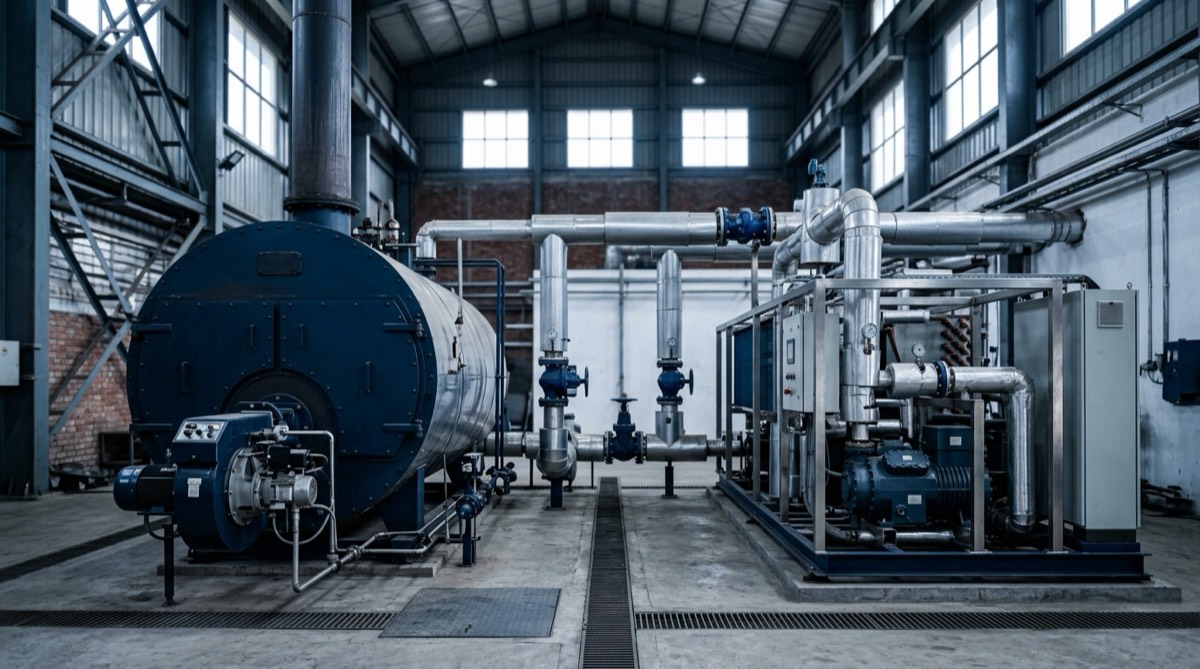
If your plant needs hot water at a steady temperature, for a wash line, a pasteuriser loop or a pretreatment bath, you have three main choices of hot water generator. Each one heats the same water. What differs is the running cost, how much connected load it takes, and whether IBR rules apply.
This guide covers all three, with current Indian fuel and power prices, a sizing formula you can use on the back of an envelope, and a worked example for a typical wash line.
per useful kWh from an electric hot water generator, MSEDCL HT-I at ₹9.25/kVAh
per useful kWh from a generator fired on furnace oil, industrial PNG, LPG or LDO
per useful kWh from a heat pump, COP 3.5 at 60 to 70°C output to COP 2.5 at 85°C, same tariff
no boiler registration, for any of the three
What a hot water generator is
A hot water generator makes hot water at a set temperature and no steam. You'll find them on:
- Process water and wash lines
- Closed loops feeding plate heat exchangers or coils
- Pretreatment baths (degrease, phosphating)
- CIP systems
- Pasteuriser loops
There are three kinds.
Fired (oil, gas, LPG)
A burner and a flue. Expect around 80% efficiency on oil and 85% on gas and LPG. A fired unit can also make steam, which a heat pump can't.
Electric resistance
A heating element in the water. Efficiency is about 97%, so you use roughly 1.03 kW of electricity for every kW of heat.
Heat pump
It doesn't make heat. It moves heat it takes from air, water or your plant's rejected heat, and raises it to the temperature you need. You get 2.0 to 5.2 kWh of heat for each kWh of electricity, depending on the output temperature. At a COP of 3.0, that's 0.33 kW of electricity per kW of heat, a third of what an electric element uses. Tetra Heat Pump goes up to 120°C.
How the COP changes with output temperature:
| Output temperature | Typical COP |
|---|---|
| 60°C, water source | 4.5 to 5.2 (Tetra Heat Pump water source units) |
| 110°C | ~2.26 (independent measurement, India) |
| 120°C | ~2.0 (independent measurement, India) |
A fired generator is still the right call if you need steam or water above 120°C.
Running cost per useful kWh of heat
This is the comparison that matters most. Each row is the cost of one kWh of heat that actually reaches your water, after efficiency losses.
| Heat source | Price | Date | ₹ per useful kWh |
|---|---|---|---|
| LDO | ₹107.65/litre | 1 Aug 2026 | 12.58 |
| Commercial LPG, 19 kg Indane, Mumbai | ₹2,775/cylinder | 1 Nov 2026 | 12.42 |
| Electric element, 97% | ₹9.25/kVAh, MSEDCL HT-I, 11 to 33 kV | FY2026-27 | 9.54 |
| Industrial PNG, Mahanagar Gas Industrial A | ₹86.79/SCM | Nov 2026 | 9.24 |
| Industrial PNG, Mahanagar Gas Industrial B | ₹74.70/SCM | Nov 2026 | 7.96 |
| Furnace oil | ₹71.99/kg | 1 Aug 2026 | 7.70 |
| Heat pump, COP 2.5 (85°C output) | ₹9.25/kVAh | FY2026-27 | 3.70 |
| Heat pump, COP 3.0 | ₹9.25/kVAh | FY2026-27 | 3.08 |
| Heat pump, COP 3.5 (60 to 70°C output) | ₹9.25/kVAh | FY2026-27 | 2.64 |
How we got these numbers
- Tariff. MSEDCL HT-I energy charge of ₹8.44/kVAh plus ₹0.81 wheeling comes to ₹9.25. That's the rate for 11, 22 and 33 kV supply, which covers most factories. If you're on EHV supply you pay ₹8.44, so the electric rows come out about 9% lower.
- kVAh billing. You're billed per kVAh, so at a power factor of 0.9 a real kWh costs you about ₹10.28.
- Calorific values (indicative). 860 kcal per kWh; gas 9,500 kcal/SCM; furnace oil 10,050 kcal/kg; LPG 11,900 kcal/kg; LDO 10,700 kcal/kg.
Breakeven COP. On this tariff, a heat pump costs the same to run as furnace oil at a COP of just 1.20. Against MGL Industrial A gas the breakeven is 1.00, and against LDO and LPG it's 0.74. Even at 120°C, a heat pump runs well above all of these.
Heat pump vs electric is the easiest comparison. Both run on the same electricity, and at COP 3.0 the heat pump uses about a third as much of it. That holds on any tariff.
The exception is solid fuel. Coal delivered at ₹6,000 a tonne works out to around ₹1.94 per useful kWh, and briquettes to about ₹2.54. Both are cheaper than a heat pump on grid power. Plants still move off solid fuel for compliance, stack emissions and labour. If you run a coal boiler, a heat pump can still pay for itself on boiler feed water preheating.
Current prices are on our industrial fuel prices and industrial electricity tariffs pages.
IBR registration
This is good news for most plants. Below 100°C, a hot water generator isn't a boiler under the Boilers Act 2025, section 2(c). That holds at any pressure and for all three kinds of generator. You don't need a boiler attendant or an annual inspection.
Above 100°C, your state Boiler Directorate decides. More on this in our non-IBR boiler guide.
| Application | Temperature | IBR position | Example |
|---|---|---|---|
| Paint shop degrease + phosphating | 50 to 80°C | Below the line | 1.5 MW automotive paint shop |
| Dairy pasteuriser loop | 85 to 90°C | Below the line | 900 kW dairy |
| Pressurised hot water | 100 to 120°C | Above the line, within heat pump range | State directorate decides |
Sizing a hot water generator
Here's the formula:
kW = litres per hour × temperature rise (°C) ÷ 860
It works because 1 kcal raises 1 litre of water by 1°C, and 860 kcal equals 1 kWh.
Worked example: a wash and rinse line
Say you heat 6,000 litres an hour from 30°C to 85°C, a 55°C rise, for 400 hours a month.
6,000 × 55 ÷ 860 = ~384 kW
For the heat pump we've used a COP of 2.5, which leaves some margin at 85°C. The real figure gets confirmed at the site survey.
| Furnace oil | LDO | Electric | Heat pump, COP 2.5 | |
|---|---|---|---|---|
| Heat delivered | 384 kW | 384 kW | 384 kW | 384 kW |
| Electricity at full output | Fans, pumps | Fans, pumps | 396 kW | 153 kW |
| Cost per hour | ₹2,955 | ₹4,827 | ₹3,659 | ₹1,420 |
| Cost per month (400 h) | ₹11.8 lakh | ₹19.3 lakh | ₹14.6 lakh | ₹5.7 lakh |
| Demand charge per month at ₹650/kVA | n/a | n/a | ₹2.57 lakh | ₹1.00 lakh |
What the heat pump saves each month:
- Against furnace oil: about ₹6.1 lakh
- Against LDO: about ₹13.6 lakh
- Against electric: about ₹9 lakh in energy plus about ₹1.6 lakh in demand charges, with 243 kW less connected load
One more thing to look at: MSEDCL gives a day rebate of 15 to 25% off the energy charge between 09:00 and 17:00. If your line runs on day shift, the electric and heat pump figures come down further.
Bigger loads and batch loads
A single 1,450 kW unit at a 55°C rise delivers about 22,700 litres an hour. For more than that, several units run together, up to 5 MW per project.
For batch loads like CIP or a shift-start wash, add hot water storage and size the machine on the average load rather than the peak. Our commercial water heater page explains how.
Where the heat comes from
A heat pump can draw heat from ambient air, from a water source, or from heat your plant already throws away. The smaller the lift from source temperature to output temperature, the better the COP. So if something on site rejects warm heat, that's usually the best source.
Two examples from our installations:
Dairy, 900 kW. The heat source is the refrigeration plant's rejected heat, which feeds an 85 to 90°C pasteuriser loop. The existing plate pasteuriser stayed exactly as it was.
Automotive paint shop. The ED bath has to be held at 28 to 32°C, which is a cooling job. The degrease and phosphating stages need 50 to 80°C. One heat pump does both, cooling one bath and heating the other two.
See waste heat recovery for more on this.
Keeping your existing generator
You don't have to scrap the generator you have. Most plants run the heat pump as base load and keep the existing fired or electric unit for standby, or for duties above 120°C.
Changeover happens on set point through your BMS, SCADA or PLC. Tetra connects to Siemens and Allen-Bradley systems over Modbus or BACnet. Details are on our integration page.
About Tetra Heat Pump
Tetra is made by Promethean Energy in India.
- Output up to 120°C, with ±0.5°C outlet control
- Up to 1,450 kW per unit, and up to 5 MW per project
- Air source, water source and cascade configurations
- 200+ installations
Frequently asked questions
What is a hot water generator?
Does a hot water generator need IBR registration?
How do I size a hot water generator?
Is a heat pump cheaper to run than an oil, gas or electric hot water generator?
How hot can a heat pump hot water generator go?
What to send us for sizing
To size a heat pump for your plant, send us:
- Flow, in litres per hour or as a daily volume, and your running hours
- Inlet and outlet temperatures
- 12 months of fuel or electricity bills
- Tariff category and sanctioned demand
- Chillers, air compressors and cooling towers on site, with their ratings
We'll size the machine, check whether there's a heat recovery source on site, and compare its running cost with your current generator.
If you'd like a quick number first, try the running cost calculator.