Heat pump versus a furnace oil boiler: what actually decides it in an Indian plant
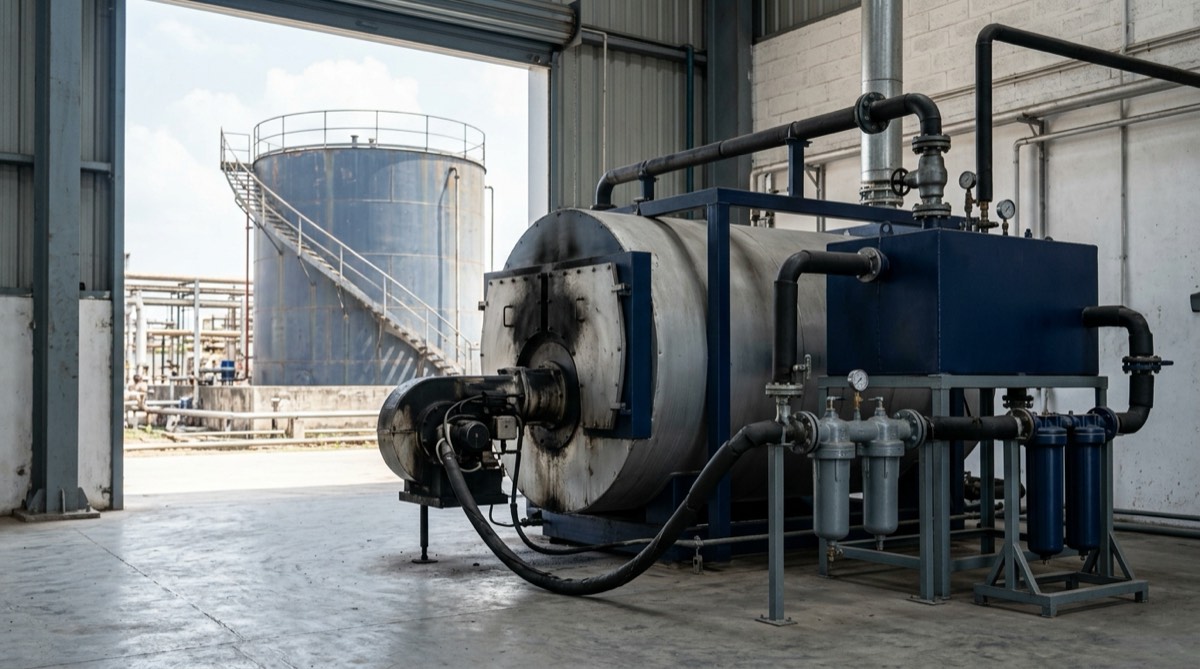
An industrial heat pump replacing a furnace oil boiler in India needs a COP of about 1.0 to 1.2 to match the fuel bill, the same breakeven band as piped natural gas, because oil and gas sit at a similar delivered cost per useful kilowatt-hour of heat. Furnace oil was ₹71.99 per kg, or ₹69.07 per litre, at the Visakhapatnam depot on 1 August 2026, and light diesel oil was ₹107.65 per litre on the same date, so a plant firing LDO for process heat has the strongest arithmetic of any fuel in the country. Measured heat pump performance in Indian conditions is about 2.26 at 110°C output and about 2.0 at 120°C, with better figures at lower output temperatures. Furnace oil also carries costs a heat pump removes rather than reduces: tank storage and oil preheating, burner and combustion maintenance, a chimney and its stack emissions, and a certified attendant on every shift wherever the loop is registered under the Indian Boiler Regulations.
What COP do I need to beat a furnace oil boiler?
You need a COP of between 1.0 and 1.2, which is the same band as it is for piped natural gas.
Heat pumps get written up as a gas story. Furnace oil and industrial PNG land at a similar cost per useful kilowatt-hour once calorific value and boiler efficiency are accounted for, so a plant on oil is in exactly as strong a position as a plant on gas.
The arithmetic is two lines. Take your delivered oil price, divide by the calorific value of the grade you receive and adjust for boiler efficiency: that is the cost of a useful kilowatt-hour of heat. Divide your landed electricity tariff by it, and the result is the COP you have to clear. The full method is set out step by step here, and the calculator will do the division.
Measured performance sits well clear of that. Independent measurement in Indian conditions puts efficiency at about 2.26 at 110°C output and about 2.0 at 120°C, and those are the hard end of the range. Very little of what an oil boiler serves needs 120°C at all.
Do not carry that result across to a solid fuel.
| Fuel | Breakeven COP in India, 2026 | Verdict | The argument that applies instead |
|---|---|---|---|
| Furnace oil | 1.0 to 1.2 | Wins on fuel cost | The fuel bill |
| Light diesel oil | 1.0 to 1.2 | Wins on fuel cost | The fuel bill, by the widest margin of any fuel here |
| PNG | 1.0 to 1.2 | Wins on fuel cost | The fuel bill |
| Biomass briquette | 3.3 to 6.5 | Does not win on fuel cost on grid power | Air quality, labour, ash and storage, customer and regulatory audit |
| Coal | 3.3 to 6.5. Pithead notified price ₹1,849 per tonne for non-coking G13 in June 2026, and the delivered cost at your gate is materially higher | Does not win on fuel cost on grid power | Air quality, labour, ash and storage, customer and regulatory audit |
On furnace oil a fuel-cost claim survives scrutiny. On coal it does not.
What is furnace oil costing right now?
| Fuel | Price | As of | Note |
|---|---|---|---|
| Light diesel oil | ₹107.65 per litre | 1 August 2026 | Depot reference. Add your freight and contract terms |
| Furnace oil | ₹71.99 per kg, ₹69.07 per litre | 1 August 2026 | Visakhapatnam depot. Add your freight and contract terms |
| PNG, industrial, Gujarat | ₹68 per SCM | June 2026 | The general industrial rate, not a household rate |
| Biomass briquette, 60 mm | ₹8,000 to ₹10,000 per tonne | 2026 | Trade pricing, not an official index |
A depot price is a reference point, not what oil costs at your gate. Freight, contract terms and offtake volume sit on top, so use the table as the anchor and your own last invoice for the sum that matters.
Converted to heat, furnace oil at ₹71.99 per kg works out at about ₹8,954 per useful million kilocalories, or ₹7.70 per useful kilowatt-hour thermal. That is our arithmetic rather than a published index, on three stated assumptions: 1 kWh equals 860 kcal, furnace oil at 10,050 kcal per kg, and an oil boiler at 80 percent efficiency. Substitute your supplier’s certificate of analysis and your own measured boiler efficiency and the number moves, but the method does not.
What if I am burning LDO rather than furnace oil?
In that case, you should run the arithmetic before reading anything else on this page.
Light diesel oil was ₹107.65 per litre on 1 August 2026 against furnace oil at ₹69.07 per litre on the same date. A plant firing LDO for process heat pays the highest liquid-fuel price in the Indian industrial set, usually for a good reason: the duty is small, or needs a clean flame, or runs intermittently. That profile, a modest intermittent load below 100°C, is what a heat pump serves well.
On the same assumptions, with LDO taken at 10,700 kcal per kg, an indicative calorific value we could not verify independently, it lands around ₹14,623 per useful million kilocalories or ₹12.58 per useful kilowatt-hour thermal. Put that against your electricity tariff and compare the ratio with the COP achievable at your output temperature. We are not printing the saving, because on LDO the reader who does the division believes the answer.
What electricity price goes on the other side?
You should use the landed rate rather than the energy charge, and this rate varies far more from state to state than most buyers expect.
| State and licensee | Category | Energy charge | Demand charge | Landed |
|---|---|---|---|---|
| Maharashtra, MSEDCL | HT-I | ₹8.44 per kVAh | ₹650 per kVA per month | Add duty and any time-of-day adjustment |
| Gujarat, GUVNL | HT-I | ₹4.30 per unit | Not separately verified | ₹7.50 to ₹8.50 all-in |
| Tamil Nadu, TANGEDCO | HT industrial | ₹7.50 per kWh | ₹608 per kVA per month | Plus 5 percent electricity tax |
| Karnataka, BESCOM and the other ESCOMs | HT-2(a) | ₹6.70 per unit plus 35 paise surcharge | ₹365 per kVA per month | About ₹7.05 before duty |
| Uttar Pradesh, UPPCL | LMV-6, Small and Medium Power | ₹9.02 per unit average billing rate | Not verified | Already all-in |
Two rows carry conditions that change the answer. The Uttar Pradesh figure is LMV-6 Small and Medium Power, not a large HT industrial tariff, so do not read it as the rate a big plant pays. Maharashtra bills HT-I per kVAh rather than per kWh, so poor power factor costs more per useful unit than ₹8.44 suggests. Fix that before you model anything.
Run the division for furnace oil and the breakeven COP comes out at 1.10 in Maharashtra, 1.04 in Gujarat and 0.92 in Karnataka. That is the whole spread across three very different power markets, and it is why the band is quoted as 1.0 to 1.2 rather than as one figure. At the other end of the same calculation, a heat pump holding COP 3.5 delivers heat at about ₹2.41 per useful kilowatt-hour on the Maharashtra tariff and about ₹2.01 in Karnataka.
The Maharashtra row carries the one fact here that looks forward. The regulator has approved a declining HT-I path, from ₹8.44 per kVAh in FY2026-27 to ₹7.45 by FY2029-30. The input price is on a published downward track, while furnace oil tracks a global crude and shipping market.
What does furnace oil cost me beyond the price per kilogram?
Furnace oil arrives as a heavy liquid, too viscous to pump cold, so the tank is heated and the lines are traced, and that parasitic load runs whether or not the boiler fires. Sulphur in the fuel leaves the stack as sulphur dioxide and incomplete combustion leaves particulate matter, which is what your state pollution control board measures when it writes your consent conditions. Soot builds on the tubes between cleans, and every layer of it is efficiency you paid for and are not getting.
| Item | Why it exists on an oil-fired system | On a heat pump loop below 100°C |
|---|---|---|
| Tank storage and bunding | Liquid fuel must be held on site and contained against spillage | Removed |
| Oil preheating and line tracing | Heavy oil will not pump or atomise until it is warmed | Removed |
| Filtration and sludge handling | Water and sediment settle out of stored oil and foul the burner | Removed |
| Burner tuning and soot removal | Air-to-fuel ratio drifts and combustion deposits build on the heat transfer surface | Removed |
| Chimney and flue gas handling | Combustion products must be taken to height and dispersed | Removed |
| Stack emission monitoring | Consent conditions attach to what leaves the chimney | Removed |
| Certified attendant across shifts | Required wherever the vessel is registered under the Indian Boiler Regulations | Removed |
| Statutory inspection and its shutdown | The registered vessel must be opened, examined and certified | Removed |
Two qualifications. Where the oil boiler stays for the balance of the load these are reduced rather than removed, because the tank and the burner are still there. And a heat pump carries its own servicing schedule: planned compressor and refrigerant circuit work instead of daily combustion attendance.
What happens to the statutory burden?
A hot water circuit operating below 100°C is a hot water generator, not a registered boiler under the Indian Boiler Regulations. The certified attendant on every shift, the annual inspection and the production shutdown it needs all fall away with the registration.
Carry the caveat honestly, because this is where the argument gets overstated. At 120°C water sits close to its saturation pressure and the loop must be pressurised to stop it flashing to steam. Whether that vessel attracts IBR is fact-specific, and the only safe answer is a written view from your state Boiler Directorate before you design around it.
For a plant on three shifts that attendant requirement is a real recurring cost. There are also tax and scheme provisions worth checking before you commit capital.
Where is furnace oil not a choice any more?
In Delhi NCR, furnace oil is not on the approved fuel list. The compliant fuels are petrol and diesel, hydrogen and methane, natural gas, LPG, electricity, and biomass for industrial boilers. Firing an unapproved fuel is not met with a warning and a fine schedule; it is enforced with closure and environmental compensation.
Now the half most vendor pages leave out. Natural gas and LPG are also on that approved list. So in NCR a heat pump is not competing against furnace oil, it is competing against a burner conversion to gas that somebody has probably already quoted.
The defensible argument is about what each path leaves you holding. A gas conversion is compliant, and it is a capital project of significant size in its own right, so it should be priced into the comparison rather than assumed to be the cheap option. It leaves you with combustion plant, a stack, an imported commodity fuel price and Scope 1 emissions on your own inventory. Gas conversion is compliant now and gets revisited later. Electrification does not.
Which of my oil-fired duties can actually move?
Not all of your oil-fired duties can move, and working out the split is the genuinely useful part of the exercise.
In range: alkaline degreasing at 55 to 80°C, zinc phosphating at 50 to 60°C, component and parts washing, galvanising flux tanks around 80°C, clean-in-place circuits with caustic at 70 to 85°C, aqueous jacketed vessels to about 88°C, hot water loops and feed preheating. More of an oil-fired plant’s fuel bill sits in this band than most expect, because a boiler raising high-temperature steam to serve a 70°C bath throws away most of the temperature it made.
Out of range: saturated steam at pressure, curing and drying ovens, and anything above the machine’s output ceiling. Paint bake and powder cure at 177 to 204°C, and alkyd polycondensation at 150 to 280°C, stay where they are, on a fired boiler or on a thermic fluid heater if that is what carries them.
COP depends on the lift. Tetra Heat Pump, a product of Promethean Energy Private Limited, builds water source units reaching COP 4.5 to 5.2 at 60°C output, with performance falling as output temperature rises toward the 120°C ceiling, in air source, water source and cascade configurations up to 1,450 kW in a single machine and up to 5 MW across a multi-unit project, holding ±0.5°C on the loop. That covers the degrease, phosphating, wash and CIP duties above and none of the ovens. There is more on the equipment here.
The realistic outcome is a split rather than a swap. The heat pump takes the low-temperature share, the oil boiler stays for the balance and as backup through the first year, and the oil bill falls rather than disappearing. Where the tie-in sits then matters more than the machine selection, because a heat pump plumbed in ahead of a boiler still firing on the same header will not deliver the modelled saving. There is detail on integration here.
What does it do to my electrical connection?
Moving thermal load off oil and onto electricity raises your sanctioned load, and exceeding what you are sanctioned for is charged. An enhancement brings an application charge and a larger security deposit, because the deposit is recalculated against your new average billing. Check the last twelve months of billing for headroom before you budget, and start the licensee application in parallel with manufacture.
Working it out on your plant
Start with the calculator. It needs your delivered oil price, your landed electricity tariff and the output temperature of the duty you want to move. If the breakeven it returns sits below the COP achievable at that temperature, the next step is your load profile across the shift rather than a quotation, and you can get that started here.
Frequently asked questions
- What COP beats a furnace oil boiler?
- You need a COP of about 1.0 to 1.2 in most Indian states. Furnace oil was ₹71.99 per kg at the Visakhapatnam depot on 1 August 2026, which works out at roughly ₹7.70 per useful kilowatt-hour of heat on the assumptions of 10,050 kcal per kg and an 80 percent efficient oil boiler. Divide your landed electricity tariff by that figure and the answer is your own breakeven COP.
- Is furnace oil banned in India?
- It is not banned nationally. It is, however, off the approved fuel list in Delhi NCR, where the compliant fuels are petrol and diesel, hydrogen and methane, natural gas, LPG, electricity, and biomass for industrial boilers, and use of an unapproved fuel is enforced with closure and environmental compensation. Elsewhere furnace oil remains legal but is fired under state pollution control board consent conditions covering stack emissions.
- Can a heat pump replace an oil-fired steam boiler?
- It cannot replace a boiler raising saturated steam at pressure. What it does replace are the low-temperature duties that the steam boiler is currently serving, such as wash and pretreatment baths, clean-in-place circuits, jacketed vessels on aqueous duties and hot water loops. In most oil-fired plants those are a larger share of the fuel bill than expected, and the boiler stays for the duties that genuinely need steam.
- Do I still need a boiler attendant?
- Not for a hot water circuit operating below 100 degrees Celsius, which is not a registered boiler under the Indian Boiler Regulations, so the certified attendant on every shift and the annual inspection shutdown do not apply to it. Above 100 degrees Celsius the loop must be pressurised to stop the water flashing, and whether it attracts IBR then is fact-specific and should be confirmed in writing with the state Boiler Directorate.