Heat pump versus a PNG boiler: what the numbers look like in India in 2026
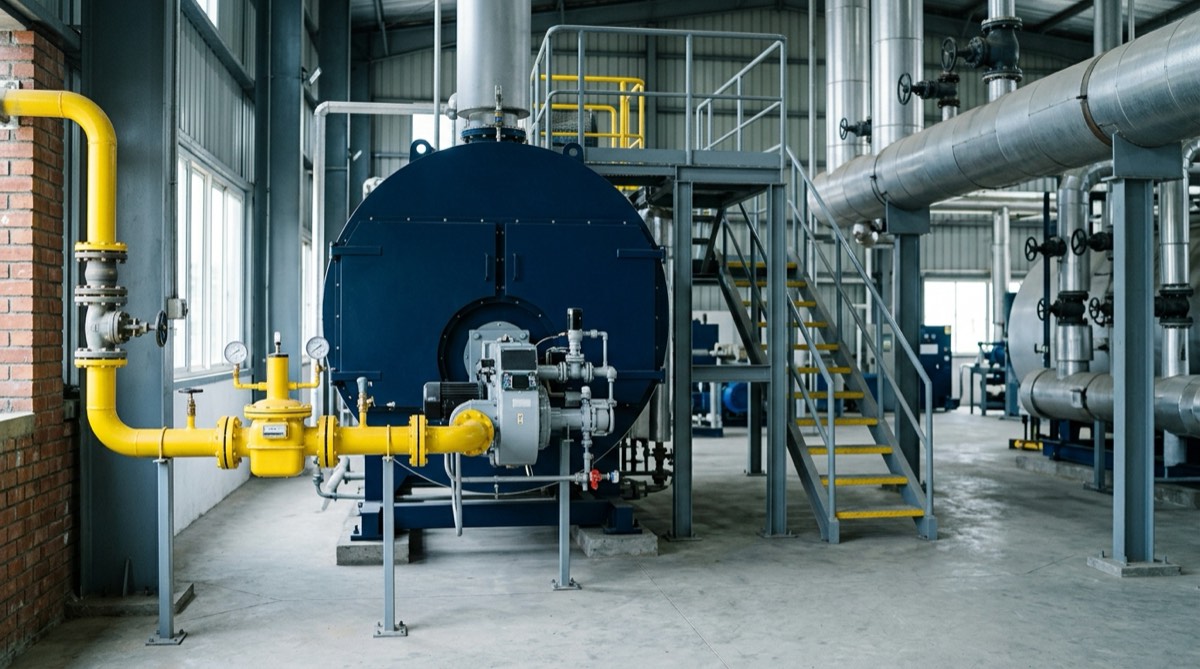
Against a piped natural gas boiler in India, the breakeven COP is 1.0 to 1.2: an industrial heat pump has to deliver only a little more than one unit of heat per unit of electricity to match what the gas boiler costs to run. Industrial PNG in Gujarat was ₹68 per SCM in June 2026 and ₹75 in the Morbi ceramic cluster, against ₹44.68 per SCM in Morbi two years earlier, while measured Indian heat pump performance is about 2.26 at 110°C output and about 2.0 at 120°C, with better figures at lower output temperatures. For hot water and process heat below 100°C the comparison is not close, and the way to test it on your own plant is to divide your electricity tariff by the delivered cost of a useful kilowatt-hour of gas heat.
What COP do I need to beat my PNG boiler?
You need a COP of between 1.0 and 1.2, depending on your state and on your contracted gas rate.
That number is worth sitting with, because it is not a claim about a machine. It is a ratio between two prices you already pay: what a useful kilowatt-hour of heat costs you as gas, and what a kilowatt-hour costs you as electricity. Any heat pump that clears the ratio is cheaper to run than the boiler it replaces, and every point of COP above it is margin.
Set against measured performance, the gap is large. Independent measurement in Indian conditions puts real-world efficiency at about 2.26 at 110°C output and about 2.0 at 120°C, and both are the hard end of the range. Most of the load in a PNG-fired plant sits well below 120°C, in hot water, wash baths and jacketed vessels, where the achievable COP is higher and the margin over breakeven is wider still.
What is industrial PNG actually costing in 2026?
| Where | Price | As of | What it tells you |
|---|---|---|---|
| Gujarat, general industrial | ₹68 per SCM | June 2026 | The current industrial benchmark |
| Morbi ceramic cluster | ₹75 per SCM | June 2026 | A cluster premium on the same fuel |
| Morbi | ₹44.68 per SCM | July 2024 | The two-year baseline, and the honest downside case |
Read the first and third rows together, because that is the actual story. Industrial gas is not sitting on a spike about to unwind. The floor moved two years ago and stayed moved.
It stayed moved for a reason no Indian buyer controls. Industrial PNG tracks imported LNG rather than administered domestic gas, and Asian spot LNG was USD 21.38 per MMBtu on 31 July 2026. So a boiler contract priced off that benchmark exposes you to a global shipping market, which is not the risk most plants think they are carrying. There is more market context in our piece on gas dependence and factory heating.
Why is the PNG price in the news lower than the one on my bill?
The reason is that the widely published rates are household rates, and the rate your plant pays is not one of them.
Consumer price aggregators list Mumbai at ₹51.50 per SCM and Gujarat between ₹46.82 and ₹55.79 per SCM. Those are domestic piped gas rates for homes. Industrial PNG in the same city is a separate, contract-specific and materially higher number, verified at ₹68 per SCM in Gujarat in June 2026.
This matters more than a footnote, and it cuts against the vendor case rather than for it. A cost model built on the household figure understates what the incumbent fuel is costing you, and therefore understates the saving from replacing it. If someone has quoted you a comparison built on ₹51.50, the arithmetic is wrong in your own disfavour.
There is a related trap in the policy news. Administered-price gas is allocated to CNG and household PNG, not to industrial supply. So a headline announcing that domestic PNG prices have fallen is describing a different product from the one burning in your boiler.
How do I work out my own delivered cost per kilowatt-hour of heat?
There are four steps to it. Two of the inputs are given on this page already, and the other two you will take from your own paperwork.
| Step | What you need | Watch out for |
|---|---|---|
| Find your delivered gas cost per useful kWh of heat | Your contracted rate per SCM, the calorific value of your contracted gas, and your boiler’s efficiency | Mixing gross and net calorific value. Take the calorific value and the efficiency on the same basis or the answer is meaningless |
| Find your electricity tariff per kWh | Your bill, including demand charges, fuel surcharge and duty | Using the headline energy charge instead of the landed rate. The gap between the two is large enough to change the decision |
| Divide the second by the first | The two numbers above | Using a household PNG rate instead of your industrial contract rate |
| Compare the result with the COP achievable at your output temperature | The output temperature of the duty you actually want to move | Comparing a top-end COP against a top-end temperature. They do not occur together |
The result of step three is your breakeven COP. If it is below the COP achievable at your duty temperature, the switch pays on running cost alone. The full method, with the same arithmetic applied to boilers generally, is set out here, the same three steps run against a furnace oil boiler or a thermic fluid heater if you fire either alongside the gas, and the calculator will do the division for you.
What electricity price should I put in the other half?
You should use the landed rate rather than the energy charge, and this rate varies far more from state to state than most buyers expect.
| State and licensee | Category | Energy charge | Demand charge | Landed |
|---|---|---|---|---|
| Maharashtra, MSEDCL | HT-I | ₹8.44 per kVAh | ₹650 per kVA per month | Add duty and any time-of-day adjustment |
| Gujarat, GUVNL | HT-I | ₹4.30 per unit | Not separately verified | ₹7.50 to ₹8.50 all-in |
| Tamil Nadu, TANGEDCO | HT industrial | ₹7.50 per kWh | ₹608 per kVA per month | Plus 5 percent electricity tax |
| Karnataka, BESCOM and the other ESCOMs | HT-2(a) | ₹6.70 per unit plus 35 paise surcharge | ₹365 per kVA per month | About ₹7.05 before duty |
| Uttar Pradesh, UPPCL | LMV-6, Small and Medium Power | ₹9.02 per unit average billing rate | Not verified | Already all-in |
Two rows carry conditions that change the answer. The Uttar Pradesh figure is LMV-6 Small and Medium Power, not a large HT industrial tariff, so do not read it as the rate a big plant would pay. And Maharashtra bills HT-I per kVAh rather than per kWh, so a plant running poor power factor pays more per useful unit than ₹8.44 suggests. If yours is weak, fix that before you model anything.
The Maharashtra row also holds the most useful forward-looking fact on this page. The regulator has approved a declining HT-I path, from ₹8.44 per kVAh in FY2026-27 to ₹7.45 by FY2029-30. In one of the largest industrial markets in the country, the electricity price is on a published downward track while the gas price tracks an imported commodity. That is a hedging argument on the public record rather than a vendor assertion.
What if gas comes back down?
This is the question that every gas-switching page invites and that most of them avoid answering, so here is the honest version.
The defensible low case is not a guess. Industrial PNG in Morbi was ₹44.68 per SCM in July 2024, so that is the level to test against, and it is a price that really occurred.
At a lower gas price the breakeven COP rises and the margin narrows. It does not invert. It narrows fastest at the top of the temperature range, where measured performance is around 2.0 at 120°C, and far less at the lower output temperatures where most hot water and wash-bath load sits. A plant moving a 70°C duty and one attempting the top of the range are in genuinely different positions here.
There is also a supply-side reason a return to that level is not the base case. Export capacity was lost and the repair is measured in years, and Indian manufacturers responded by moving onto shorter monthly gas agreements. On a monthly contract you have no forward price visibility in either direction, which is itself an argument for moving part of the load onto a fuel priced by a published tariff order.
Does a heat pump actually reach my process temperature?
It reaches some of your loads but not all of them, and setting out that split honestly is what makes this page worth reading.
In range: wash and pretreatment baths, clean-in-place circuits, jacketed vessels on aqueous duties, hot water loops and feed preheating. In most gas-fired plants these are a larger share of the fuel bill than anyone expects, because a boiler raising steam at high temperature to serve an 80°C bath wastes most of the temperature it worked to produce.
Out of range: saturated steam at pressure, curing ovens and drying ovens. Those stay on the existing plant.
So the realistic outcome in most PNG plants is a partial switch. The heat pump takes the low-temperature loads, the gas boiler is retained for the balance and for backup through the first year, and the gas bill falls rather than disappearing. Tetra Heat Pump, a product of Promethean Energy Private Limited, builds air source, water source and cascade configurations for this kind of retrofit; there is more on the equipment and how it integrates here.
What changes besides the fuel bill?
Four things change besides the fuel bill, and two of them are worth real money.
The boiler regulations may stop applying to that loop. A hot water circuit below 100°C is not a registered boiler under the Indian Boiler Regulations, and the certified attendant across every shift and the annual inspection shutdown go with it. Above 100°C this does not apply, so scope it against the duty you are actually moving.
The gas infrastructure stops being your problem. The connection, the chimney and the flue gas handling all leave with the boiler.
Your electrical load goes up, and this is the one that catches people. Switching from fuel to electricity raises your sanctioned load, and exceeding it triggers charges most plants have not budgeted for. The security deposit is recalculated against your new average billing too, so a higher monthly bill pulls through a larger deposit at the next revision. Check your headroom before you budget the project rather than after.
Price risk also moves. You exchange a fuel priced off a shipping lane for one set by a published state tariff order, which is worth real money if you quote fixed-price work months ahead. There are tax and scheme provisions worth checking before you commit capital.
Working it out on your plant
Start with the calculator, which needs your gas rate, your electricity tariff and your output temperature. If the breakeven it returns is below the COP achievable at your duty, the next step is a look at your actual load profile rather than a quotation, and you can get that started here.
Frequently asked questions
- What COP do I need to beat a PNG boiler?
- You need a COP of between 1.0 and 1.2 in most Indian states. That figure is the ratio of your electricity price per kWh to your delivered gas cost per useful kWh of heat, so it moves with both prices and with your boiler's efficiency.
- Is a heat pump cheaper than gas at today's Indian gas price?
- Yes, on running cost for loads below 100°C, and the margin is not a narrow one. Industrial PNG in Gujarat was ₹68 per SCM in June 2026, and measured Indian heat pump performance of about 2.26 at 110°C output sits well clear of a breakeven of 1.0 to 1.2.
- What happens if gas prices fall?
- The margin narrows and does not invert. The defensible low case is ₹44.68 per SCM, the Morbi industrial rate in July 2024. The narrowing is sharpest at the top of the temperature range and much smaller at the lower output temperatures where most process hot water sits.
- Can a heat pump replace a gas-fired steam boiler?
- It cannot replace a boiler raising saturated steam at pressure. What it does replace are the low-temperature loads that a steam boiler is currently serving inefficiently, which in most plants is a substantial share of the fuel bill. The steam boiler stays for the duties that genuinely need steam.