Water to water heat pump: process heat up to 120°C from warm water your plant already rejects
Most factories have two water problems running side by side. Somewhere, warm water is being cooled: in a cooling tower, a chiller condenser or a process jacket. Somewhere else, water is being heated with furnace oil, PNG, LDO or diesel. A water to water heat pump connects the two. It takes heat out of the stream you are paying to cool and puts it into the stream you are paying to heat.
This page covers how a water source heat pump works on an industrial site, which source streams are worth using, what COP to expect at your output temperature, and what it costs to run in India. At the end there's a list of what to send us so we can size one for your plant.
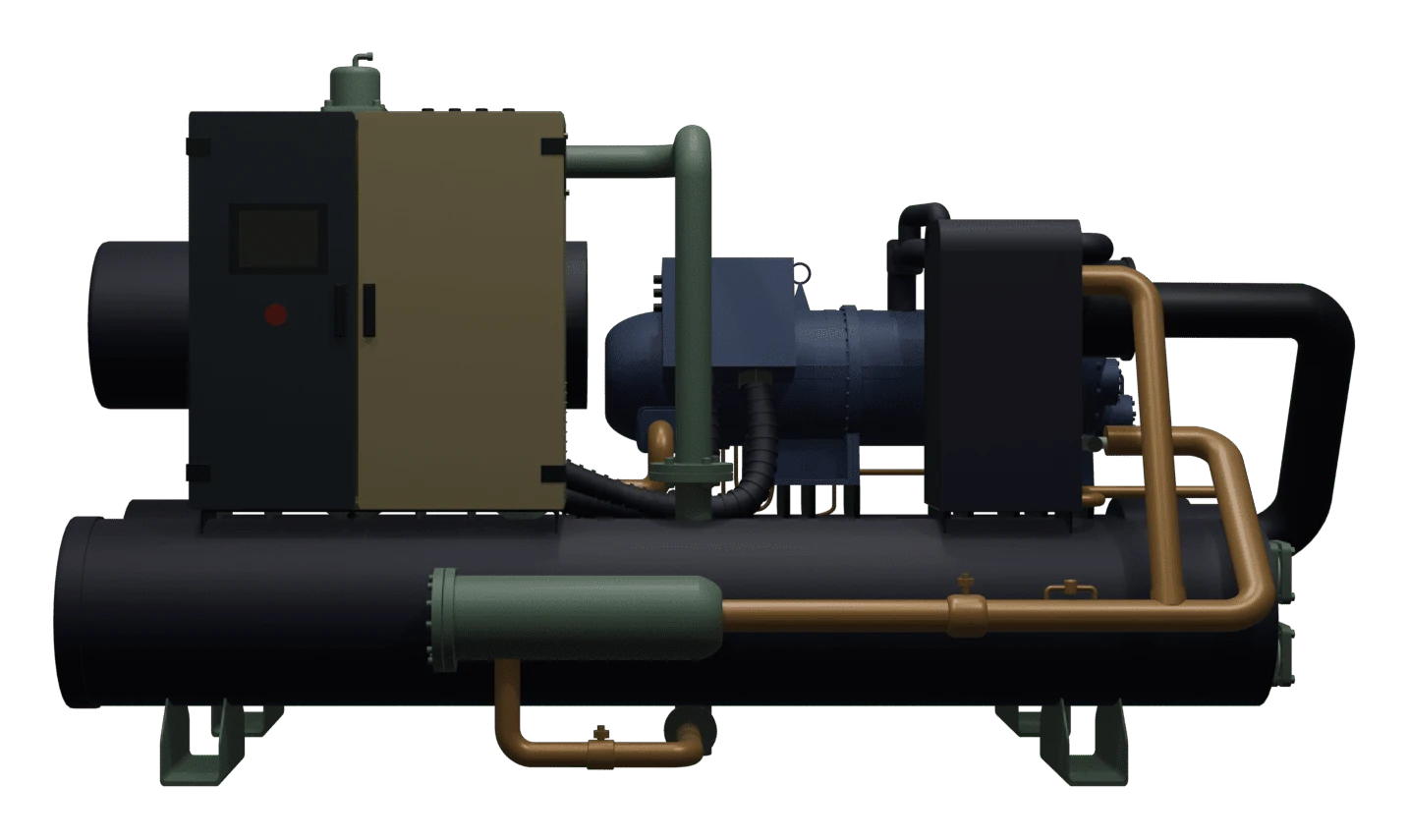
What a Tetra Heat Pump water source unit does
What a water to water heat pump is
A water to water heat pump moves heat from one water stream into another at a higher temperature. On a factory, the source is nearly always water you are already cooling:
- cooling tower return water
- chiller condenser water
- process cooling water
- warm effluent
Inside the machine there are three main parts. A source-side heat exchanger picks up heat from the warm stream. A compressor raises that heat to a higher temperature. A load-side heat exchanger hands the heat to whatever you need to heat, such as a hot water loop, a wash tank or boiler feed water.
You pay for one electricity input and get two jobs done. The heat pump covers your heating duty, and because it has already taken heat out of the source stream, your cooling tower or chiller has less heat to reject.
The Tetra Heat Pump, made by Promethean Energy, delivers up to 120°C, held to ±0.5°C. A single unit goes up to 1,450 kW, and a project can reach 5 MW using several machines. There are more than 200 installations so far.
If your plant has no suitable warm stream, an air source machine may be the better fit. See air source vs water source.
Two installations
Dairy, 900 kW, liquid milk
rejected heat, as the source
hot water loop for the pasteuriser and CIP
In a fluid milk plant, refrigeration uses about 19% of the energy, and centrifugation, homogenisation and pasteurisation together use about 38%. The two loads run at the same time, so the plant is rejecting heat from refrigeration while it buys heat for pasteurisation.
At this dairy, the heat pump takes the heat rejected by the refrigeration system and delivers an 85 to 90°C hot water loop. That loop feeds the existing plate pasteuriser and also serves CIP. The product side of the plates didn't change. The loop stays below 100°C, so no boiler registration is needed.
Read the full story: dairy processing case study.
Automotive paint shop, 1.5 MW
An electrodeposition (ED) bath has to be held at 28 to 32°C, so it needs constant cooling. Upstream of it, pretreatment needs heat: alkaline degreasing at 55 to 80°C and zinc phosphating at 50 to 60°C.
The plant installed 1.5 MW of heat pumps across more than one machine. They take heat out of the ED bath and put it into the pretreatment tanks. The results:
less spent on pretreatment heating energy
of CO2 avoided each year
payback
Read the full story: automotive paint shop case study.
Source streams worth looking at
| Source | Where you'll find it | Temperature | Note |
|---|---|---|---|
| Refrigeration condenser / desuperheater water | Dairies, cold stores, ammonia plants | Desuperheater 55 to 70°C; roughly 50 litres/hour per TR | Short lift to 85 to 90°C |
| Chiller condenser water, cooling tower return | Most plants | Measure on the return line over a normal week | The most common source; the tower also rejects less |
| Process cooling water | Reactor jackets, condensers (paint, chemical) | Set by the process | Heat you currently pay to remove |
| Process bath cooling | ED bath, paint shop | 28 to 32°C | Cooling and heating from one machine |
| Air compressor cooling water | Screw and reciprocating compressors | Set by the compressor | Small; suits a hot water loop or boiler make-up |
| Warm effluent | Dye houses, washing lines, CIP drain | Varies by batch | Needs a cleanable plate exchanger first |
Check three things before you pick a source.
Timing. You can only use a stream while it is flowing. If the source runs on different shifts from the duty, add a hot water store, sized from both profiles.
Distance. Every metre between source and duty costs you pumping power and pipe losses.
Whether you need a heat pump at all. If the source is already hotter than the duty, a plain heat exchanger may do the job for less. See waste heat recovery.
Why a warmer source gives a higher COP
The compressor's work depends on the lift, meaning the gap between the source temperature and the output temperature. The smaller the lift, the less electricity you need for each kW of heat.
For Tetra on a water source:
- 60°C output: COP 4.5 to 5.2 (rated)
- 110°C output: about 2.26 (independently measured in India)
- 120°C output: about 2.0 (independently measured in India)
A 2026 study of an Indian dairy, published in Energy Conversion and Management, shows the same effect. A 344 kW single-stage machine on R245fa reached a COP of 2.29 with a payback of 4.93 years. When the coupling temperature was raised to 50°C, the COP rose to 3.08 and payback fell to 3.07 years.
So the best design uses the warmest steady stream you have and the lowest output temperature your process can actually work with. We choose the refrigerant, such as R1234ze or R245fa, to suit the output temperature.
Running cost
As an example tariff we use Maharashtra HT-I (11 to 33 kV): ₹8.44/kVAh for energy plus ₹0.81 wheeling, which comes to ₹9.25/kVAh. We treat 1 kVAh as 1 kWh. These figures leave out demand charges and electricity duty.
| COP | Output temperature | ₹ per useful kWh of heat |
|---|---|---|
| 5.2 to 4.5 | 60°C | 1.78 to 2.06 |
| ~2.26 | 110°C | 4.09 |
| ~2.0 | 120°C | 4.63 |
For comparison, here is what useful heat costs from other fuels, and the COP a heat pump needs to match each one:
| Fuel | ₹ per useful kWh, about | Breakeven COP |
|---|---|---|
| Furnace oil | 7.70 | 1.20 |
| PNG (MGL Industrial A) | 9.24 | 1.00 |
| LDO | 12.58 | 0.74 |
Even at 120°C, the heat pump runs well above every one of those breakeven figures. Against PNG, LPG, furnace oil, LDO or diesel, expect savings of 40 to 70% on the heating duty the heat pump takes over.
Coal and briquette are a different case. On grid power, a heat pump usually costs more to run than a coal or briquette boiler. Plants still switch for other reasons: compliance, air quality on site, and the labour that solid fuel handling needs.
For current numbers, see industrial fuel prices in India and industrial electricity tariffs in India. For a full worked example, see the hot water generator page.
Cascade heat pumps for 110 to 120°C
Cascade is the third Tetra configuration, alongside air source and water source. It works with either a water or an air source.
The heat is lifted in two stages. Stage one takes heat from the source up to an intermediate temperature. Stage two lifts it from there to the output temperature. This is how you reach 110 to 120°C. For budgeting, use a COP of about 2.26 at 110°C and about 2.0 at 120°C.
Before you specify a cascade, check the lowest temperature your process really needs. If you can stay below 100°C, there's no boiler registration, a single-stage machine is often enough, and the COP is better.
If you need steam at pressure, or anything above 120°C, that stays on the boiler. The heat pump can still help there by preheating the boiler feed water. See boiler feed water preheating.
Frequently asked questions
What is a water to water heat pump?
It is a heat pump that takes heat out of one water stream and puts it into another at a higher temperature. On a factory the source is usually water you are already cooling, such as cooling tower return, chiller condenser water, process cooling water or warm effluent. The heat goes into a hot water loop, a wash tank or boiler feed water, and your cooling tower or chiller has less heat to reject.
What COP does a water source heat pump reach?
It depends on the lift, the gap between the source temperature and the output temperature. For Tetra on a water source, the rated COP is 4.5 to 5.2 at a 60°C output. At 110°C, independent measurement in India gives about 2.26, and at 120°C about 2.0. A warmer source means a smaller lift and a higher COP.
Which plant streams can feed a water source heat pump?
Refrigeration condenser and desuperheater water, chiller condenser water and cooling tower return, process cooling water from reactor jackets and condensers, process baths that need cooling such as an ED bath at 28 to 32°C, air compressor cooling water, and warm effluent. Effluent goes through a cleanable plate exchanger first. You can only use a stream while it is flowing, so if it runs on different shifts from the heating duty, add a hot water store.
Is a water source heat pump cheaper to run than an oil or gas boiler?
Yes. On the Maharashtra HT-I tariff at 11 to 33 kV, ₹9.25/kVAh, useful heat from the heat pump costs ₹1.78 to ₹2.06 per kWh at 60°C and ₹4.63 at 120°C. Furnace oil costs about ₹7.70 per useful kWh, PNG about ₹9.24 and LDO about ₹12.58. Against PNG, LPG, furnace oil, LDO or diesel, expect savings of 40 to 70% on the heating duty the heat pump takes over.
How hot can a water source heat pump go?
Tetra delivers up to 120°C, held to ±0.5°C. For 110 to 120°C we use a cascade, where stage one lifts heat from the source to an intermediate temperature and stage two lifts it to the output. If your process can stay below 100°C, there is no boiler registration and a single-stage machine is often enough, at a better COP. Steam at pressure, or anything above 120°C, stays on the boiler.
What to send us
With a few numbers from your plant, we can tell you whether a water to water heat pump fits and what it would save.
For each warm stream:
- temperature
- flow rate, ideally logged over a normal week
- running hours
- whether it is clean, oily or effluent
For the heating duty:
- temperature needed
- running hours
- current fuel and its delivered price
From a recent electricity bill:
- tariff category
- sanctioned demand
We'll then match the source to the duty, give you the output and COP at your temperatures, tell you whether it needs a single-stage or cascade machine, and work out the running cost against your current fuel.