What India's higher gas price floor means for factory process heat
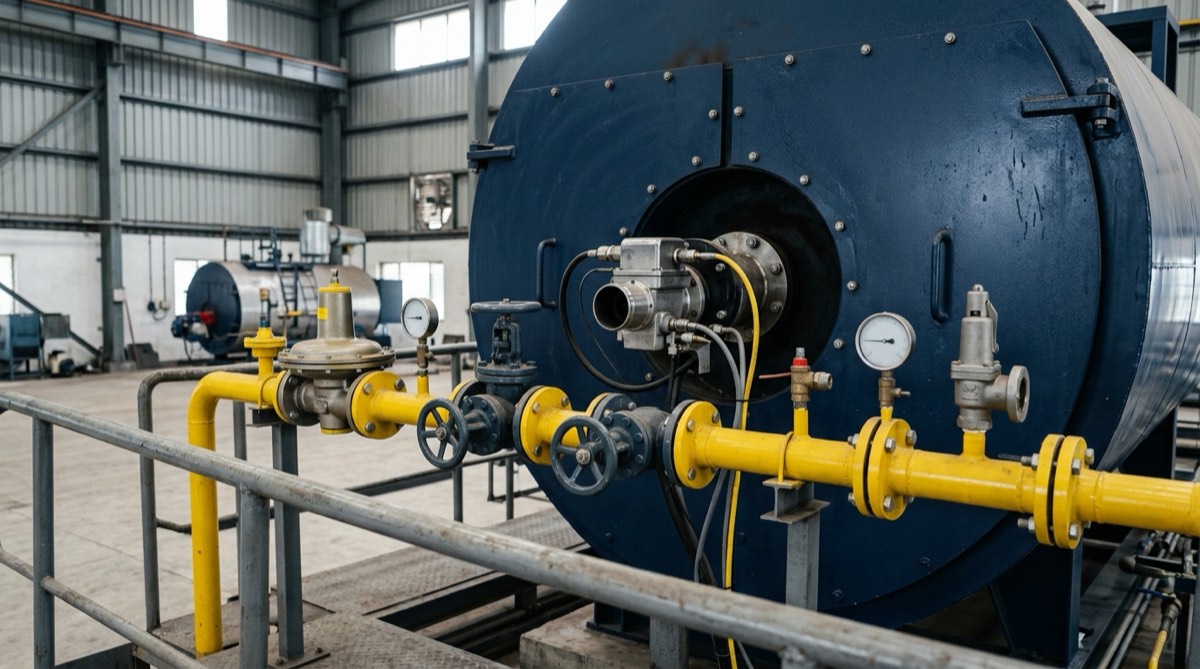
Industrial piped natural gas in Gujarat cost ₹68 per SCM in June 2026, and ₹75 per SCM in the Morbi ceramic cluster, against ₹44.68 per SCM in Morbi two years earlier. That is well below the peak of the 2026 supply disruption and well above where it sat before it, and the structural damage to Qatari export capacity means the higher floor is measured in years rather than quarters. For a factory heating water, air or a process bath below 100°C, that turns the question from how to survive a spike into whether to keep buying a contract-priced imported fuel at all. The number that settles it is the breakeven COP, and against gas in India today it is 1.0 to 1.2, which means a heat pump has to do very little more than work.
What is industrial gas actually costing an Indian factory in 2026?
The answer rests on two figures from June 2026, together with one figure from two years earlier.
| Where | Price | As of | What it tells you |
|---|---|---|---|
| Gujarat, general industrial | ₹68 per SCM | June 2026 | The current industrial benchmark |
| Morbi ceramic cluster | ₹75 per SCM | June 2026 | A cluster premium on the same fuel |
| Morbi | ₹44.68 per SCM | July 2024 | The two-year baseline |
Read the first and third rows together, because the distance between them is the subject of this page. Industrial gas is not sitting on a spike waiting to unwind. The floor moved, and two years later it has stayed moved.
The middle row matters if you are in Morbi. The ceramic cluster pays a premium over the rest of the state on the same fuel, so a plant there budgeting off the Gujarat figure will come up short. Cluster pricing is contract pricing, set by your city gas distributor rather than by a published state rate.
None of the three rows tells you what you pay. Industrial PNG is contracted plant by plant, so treat these as the benchmark to check your own contract against.
Why is the gas price in the news not the price on my bill?
The reason is that most of the rates you can easily find quoted are household rates, and the rate your plant pays is not one of them.
Consumer price aggregators list Mumbai at ₹51.50 per SCM and Gujarat between ₹46.82 and ₹55.79 per SCM. Those are domestic piped gas rates, for homes. Industrial PNG in the same city is a separate, contract-specific and materially higher number, verified at ₹68 per SCM in Gujarat in June 2026. City gas distributors treat industrial pricing as commercial and point buyers at a zonal desk rather than a published tariff card, which is exactly why the household figure is the one that surfaces in a search.
This matters more than a footnote, and it cuts against the vendor case rather than for it. A cost model built on the household rate understates what the incumbent fuel is costing you, and therefore understates the saving from replacing it. If anyone has shown you a comparison built on ₹51.50, the arithmetic is wrong in your own disfavour.
There is a second version of the same trap in the policy news. Administered-price gas, the domestically produced gas whose price the government sets, is allocated to CNG and to household PNG. Industrial supply comes from imported LNG. So a headline announcing that domestic gas has been made cheaper is describing a different product from the one burning in your boiler, and it will not reach your invoice.
Is the price going back down?
It has already come down part of the way, but it is not going back to the level it was at earlier.
Supply is flowing again and the acute phase has passed. What has not been repaired is the export capacity lost at Ras Laffan, where the damaged equipment carries replacement lead times measured in years rather than months. That is the reason to treat today’s price as a floor rather than as a peak on its way down.
The mechanism underneath tells you which headlines to ignore. Industrial PNG is supplied from imported LNG rather than from administered domestic gas, so the rate you pay tracks the Asian spot market. Asian spot LNG was USD 21.38 per MMBtu on 31 July 2026. Your boiler is priced off a shipping lane.
Then the question a capital committee should be asking, which is not what happens if gas stays high but what happens if it goes all the way back. The lowest recent Indian industrial gas benchmark is ₹41.60 per SCM, the Morbi rate before the 2026 supply disruption. Against gas at ₹41.60 per SCM, on a 60 to 70°C duty where a COP near 3.5 is plausible, a heat pump on the Maharashtra HT-I energy charge of ₹8.44 per kVAh still delivers a useful kilowatt-hour of heat for about 46 percent less than the gas boiler. The case does not need the price of gas to stay where it is. It survives gas returning to its own low.
One change in how gas is bought has not been priced by most plants. Through the disruption, Indian manufacturers moved off long-term gas contracts and onto shorter monthly agreements, because availability mattered more than price. A monthly contract removes forward visibility in both directions: you are not protected when the price rises and you cannot bank a saving when it falls. That is a live problem for anyone quoting work months ahead.
Is electricity any more predictable than gas?
On the public record it is, and in one large industrial state it is on an approved downward path.
| State and licensee | Category | Energy charge | Demand charge | Landed |
|---|---|---|---|---|
| Maharashtra, MSEDCL | HT-I | ₹8.44 per kVAh | ₹650 per kVA per month | Add duty and any time-of-day adjustment |
| Gujarat, GUVNL | HT-I | ₹4.30 per unit | Not separately verified | ₹7.50 to ₹8.50 all-in |
| Tamil Nadu, TANGEDCO | HT industrial | ₹7.50 per kWh | ₹608 per kVA per month | Plus 5 percent electricity tax |
| Karnataka, BESCOM and the other ESCOMs | HT-2(a) | ₹6.70 per unit plus 35 paise surcharge | ₹365 per kVA per month | About ₹7.05 before duty |
| Uttar Pradesh, UPPCL | LMV-6, Small and Medium Power | ₹9.02 per unit average billing rate | Not verified | Already all-in |
Two rows carry conditions that change how you read them. The Uttar Pradesh figure is LMV-6 Small and Medium Power rather than a large HT industrial tariff, so it is not the rate a big plant would pay. And Maharashtra bills HT-I per kVAh rather than per kWh, so a plant running poor power factor pays more per useful unit than ₹8.44 suggests. If yours is weak, fix that before you model anything.
The Maharashtra row also holds the most useful forward-looking fact on this page. The regulator has approved a declining HT-I path, from ₹8.44 per kVAh in FY2026-27 to ₹7.45 by FY2029-30. A committee weighing a long-lived asset is therefore comparing an input whose price has been approved downward for five years against an input that tracks an imported commodity. The path is state-specific and will not hold everywhere, so read your own DISCOM’s current order rather than assuming it. A tariff order is still a document you can read before you commit capital, which is more than a gas contract renewal offers.
At what gas price does switching stop making sense?
It stops making sense at the point where your breakeven COP rises above the COP you can actually achieve, and against gas in India that point is still a long way off.
Breakeven COP is one division. Take your electricity price per kWh and divide it by the cost of a useful kWh of heat from the fuel you burn today. Below that ratio the heat pump costs more to run than the boiler. Above it, every point of COP is margin.
Against gas and furnace oil in India in 2026, breakeven sits at 1.0 to 1.2. Against coal it sits at 3.3 to 6.5. Those two bands describe two completely different decisions.
| Fuel you burn today | Breakeven COP in India, 2026 | What that means | Where the real argument is |
|---|---|---|---|
| PNG | 1.0 to 1.2 | Heat pump wins on fuel cost | The fuel bill |
| Furnace oil | 1.0 to 1.2 | Heat pump wins on fuel cost | The fuel bill |
| LDO or diesel | Lower still than the gas band | Heat pump wins on fuel cost, by more | The fuel bill |
| Coal | 3.3 to 6.5 | Heat pump does not win on fuel cost | Compliance, air quality, labour and customer audit |
| Biomass briquette | In the same solid-fuel territory as coal | Heat pump does not win on fuel cost | Compliance, air quality, labour and customer audit |
On gas, the margin is not marginal. A ratio near 1.1 means the machine has to deliver a little more than one unit of heat per unit of electricity to match the boiler it replaces, and any working heat pump does considerably better than that. There is no sensitivity analysis to lose, which is unusual in a capital case.
On solid fuel it is the other way round. A heat pump on grid power generally loses to coal on fuel cost and reaches roughly parity only on a levelised basis that counts the capital, and it is clearly ahead only where the power comes from captive renewables. So against coal or briquette this is a compliance, air quality, labour and customer-audit decision rather than a cost one. Anyone who tells you a heat pump cuts your coal bill has not done the division, and your energy manager will do it in the first meeting.
The full method, worked against boilers generally, is set out here, the same comparison run against a PNG boiler alone is here, and the calculator will do the division for you.
What does an honest COP look like at my temperature?
COP is set by the lift and not by the output temperature alone, and the honest Indian figures are lower than the ones generally in circulation.
Independently measured performance in Indian conditions is about 2.26 at 110°C output and about 2.0 at 120°C. Those are the hard end of the envelope. Most of the heat in a gas-fired plant is not there. It is in wash baths, hot water loops and jacketed vessels below 100°C, where the lift is smaller and the achievable COP is higher.
Tetra Heat Pump water source units reach COP 4.5 to 5.2 at 60°C output, and performance falls as the output temperature rises toward the 120°C ceiling. Both ends of that curve belong to the same machine, and a supplier publishing only one of them is not giving you enough to model with. Tetra Heat Pump is a product of Promethean Energy Private Limited.
Which is why a COP quoted with no conditions attached is not usable. If you have been told 4.5 and not told the source temperature, the output temperature and who measured it, you cannot put the number in a business case. Ask for all three.
What does a fired boiler cost me that is not on the fuel bill?
Begin with the item that is legally grounded rather than commercial. Below 100°C, a hot water loop is a hot water generator and not a registered boiler, so the Indian Boiler Regulations do not attach to it. With the registration go the certified attendant on every shift and the annual inspection, along with the shutdown that inspection requires.
The caveat travels with the claim every time. The exemption is defined by temperature and pressure, not by technology. Above 100°C the water sits at saturation pressure and has to be held above it to stop flashing, so the position depends on vessel design and volume and on the view of your state Boiler Directorate. Below 100°C it is clear. Above it, get an opinion in writing before you budget the saving.
The rest of the overhead is ordinary, unglamorous and usually treated as sunk when it is actually annual.
| Cost item | Why it exists on a fired system | What changes on a heat pump loop below 100°C |
|---|---|---|
| Gas connection and its maintenance | The fuel arrives by pipeline, with metering and safety fittings that are yours to maintain | Removed |
| Boiler annual maintenance | Combustion parts, burners, tubes and refractory wear and need scheduled attention | Reduced |
| Certified boiler attendant across shifts | The regulations require a certificate holder in charge whenever a registered boiler is under steam | Removed below 100°C |
| Statutory inspection and its shutdown | Certificates run a year and re-inspection needs the plant cold | Removed below 100°C |
| Emission monitoring | Combustion produces a stack, and the stack is a regulated discharge point | Removed |
| Chimney and flue gas handling | The products of combustion have to be taken to height and dispersed | Removed |
| Fuel storage and handling | Liquid and solid fuels need tanks, yards, pumps and the labour to run them | Removed, or unchanged where the fired plant is retained |
None of these move with the gas price. They are the standing cost of being a plant that burns something, and they were the same at ₹44.68 per SCM as they are at ₹68.
How do I quote a customer when my fuel price moves like this?
It has to be done with some difficulty, and this is a commercial problem rather than an engineering one.
A manufacturer prices work from input costs. A plant on a monthly gas agreement is quoting against a number it does not control and cannot see months ahead, which leaves three unattractive options: quote high and lose the work, quote flat and carry the exposure yourself, or add a fuel surcharge clause that your customer reads as a warning about you.
Industrial electricity behaves differently in one respect. It is generated domestically and its industrial tariff is set by a state regulator in a published order, so the price still moves, but it moves on a schedule and in public.
In a tender that is worth something separate from the running-cost saving. A supplier who can hold a price for the length of a contract is easier to buy from than one who cannot, and the buyer does not need to understand heat pumps to understand that.
Do CCTS or CBAM change the arithmetic?
They change it less than you have probably been told, and not in the direction of money.
India’s Carbon Credit Trading Scheme places obligations on a defined list of notified sectors, and most of the industries a heat pump serves sit outside that perimeter. For a plant that is not an obligated entity, the offset route is the only way in and it is not operational. Treat CCTS as something to watch rather than a reason to buy. The same applies to PAT and ESCerts, which bite only above the Designated Consumer threshold of 30,000 MTOE for most sectors, well clear of a mid-size plant.
The definitive phase of the EU’s carbon border mechanism is now in force, and its useful effect is procedural rather than financial. It requires verified emissions data in place of default values, so somebody has to build a plant-level emissions inventory. That exercise puts onsite fuel combustion on a page with a price beside it, often for the first time. It is a trigger for a conversation, not a subsidy.
What is actually claimable is duller and more dependable. Accelerated depreciation runs at 40 percent, and heat pumps are named explicitly in Appendix I of the Income Tax depreciation rules, at item 8(ix), under waste heat recovery equipment. There is more on the tax and scheme provisions worth checking before you commit capital.
Where does a heat pump actually fit in a gas-fired plant?
It fits on part of the load, and being precise about which part is exactly what makes the rest of this argument credible.
In range: wash tanks, pretreatment and phosphating baths, clean-in-place circuits, jacketed vessels on aqueous duties, hot water loops and feed preheating below 100°C. In a gas-fired plant these are usually a larger share of the fuel bill than anyone expects, because a boiler raising steam at high temperature to serve an 80°C bath throws away most of the temperature it worked to produce.
Out of range: saturated steam at pressure, curing ovens, drying ovens and any duty above the heat pump envelope. Those stay on the fired system. A vendor who tells you otherwise is selling you an argument with your own process engineer.
So most Indian retrofits are partial. The heat pump takes the low-temperature duties, the boiler is retained for the balance and for backup through the first year, and the gas bill falls rather than disappearing. Tetra Heat Pump builds air source, water source and cascade configurations for that kind of split, and there is more on the equipment and how it ties into existing BMS, SCADA and PLC networks here.
Working it out on your own plant
Two prices decide this question, and you already hold both of them. Start with the calculator, which wants your contracted gas rate, your landed electricity tariff and the output temperature of the duty you are thinking of moving, and returns the breakeven COP for your plant.
If that number sits below the COP achievable at your temperature, the next step is a look at your real load profile rather than a quotation, and the order that work actually happens in is set out here. Background on the manufacturer is here, and a load profile review starts here.
Frequently asked questions
- Does the case for switching survive gas falling further?
- Yes, on the published low case. The cheapest recent Indian industrial gas benchmark is ₹41.60 per SCM, the Morbi rate before the 2026 supply disruption. At that price, on a 60 to 70°C duty where a COP near 3.5 is plausible, a heat pump on the Maharashtra HT-I energy charge of ₹8.44 per kVAh still delivers useful heat about 46 percent cheaper than a gas boiler. The margin narrows as gas gets cheaper and as the required output temperature rises, but against gas it does not invert.
- Do I need to replace the whole boiler?
- No, and most Indian retrofits do not. A heat pump takes the duties below 100°C, which usually means wash and pretreatment baths, clean-in-place circuits, hot water loops and feed preheating. Saturated steam at pressure, curing ovens and drying ovens stay on the fired system, so the boiler is normally retained for the balance of the load and for backup.
- Does my electricity bill go up by as much as my gas bill goes down?
- No. A heat pump moves heat rather than burning fuel to make it, so one unit of electricity delivers several units of heat. Budget for two second-order effects. Switching load from fuel to electricity raises your sanctioned load, and the security deposit is recalculated against the higher average monthly billing, which is a cash-flow item plants routinely miss.
- Is this only worth doing in Gujarat?
- No. Gujarat appears in the examples because its industrial PNG price is the best documented in India, at ₹68 per SCM in June 2026. The decision is set by the ratio between your electricity tariff and your delivered gas cost, and industrial tariffs vary widely by state, from about ₹7.05 per unit before duty in Karnataka to ₹8.44 per kVAh in Maharashtra. Run the ratio on your own two prices.