Heat pump versus thermic fluid heater: what a heat pump can and cannot take off your hot oil loop
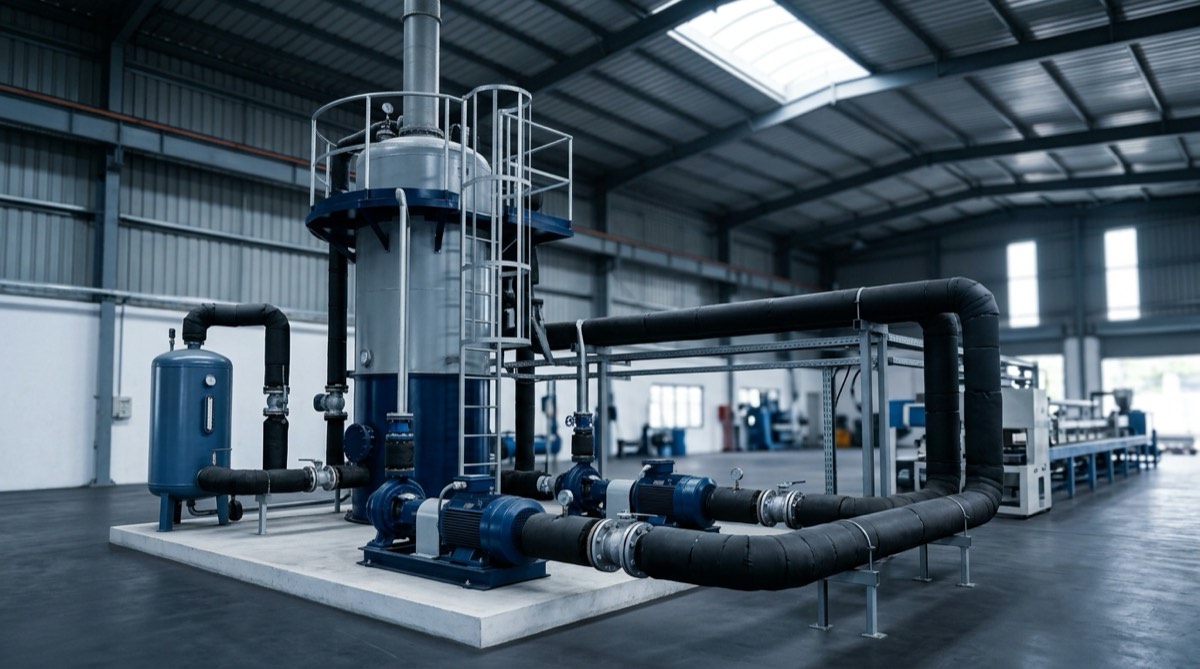
A thermic fluid heater exists to deliver process heat well above the temperature an industrial heat pump can produce, so on that duty there is no comparison to make and Tetra Heat Pump does not claim one. What is worth checking is whether the same hot oil loop also carries duties below 120°C, because one fired heater and one circulating loop commonly serve wash tanks, jacketed vessels, pretreatment baths and hot water alongside the process the loop was sized for. Those duties can usually be separated onto a heat pump, and where the heater burns furnace oil, light diesel oil or PNG the breakeven COP is 1.0 to 1.2, so the separated share pays on fuel cost alone. Where it burns briquette or coal the breakeven COP is 3.3 to 6.5, which a heat pump delivering up to 120°C does not reach, and the reason to move a duty becomes compliance, air quality, labour and customer audit rather than the fuel bill.
Can a heat pump replace a thermic fluid heater?
No, it cannot, at least not on the duty that the loop exists to serve.
A thermic fluid heater is chosen for a physical reason: it delivers high process temperature at close to atmospheric pressure. Hot oil carries heat at temperatures that would need a pressurised vessel, and a registered boiler, if you carried the same heat in water. Changing the fluid is how the plant escapes the pressure, and it is also what places the duty outside the range of a heat pump, because a heat pump raises heat through a temperature lift using a refrigerant cycle, and that lift has a definite ceiling.
Independently measured performance in Indian conditions is about 2.26 at 110°C output and about 2.0 at 120°C. These figures describe the top of the range rather than a comfortable operating point, and they remain far below the temperature at which a hot oil loop is held.
Therefore, if you run hot oil because a reactor, an oven or a reboiler genuinely needs that temperature, nothing on this page changes that position.
So what is the actual question?
The question that actually matters is whether the loop is serving only the duty for which it was sized, and in most Indian plants it is not.
A hot oil system is one fired heater and one circulating loop, and once it exists, anything needing heat gets plumbed into it, because a tapping off the loop is cheaper than a second heat source. A wash tank, a phosphating bath or a hot water requirement is then served at whatever the loop happens to be at. Such a duty is not asking for high temperature at all. It is asking only for heat, and it receives high temperature simply because that is what was already flowing in the pipe.
Finding this gap requires a duty-by-duty audit rather than a reading of the fuel bill. You will need to walk along the loop, list out every tapping on it, and record the temperature that each duty actually requires at the point of delivery.
| Duty on the loop | Does it need the loop temperature, or just the loop? | Can it move to a heat pump? | What to record before asking anyone for a quote |
|---|---|---|---|
| Reactor or process vessel held at reaction temperature | Needs it | Stays on hot oil | Its share of total loop load, so you know what the heater must still cover |
| Drying or curing oven | Needs it | Stays on hot oil | Its share of loop load and its running hours |
| Distillation reboiler on a high boiler | Needs it | Stays on hot oil | Its share of loop load and whether it runs continuously or in campaigns |
| Jacketed vessel on aqueous chemistry | Just the loop | Candidate for separation | Jacket inlet temperature the batch actually needs, and batch hours per day |
| Wash and degreasing tank | Just the loop | Candidate for separation | Bath set point, bath volume and the hours it is held hot |
| Pretreatment or phosphating bath | Just the loop | Candidate for separation | Bath set point and hours held hot, including idling between shifts |
| Clean-in-place and drum washing | Just the loop | Candidate for separation | Delivery temperature, litres per cycle and cycles per day |
| Hot water, storage, thinning and preheating | Just the loop | Candidate for separation | Flow rate, delivery temperature and daily hours |
Which duties on a hot oil loop can move?
It is best to begin with the duties that do not fit, because that is the half your engineer will check first.
Reactors held at polycondensation temperature do not move. Nor do distillation reboilers on high boilers, drying and curing ovens, or heated presses and platens. All of these run well above the range that an industrial heat pump serves, and every one of them is a perfectly normal reason to have installed hot oil in the first place. Being straightforward about what cannot move is precisely what makes the case for the wash tank believable.
What moves is the aqueous end of the plant, the lower half of the table above. Those duties sit around the process rather than in it, which is why they disappear when the fuel bill is read as one number. Our chemical industry page sets the aqueous jacketed duties against the synthesis loads that do not fit.
Tetra Heat Pump, a product of Promethean Energy Private Limited, builds air source, water source and cascade units delivering output up to 120°C with ±0.5°C control, which covers the wash, pretreatment, clean-in-place, jacketed aqueous and hot water duties in that half of the table and none of the reactor, reboiler or oven duties above them.
What does separating a low-temperature duty actually involve?
It involves building a new circuit rather than modifying your existing hot oil system, and that distinction matters a great deal to whoever has to approve the work.
The arrangement is a heat pump, a buffer vessel, a hot water loop and a tie-in at the duty rather than at the heater. The thermic fluid loop stays intact and keeps serving what it must; the tapping that fed the wash tank is blanked and the tank fed from the new circuit. Nothing is done to the fired heater, its burner or its safety devices, which keeps the change out of the part of the plant carrying the most approval weight. There is more on the equipment and configurations here, and how a new circuit ties into existing controls, BMS or SCADA is covered here.
There is one further effect that belongs at the design stage. A fired heater sized for the whole spread, then turned down to serve only the high-temperature duties, may no longer sit near its best point, so you should check the load separation against your heater’s turndown curve and not against its fuel bill alone.
What else does keeping the loop hot cost you?
Fuel is the visible cost. The remaining costs scale with the number of hours for which the loop is held hot, and it is the low-temperature duties that drive those hours. The fluid degrades: thermal cracking and oxidation change it over its life, so the charge is sampled, topped up and eventually replaced, and replacement is a shutdown as well as a purchase. The degradation products then foul, building carbon deposits on the heater coil that raise film temperature at the tube wall and accelerate the next round of degradation. A fired heater circulating hot oil also carries its own safety case, flue gas handling and inspection routine, none of it smaller because the duty at the far end is a wash tank.
The loop is also oversized by its very design. Holding a high-temperature circuit live so a wash bath stays warm carries the full circulation pumping load and the distribution losses of a hot loop for a duty needing neither. Where the low-temperature duties run long hours and the process runs in campaigns, this is often the largest part of the case, and it never appears in a fuel comparison.
Does the fuel the heater burns change the answer?
Yes, the fuel matters more than anything else discussed on this page, and it is the point that most vendor comparisons leave out.
| Heater fuel | Price and date | Breakeven COP in India, 2026 | Does the separated duty pay on fuel cost? | What the argument becomes instead |
|---|---|---|---|---|
| Furnace oil | ₹71.99 per kg, or ₹69.07 per litre, 1 August 2026 | 1.0 to 1.2 | Yes | The fuel bill |
| Light diesel oil | ₹107.65 per litre, 1 August 2026 | 1.0 to 1.2 | Yes | The fuel bill |
| PNG, Gujarat industrial | ₹68 per SCM, June 2026 | 1.0 to 1.2 | Yes | The fuel bill |
| Biomass briquette, 60 mm | ₹8,000 to ₹10,000 per tonne, about ₹8,500 average, 2026, trade pricing rather than an official index | 3.3 to 6.5 | No | Air quality, labour, ash and storage, customer and regulatory audit |
| Coal, non-coking G13 | ₹1,849 per tonne, June 2026, pithead notified price only, so the delivered cost at your gate is materially higher | 3.3 to 6.5 | No | Air quality, labour, ash and storage, customer and regulatory audit |
On an oil-fired or gas-fired heater, the arithmetic is not even close. A breakeven COP of 1.0 to 1.2 means the heat pump need only return a little more than one unit of heat per unit of electricity to match the incumbent, and measured Indian performance stays comfortably above that level even at the top of the range. The full method is set out here.
On a briquette or coal fired heater the answer inverts. Solid fuel breaks even at a COP of 3.3 to 6.5, and a machine delivering up to 120°C does not reach it. On a levelised basis a heat pump is roughly at parity with coal on grid power and clearly ahead only on captive renewables. Do not carry the oil-fired conclusion across to a solid-fuel heater, and treat any comparison that does as a reason to check the rest of it.
Thermic fluid heaters in Indian plants are quite often fired on briquette or coal, so this is more likely than not to be your row. If it is, the case for separating a duty is the stack, the ash handling and storage, the labour the fired system needs, and whether a customer audit or a pollution board makes the fuel a problem before your accounts do. Several of these considerations are worth more to a plant than the fuel saving itself. They simply do not show up on the fuel bill.
What changes on the statutory side?
Less than you may be hoping for, and this is one area in which a thermic fluid heater differs from a steam boiler.
The Indian Boiler Regulations turn on temperature and pressure. Equipment heating water below 100°C is a hot water generator and needs no registration, a real advantage a heat pump holds over a steam boiler and one almost nobody in this market uses. It is not an advantage over hot oil. Circulating oil at high temperature and low pressure is precisely how your plant avoided a registered boiler to begin with, so you took that benefit years ago.
Two further points cut against the easy version of this. Separating one duty does not remove the fired heater, so the statutory position on the fired side is unchanged; that changes only if the fired system goes entirely, which for a plant with a real high-temperature process it will not. And the exemption turns on temperature and pressure rather than technology, so a hot water circuit above 100°C is not automatically outside the definition either. Where a separated duty needs more than 100°C, get a written opinion from your state directorate.
Making the list
What you need to prepare here is not a quotation request but a duty-by-duty temperature list, built up from the last column of the first table.
With that list, the calculator will do the breakeven division for the separated share against your own tariff and your heater’s fuel. If the answer clears the COP achievable at those duty temperatures, the next step is a look at the load profile rather than a price, and you can start that here.
Frequently asked questions
- Can a heat pump replace a thermic fluid heater?
- No, it cannot replace the heater on the high-temperature duty that the hot oil loop exists to serve. A thermic fluid heater is chosen because it delivers high process temperature at close to atmospheric pressure, and that range sits above what an industrial heat pump produces. What a heat pump can take over are the low-temperature duties that are commonly tapped off the same loop, such as wash and degreasing tanks, pretreatment baths, clean-in-place circuits and hot water. The fired heater stays and continues to serve the duties that need it.
- Can a heat pump reach 200°C?
- No. Tetra Heat Pump units deliver output up to 120°C, and independently measured performance in Indian conditions is about 2.26 at 110°C output and about 2.0 at 120°C, which is the hard end of the range rather than a comfortable operating point. Any duty needing more than that stays on a thermic fluid heater or another fired source.
- What temperature duties should stay on hot oil?
- The duties that the loop was originally built for should remain on hot oil. Reactors held at reaction temperature, distillation reboilers on high boilers, drying and curing ovens, and heated presses and platens all run well above the range an industrial heat pump serves, and they should stay on the fired heater. The duties worth separating are those being served at loop temperature only because the loop is there, typically wash and degreasing tanks, pretreatment and phosphating baths, clean-in-place and drum washing, aqueous jacketed vessels and hot water.
- Does the heat pump case work if my heater burns briquette?
- No, the case does not stand on fuel cost alone. Against briquette or coal the breakeven COP in India is 3.3 to 6.5, and a heat pump delivering up to 120°C does not reach that, so a separated duty will not pay back on the fuel bill. On a levelised basis a heat pump is roughly at parity with coal on grid power and clearly ahead on captive renewables. Against solid fuel the reasons to move a duty are air quality, labour, ash and storage handling, and customer or regulatory audit.