Pretreatment plant heating: the degreasing tank, phosphating and hot rinses on one heat pump
A pretreatment plant on an automotive paint line is a set of hot water tanks, and one industrial heat pump can hold all of them while it cools the electrocoat bath. See the full heat pump specification →
Applications
- →
Alkaline degreasing tank
Held at 55 to 80°C through the shift, and usually the largest heat demand on the line.
- →
Zinc phosphating bath
Runs at 50 to 60°C, the shortest lift on the line and the best COP.
- →
Hot rinses between the chemical stages
Plain water at the set point your process sheet gives, heated as fresh water overflows in.
- →
Component washing machines
Batch loads at 55 to 80°C in the machine shop, sized on the shift-start peak.
- →
Electrocoat bath cooling
Held at 28 to 32°C, so the heat taken out of it feeds the tanks upstream.
Industry Benefits
- Degrease, phosphate, rinse and washer tanks held from one hot water loop
- Electrocoat bath cooled by the same machine that heats the tanks
- Tank coils, spray headers, pumps and dosing left as they are
- Output up to 120°C with ±0.5°C control
- Existing boiler kept for peak and backup
Process temperatures
| Process | Temperature | Heat pump |
|---|---|---|
| Alkaline degrease | 55 to 80°C | In range |
| Zinc phosphating | 50 to 60°C | In range |
| Hot rinses | Hot water, below 100°C | In range |
| Component washing | 55 to 80°C | In range |
| Electrocoat bath, cooled as the heat source | 28 to 32°C | In range |
| Electrocoat cure oven | 190°C | Not served |
| Bake oven | 140 to 200°C | Not served |
| Powder cure oven | 177 to 204°C | Not served |
A pretreatment plant uses a lot of hot water. The degreasing tank, the phosphating tank, the hot rinses and the component washers in the machine shop all have to be held at temperature for the whole shift. In most Indian automotive plants that heat comes from a boiler burning furnace oil, gas, LPG or diesel.
Tetra Heat Pump, made by Promethean Energy, makes hot water up to 120°C and holds it within ±0.5°C. One unit delivers up to 1,450 kW, and there are more than 200 installations in India. This page goes through the line tank by tank. For each stage it covers what the heat pump can take over, what stays the same, and what to measure before you size anything.
The tanks on a pretreatment line
| Stage | Typical temperature | How a heat pump fits |
|---|---|---|
| Alkaline degreasing tank | 55 to 80°C | Largest heat load on the line; supply must be hotter than the tank |
| Zinc phosphating | 50 to 60°C | Best fit: short lift, highest COP |
| Hot rinses | Set by your process sheet | Put each one on the nearest loop |
| Machine shop component washers | 55 to 80°C | Can share the heat pump; size for shift start |
| Electrocoat (ED) bath | Held at 28 to 32°C | A heat source, not a load |
The heat pump feeds the coils or plate heat exchangers you already have. The same machine can also take heat out of the electrocoat bath, which needs cooling to 28 to 32°C during the same hours the tanks need heating. We cover that in the ED section below.
Degreasing tank heating
Most degreasing tanks are heated in one of two ways. There is either a coil inside the tank, or a plate heat exchanger on a circulation pump. Boiler hot water or steam runs on the primary side.
The heat pump replaces the primary side only. Your coil, spray headers, pumps and dosing unit stay as they are, and the bath runs at the same temperature it does today.
The degreasing tank is usually the largest heat demand on the line, and it needs heat in several ways:
- Heat-up after every shutdown, from cold to set point
- Evaporation from the bath surface
- Losses through the tank walls
- Cold bodies entering the tank and absorbing heat
- Make-up water added to replace dragout
Measure the supply temperature first. The coil sets the supply temperature you need, because the water going into it has to be hotter than the tank. Put a gauge or a probe on the supply line into the coil today and note the reading. That number decides the COP more than anything else.
If the tank runs near 80°C, the supply has to be above 80°C. That is fine, since the heat pump can deliver up to 120°C. It just runs at a lower COP at those temperatures than it would for a cooler tank.
Phosphating tank heating
Zinc phosphating runs at 50 to 60°C. This is a short lift and the best fit on the line. Tetra Heat Pump water source units are rated at COP 4.5 to 5.2 at 60°C output.
If phosphating and degreasing share one hot water loop, the phosphating tank takes its lower set point through its own control valve. When the two set points are far apart, it is often better to run two loops at two temperatures. Each loop then has its own COP, and the cooler loop should carry as much of the heat as it can.
Phosphating produces sludge, and some of it settles on heating surfaces. Choose a heat exchanger that can be opened, and clean it on the bath's normal maintenance schedule.
Hot rinses
Hot rinses are plain water. The set point comes from your process sheet or your chemical supplier and differs from line to line, so put each rinse on whichever loop is nearest its temperature.
Most of the heat a rinse uses goes out with the overflow, and you can work it out quickly:
litres per hour × temperature rise (°C) ÷ 860 = kW
Add the make-up for the chemical tanks and their losses while holding temperature, and you have the steady load of your pretreatment plant.
Component washers in the machine shop
Component washers usually run at 55 to 80°C, like the degreasing tank. If the pipe run is reasonable, they can share the same heat pump.
Their demand is uneven. A washer draws hard for a few minutes after each batch and then very little. At shift start, several of them heat up at the same time.
Size for the shift-start peak, with a buffer tank to cover it. If you size on the average, the washers will run cold for the first hour of every shift.
Electrocoat bath cooling: the free heat source
The ED bath is held at 28 to 32°C. It picks up heat from the electrocoat current and from its own circulation pumps, and a chiller removes that heat. In most plants the chiller rejects it to a cooling tower.
While that is happening, the boiler is burning fuel a few metres upstream to heat the degreasing and phosphating tanks.
A water source heat pump connects the two. Its source is the ED cooling loop and its load is the pretreatment hot water loop. One machine does the chiller's job and the boiler's job on a single electricity input. Because the lift is short, the COP is at its best.
A few checks before you plan around it:
- Both stop at the weekend shutdown. Keep the existing chiller as standby for the bath.
- The bath only gives the heat it rejects. Compare the chiller duty with the tank demand. If the bath falls short, the rest can come from compressor cooling water or an air source unit.
- Cure ovens run at 140 to 204°C. That is above 120°C, so the ovens stay on their current fuel.
Paint booths are worth adding to the scope too. At another plant, a 600 kW Tetra Heat Pump holds the booths at 26°C and 60% RH (read the paint booth case study). If you are looking at pretreatment, look at booth air handling at the same time.
An installation in an Indian paint shop
At one Indian automotive paint shop, 1.5 MW of Tetra Heat Pump capacity (more than one machine) heats:
- the alkaline degreasing tank, at 55 to 80°C
- zinc phosphating, at 50 to 60°C
- the hot rinses
- reheat in the paint shop AHUs
Results on the pretreatment heating duty:
| Measure | Result |
|---|---|
| Energy cost | −65% |
| CO₂ | −400 tonnes a year |
| Simple payback | 18 months |
The 65% was measured on the duty the heat pump took over. To estimate what it means for your plant, compare it with your own pretreatment fuel bill. Read the full paint shop case study.
Running cost against your current fuel
Take Maharashtra HT-I at 11 to 33 kV as an example. The rate is ₹8.44 energy plus ₹0.81 wheeling, which comes to ₹9.25 per kVAh before demand charge and duty.
A quick way to compare is the breakeven COP:
Breakeven COP = electricity tariff ÷ fuel cost per useful kWh of heat
If the heat pump runs above that COP, it costs less than the fuel.
| Fuel | Price, date | ₹ per useful kWh | Breakeven COP |
|---|---|---|---|
| Furnace oil | ₹71.99/kg, 1 Aug 2026 | 7.70 | 1.20 |
| PNG, MGL Industrial A | ₹86.79/SCM, Nov 2026 | 9.24 | 1.00 |
| Commercial LPG, Mumbai | ₹2,775 per 19 kg, 1 Nov 2026 | 12.42 | 0.74 |
| LDO | ₹107.65/litre, 1 Aug 2026 | 12.58 | 0.74 |
These figures assume 85% boiler efficiency for gas and LPG, and 80% for oil. Calorific values are on our industrial fuel prices page. We take 1 kVAh as 1 kWh. With a poor power factor you pay for more kVAh per useful unit of heat.
What that means on the line:
- A 60 to 70°C duty at a COP of about 3.5 costs around ₹2.64 per kWh of heat.
- A 120°C duty at a COP of 2.0 costs around ₹4.63 per kWh of heat.
Both are below every fuel in the table. To run the numbers on your own state's rates, see industrial electricity tariffs in India.
If your boiler burns coal or briquettes, the heat pump will usually cost more to run. The case there rests on air quality, compliance and boiler labour, not on the energy bill.
Changing over without stopping the line
The heat pump connects to the hot water header that feeds your coils, usually through a buffer tank. The boiler stays in place to cover peaks and act as backup, while the heat pump carries the base load.
Most of the piping can be done around a running line. The final connection goes in during a planned shutdown.
Set points and alarms go into your existing PLC or SCADA over Modbus or BACnet (more on integration). Service response is 24 to 48 hours.
Two regulatory points to check early:
- Below 100°C, a hot water generator falls outside the Boilers Act. See non-IBR boilers.
- Your sanctioned load will go up. See sanctioned load and heat pump retrofits.
What to send us
To size a heat pump for your pretreatment plant, send us:
- Your tank list, with the volume and set point of each stage
- The supply temperature into each coil today
- Your boiler fuel and one month's consumption
- The rating and running hours of your ED chiller
From that, we will tell you how much of the pretreatment load a heat pump can carry, where the heat should come from, the COP to expect and the running cost on your own tariff.
An installation in this sector
Automotive paint shop
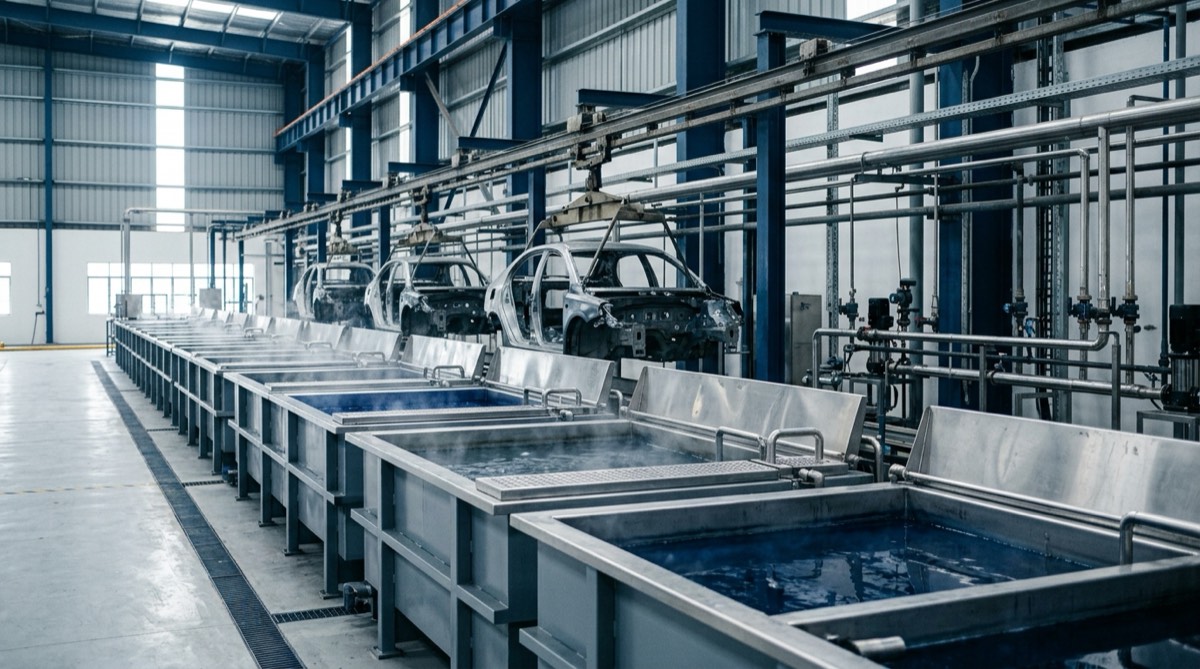
A 1.5 MW heat pump installation on an automotive paint shop pre-treatment line
1.5 MW installation, multiple units
The plant is not named. Large industrial buyers rarely grant a supplier permission to use their name, so every study publishes the sector, the capacity, the duty and the result, and withholds only the identity.
Read the full case study →Technology Specifications
Output temperature, capacity and configuration for the industrial heat pump range.
View Specifications →System Integration
How a unit ties into the pipework, the controls and the plant you already run.
Learn About Integration →Maintenance & Support
Servicing, spares and support once the unit is running.
Explore Support Options →Frequently asked questions
- What temperature is a degreasing tank kept at?
- An alkaline degreasing tank on an automotive pretreatment line usually runs at 55 to 80°C. The water going into its coil has to be hotter than the tank, so measure that supply temperature first. Tetra Heat Pump makes hot water up to 120°C, so it can feed a tank anywhere in that range. Near the top of the range it runs at a lower COP.
- Can a heat pump heat a zinc phosphating tank?
- Yes, and it is the best fit on the line. Zinc phosphating runs at 50 to 60°C, which is a short lift. Tetra Heat Pump water source units are rated at COP 4.5 to 5.2 at 60°C output. Phosphating leaves sludge on heating surfaces, so use a heat exchanger you can open and clean.
- Can one heat pump cool the electrocoat bath and heat the pretreatment tanks?
- Yes. The electrocoat (ED) bath is held at 28 to 32°C and needs cooling during the same hours the tanks need heating. A water source heat pump takes heat from the ED cooling loop and puts it into the pretreatment hot water loop, so one machine does the chiller's job and the boiler's job. Keep the existing chiller as standby for the weekend shutdown, and check the chiller duty against the tank demand.
- How much does a heat pump save on a pretreatment line?
- At one Indian automotive paint shop, 1.5 MW of Tetra Heat Pump capacity cut the energy cost of the pretreatment heating duty by 65%, with a simple payback of 18 months. Your own figure depends on the fuel you burn today. On Maharashtra HT-I at 11 to 33 kV, at ₹9.25 per kVAh, the heat pump needs a COP above 1.20 to beat furnace oil and above 1.00 to beat MGL Industrial A PNG.
- Does a heat pump on a pretreatment line need boiler registration?
- Below 100°C, a hot water generator falls outside the Boilers Act, so a heat pump loop feeding tanks below that temperature does not need boiler registration. Above 100°C, check with your state's boiler directorate.
Can a heat pump carry this duty in your plant?
Send us the output temperature, the flow or heat demand, the hours it runs and the fuel it burns today. Our engineers will size a unit against those figures and tell you which part of the load it can take and which part stays on the heating you run today.