How Factories That Switched Off Gas Boilers Are Running at Full Capacity While Others Struggle
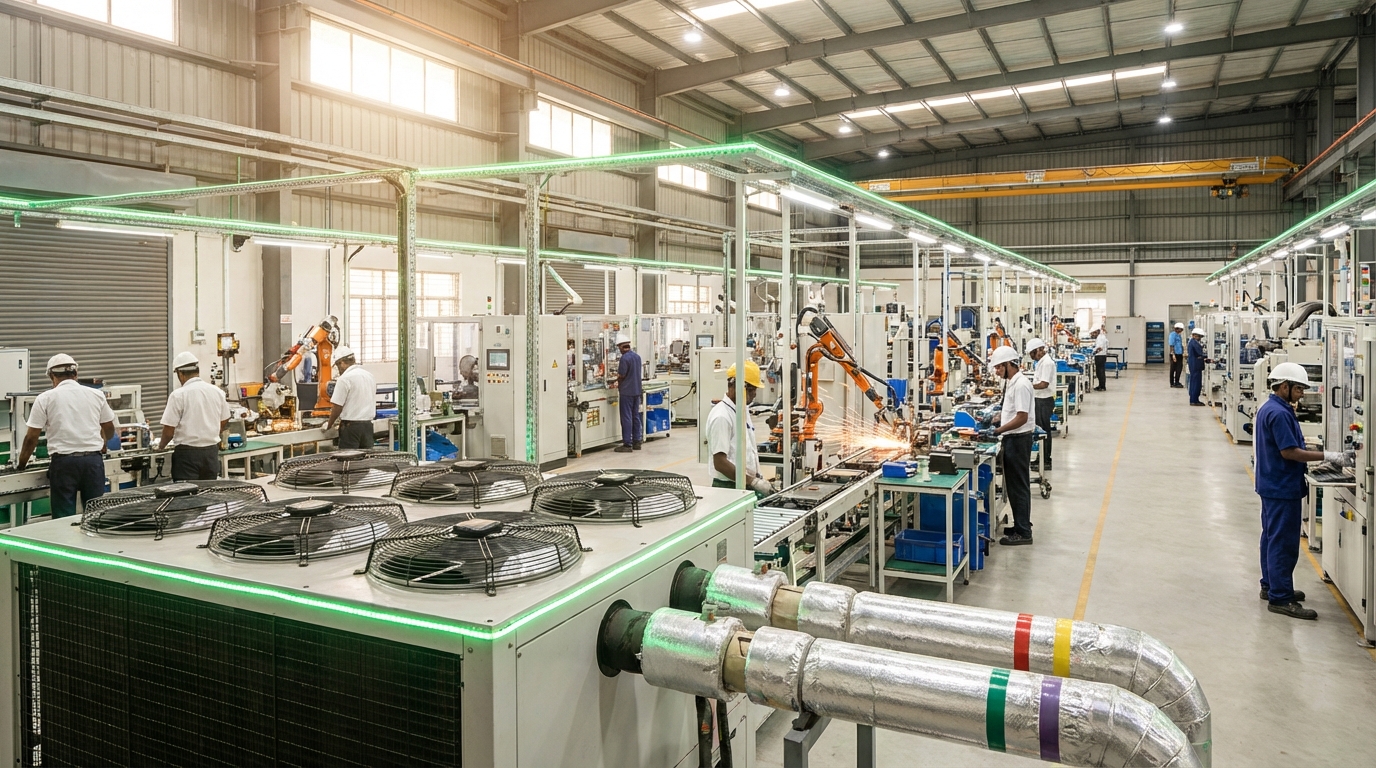
Two factories on the same industrial estate in Gujarat. Same product. Same customers. One is running at 100% capacity, quoting stable prices, and winning orders. The other is operating at 70%, scrambling for gas, and watching customers leave. The difference? One switched off its gas boiler 18 months ago. Here's how — and why you still can.
Key Takeaways
- Before the crisis: Factories with heat pumps were saving 50–70% on heating costs vs. gas boilers
- During the crisis: The same factories are saving 80–90% because gas prices tripled while electricity didn't move
- The real advantage: Zero supply disruption. While gas-dependent factories are rationed to 65–80%, electric factories run at 100%
- Zero capex option available: Shared-savings (ESCO) model means you pay nothing upfront
The Two Factories
We work with over 200 factories across India. Since the gas crisis began in March 2026, the contrast between factories that electrified their heating and those that didn't has been stark.
Here's what we're seeing on the ground:
| Metric | Factory on Gas Boiler | Factory on Heat Pump |
|---|---|---|
| Production capacity | 65–80% (gas rationed) | 100% |
| Heating cost (per month, 500 kW) | ₹5.7–6.2L | ₹58K–75K |
| Supply disruption | Yes — allocation cuts | None |
| Customer delivery | Delayed, penalty risk | On time |
| Quoting ability | Uncertain — fuel surcharges | Stable prices |
| New orders | Declining | Growing (picking up competitor orders) |
The factories that switched didn't do it because they predicted the Iran war. They did it because the economics of heat pumps made sense at ₹40/SCM gas prices. At ₹119/SCM, they look like geniuses.
How It Works: The Technology Behind the Switch
If you're hearing about this for the first time, here's the concept in plain terms.
Your gas boiler works by burning fuel to create heat. It takes one unit of gas and produces about 0.8 to 0.85 units of heat (the rest goes up the chimney). It's a simple, old technology.
An industrial heat pump works differently. It moves heat from one place to another instead of creating it by burning fuel. It extracts thermal energy from the surrounding air, from groundwater, or from your factory's own waste heat streams (cooling tower water, wastewater, exhaust air), and concentrates it to the temperature your process needs.
The key number is called the Coefficient of Performance (COP). A modern industrial heat pump has a COP of 3.5 to 5.0, meaning:
For every 1 unit of electricity in, you get 3.5 to 5 units of heat out.
That's 350–500% efficiency, vs. 80–85% for a gas boiler.
This isn't magic and it doesn't violate thermodynamics. The heat pump isn't "creating" extra energy — it's harvesting heat that already exists in the environment and upgrading it to a useful temperature. The electricity is just the energy needed to run this transfer process.
The Numbers: Pre-Crisis vs. Crisis Economics
Let's look at a real comparison for a typical factory with a 500 kW process heating need (hot water at 70°C, 8 hours/day, 300 days/year):
Before the Crisis (Gas at ₹40/SCM)
Gas Boiler
Industrial Heat Pump
Pre-crisis savings: ₹20–23L/year (70% reduction)
During the Crisis (Gas at ₹119/SCM)
Gas Boiler (at crisis prices)
Industrial Heat Pump (unchanged)
Crisis savings: ₹66–70L/year (89% reduction) + full production vs. rationed
Read that last line again. At today's gas prices, the heat pump saves nearly ₹70 lakh per year for a 500 kW system. And the heat pump factory is shipping full orders while the gas factory is losing customers.
Real Results from Real Factories
Paint Manufacturer, Gujarat
The Switch:
Replaced LPG boiler with 750 kW industrial heat pump system for paint drying and solvent recovery (60–80°C). Also capturing waste heat from air compressors.
During the Crisis:
Production running at 100%. Competitors on LPG facing 80% commercial cylinder cuts. Winning overflow orders from two competitors who can't deliver.
Pharmaceutical Plant, Maharashtra
The Switch:
Replaced PNG-fired boiler with 300 kW heat pump for process water heating (55–65°C) in API manufacturing. Needed precise temperature control that the boiler struggled with.
During the Crisis:
While other pharma units in the same cluster are running at 75% due to PNG allocation cuts, this plant is at 100%. Picking up contract manufacturing orders from affected competitors.
Textile Dyeing Unit, Tamil Nadu
The Switch:
Replaced diesel-fired boiler with 500 kW heat pump for hot water generation in dyeing process (80°C). Also installed waste heat recovery from dye bath effluent.
During the Crisis:
Diesel prices up 40%+ for competitors still on oil-fired boilers. This unit's costs unchanged. Now the lowest-cost producer in the cluster and booking orders months ahead.
What Industries Can Switch?
Industrial heat pumps work for any process heating application that requires temperatures up to 90°C. This covers the majority of factory heating needs:
| Industry | Process | Temperature | Heat Pump Suitable? |
|---|---|---|---|
| Pharmaceutical | Process water, reactor jacketing, HVAC | 40–80°C | Ideal |
| Textiles | Dyeing, washing, drying | 60–90°C | Ideal |
| Food & Beverage | Pasteurization, CIP, cooking | 50–85°C | Ideal |
| Automotive | Paint curing, parts washing, plating | 50–80°C | Ideal |
| Chemicals | Reactor heating, distillation preheat | 50–90°C | Ideal |
| Dairy | Pasteurization, cleaning, packaging | 55–80°C | Ideal |
| Plastics | Mould temperature control | 40–90°C | Ideal |
For processes requiring higher temperatures (steam, metal treatment, etc.), hybrid systems combine a heat pump for the base load with a smaller boiler for peak temperatures, still eliminating 60–80% of gas consumption.
"We Want to Switch, But We Can't Afford the Capex Right Now"
This is the most common response we hear — and it's the one we've specifically solved for.
The gas crisis has squeezed your margins. Spending ₹1–2 crore on new equipment feels impossible when your operating costs just tripled. We get it.
That's exactly why we offer the shared-savings (ESCO) model:
How the Zero-Capex Model Works
We Invest
We design, procure, install, and commission the heat pump system at our cost. You pay ₹0 upfront.
You Save
Your heating bill drops from day one. You pay us a share of the measured savings. Your net cost is lower than what you're paying now.
You Own
After the contract period, the system is yours. 100% of the savings flow to your bottom line.
No risk. No capex. Savings from day one. Your gas bill drops, your production stays at 100%.
At today's gas prices, the shared-savings model is especially compelling because the savings pool is so much larger. A factory that would have saved ₹20L/year at pre-crisis prices now saves ₹65–70L/year — which means the payback for the ESCO is faster, and your share of the savings is larger.
What About When Gas Prices Come Back Down?
They might. Eventually. But consider:
- Ras Laffan reconstruction: Qatar's LNG megafacility will take years to rebuild. Global LNG supply will remain tight through at least 2028.
- Even at pre-crisis prices, heat pumps save 70%: The economics worked at ₹40/SCM. The crisis just made them overwhelming at ₹119/SCM.
- Gas prices never go back to "normal" for long: Look at the last 5 years — COVID crash, post-COVID spike, European energy crisis, now Iran. Imported gas is structurally volatile. Electricity from India's domestic grid is structurally stable.
- Carbon costs are only going up: CCTS compliance is live. EU CBAM is active. Every year, burning gas gets more expensive on a regulatory basis, regardless of commodity price.
The question isn't "will gas come back down?" The question is "how many more crises are you willing to bet your factory on before you switch to an energy source you can actually control?"
How Quickly Can You Make the Switch?
We understand this is urgent. Here's the realistic timeline:
Site Assessment
Our engineers visit your factory, assess your heating requirements, process temperatures, existing infrastructure, and electrical capacity. You get a detailed proposal with savings projection within 48 hours.
System Design & Order
Custom system design, equipment procurement, installation planning. We maintain inventory of standard configurations for faster deployment.
Installation & Commissioning
Installation alongside your existing system (no production downtime). Testing, optimization, and handover. Your gas boiler stays as backup during the transition.
Full Operation
Heat pump running as primary heating. Gas boiler shut off (or retained for emergency backup). Savings measured and verified.
We are prioritizing crisis-affected factories. If your production is currently impacted by gas rationing, we can expedite delivery.
Stop Waiting for Gas Prices to Come Down. Start Running at Full Capacity.
200+ Indian factories have already made the switch. Get a free site assessment and find out how much your factory can save — at zero upfront cost.
Or call us directly: +91 78359 98980
Frequently Asked Questions
What happens to my existing gas boiler?
You can keep it as a backup for emergencies or for any high-temperature processes above 90°C. Many factories retain the boiler initially for confidence, then decommission it once they're comfortable with the heat pump performance. Either way, your gas consumption drops by 70–100%.
Does my factory need an electrical upgrade?
It depends on your existing electrical capacity. A 500 kW heat pump draws approximately 125 kW of electricity (thanks to the COP multiplier). Many factories can accommodate this within existing capacity. Our engineers assess this during the site visit and include any upgrade costs in the proposal.
How is the shared-savings payment calculated?
We install metering on the heat pump system. Each month, we measure the thermal energy delivered and compare the electricity cost against what the equivalent gas would have cost (using published gas tariffs). The savings are split between us according to the contract terms. Your net payment is always lower than your gas bill would have been.
Is this technology proven in Indian conditions?
Yes. Over 200 industrial heat pump installations across India in automotive, pharmaceutical, textile, food & beverage, and chemical plants. Operating in ambient temperatures from 15°C (winter in north India) to 45°C+ (summer in Gujarat/Rajasthan). Our systems are designed for Indian industrial conditions.
What government incentives are available?
Several: PAT scheme ESCerts, CCTS carbon credits, accelerated depreciation (80% first year), state subsidies (Gujarat up to ₹20L, Tamil Nadu PEACE scheme for MSMEs), and BEE's ADEETIE interest subvention for MSMEs. See our complete incentives guide.
Continue Reading
India's Gas Crisis: What Every Factory Owner Needs to Know Right Now
The full breakdown: Strait of Hormuz closure, Ras Laffan damage, government rationing, and what it means for your factory.
Heat Pump vs Boiler: How to Cut Process Heating Costs by 70%
Detailed technical and economic comparison between industrial heat pumps and traditional boilers.
About Tetra Heat Pump
Tetra Heat Pump, a brand of Promethean Energy, is a leading manufacturer of industrial heat pumps in India. With over 200 installations across automotive, pharmaceutical, textile, food & beverage, and chemical industries, we help factories eliminate their dependence on imported fuel and switch to efficient, domestically powered process heating.