The Real Cost of Your Factory's Gas Dependence: It's No Longer Just About Price
Three months ago, you thought your gas bill was a cost problem. Today, it's a survival problem. The Iran war has exposed what was always true but easy to ignore: running your factory on imported fuel is not just expensive — it's a structural vulnerability that threatens your entire operation. Here's the full picture.
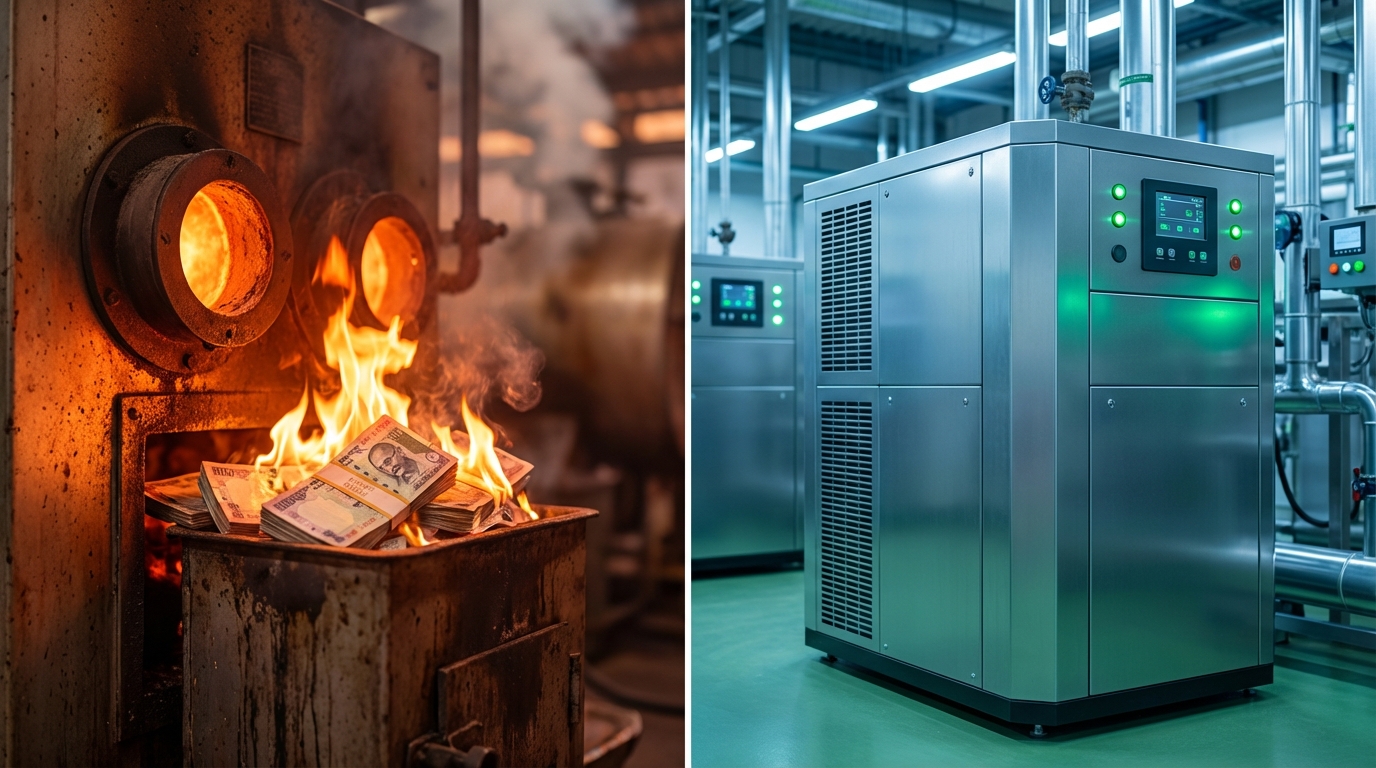
The Lesson of March 2026
When Gujarat Gas raised industrial PNG prices from ₹40 to ₹119 per SCM overnight — a 3x increase with no warning — it revealed something every factory CFO should have planned for but didn't: your gas price is set by events you cannot control, in places you've never been, by governments that don't know your factory exists.
Cost #1: The Price You See (And How Fast It Can Move)
Let's start with what's on your invoice. Before the crisis, industrial PNG in most Indian cities cost approximately ₹40 per standard cubic metre. Factories budgeted accordingly. Margins were calculated. Customer quotes were issued.
Then, in the span of days:
The Price Shock Timeline
PNG at ~₹40/SCM. Business as usual.
Strait of Hormuz closes. Brent crude jumps to US$82. Markets nervous.
Brent crude hits US$120. Government invokes Essential Commodities Act. Industrial gas allocation cuts begin.
Ras Laffan struck. Asian LNG spot prices surge 140%+. Gujarat Gas invokes force majeure. Industrial PNG repriced to ~₹119/SCM.
In 18 days, your heating costs tripled. No advance notice. No negotiation. No opt-out. Every customer quote you issued in February is now underwater. Every margin calculation is wrong.
For a factory spending ₹25 lakh per year on gas heating, the annualized cost at crisis prices is ₹75 lakh — an additional ₹50 lakh that appears nowhere in your business plan.
Cost #2: Supply Rationing — The Cost of Not Being Able to Produce
Price is painful. But at least when the price goes up, you can still run your factory (at lower margins). The worse scenario — the one playing out right now — is when you can't get gas at all.
Under the Natural Gas Control Order:
- Domestic households and CNG get full allocation (Tier 1)
- Fertilizer plants get 70% (Tier 2)
- Most industrial users get 65-80% (Tier 3-4)
- Commercial LPG has been cut by up to 80%
If your factory runs on gas and you're receiving 70% of your normal supply, you have two choices:
Option A: Run at Reduced Capacity
Operate your boiler at 70% and reduce production proportionally. Miss delivery deadlines. Trigger penalty clauses with customers. Watch them source from competitors.
Option B: Buy Spot Gas at Any Price
Source spot LNG at 140%+ premium (if available at all). Your margins go negative, but at least you deliver. Unsustainable beyond a few weeks.
Neither option is acceptable. And this is the cost that doesn't appear on any invoice: the revenue you lose, the customers who leave, the contracts you can't bid on because you can't guarantee supply.
Cost #3: The Quoting Problem
Every manufacturer quotes prices based on input costs. When your primary heating fuel can triple in price with 18 days' notice, how do you quote?
- Quote at current (crisis) prices? You price yourself out of the market. Competitors on electric heating are quoting 30-40% lower because their energy costs haven't moved.
- Quote at pre-crisis prices and hope gas comes back down? You're gambling. If gas stays at ₹119/SCM for 6 months, every order loses money.
- Add a fuel surcharge clause? Customers hate it. They'll go to the supplier who offers a fixed price — which is the one whose costs aren't tied to the Strait of Hormuz.
The competitive insight: Factories that heat with electricity can quote stable prices because their input costs are stable. In a volatile market, price stability isn't just a cost advantage — it's a sales advantage. Customers prefer suppliers who can hold their prices.
Cost #4: The Infrastructure You're Paying For (That Works Against You)
Your gas-based heating setup comes with an entire infrastructure layer that most factory managers treat as a sunk cost but is actually an ongoing expense:
| Infrastructure Item | Ongoing Cost | With Electric Heating |
|---|---|---|
| Gas pipeline connection & maintenance | ₹50K–2L/year | Not needed |
| Boiler annual maintenance contract | ₹1–3L/year | Lower (no combustion parts) |
| Boiler operator salary (IBR requirement) | ₹3–5L/year | Not required |
| Emission monitoring & compliance | ₹50K–1L/year | Zero emissions |
| Safety inspections & insurance | ₹50K–1.5L/year | Significantly lower |
| Chimney & flue gas infrastructure | ₹25K–50K/year | Not needed |
| Total hidden infrastructure cost | ₹5–13L/year | ₹1–2L/year |
These costs exist whether gas prices are ₹40 or ₹119. They are the overhead of being a gas-dependent factory.
Cost #5: The Compliance Cost That's Coming
Even without the Iran crisis, Indian factories burning fossil fuels face two converging regulatory pressures:
India's CCTS (Carbon Credit Trading Scheme)
Legally binding GHG emission intensity targets for ~490 industrial entities. First compliance deadline: July 31, 2026 — three months from now. Every cubic metre of gas your boiler burns generates CO₂ that counts against your target.
EU CBAM (Carbon Border Adjustment)
Definitive phase began January 2026. If you export to the EU, the carbon from your factory's gas boiler is now adding to the CBAM surcharge your European buyers must pay. They will choose lower-carbon suppliers.
A gas boiler creates both a fuel cost and a carbon cost. An electric heat pump running on India's increasingly renewable grid eliminates both.
The Total Cost Picture
Here's what the real cost of gas dependence looks like when you add it all up for a mid-size factory (500 kW heating load):
| Cost Category | Gas Boiler (Annual) | Industrial Heat Pump (Annual) |
|---|---|---|
| Fuel / electricity cost (at crisis prices) | ₹69–75L | ₹7–10L |
| Infrastructure & maintenance | ₹5–13L | ₹1–2L |
| Production loss (at 70-80% allocation) | ₹10–30L+ (varies) | ₹0 |
| Customer attrition risk | Unquantifiable but real | None |
| Carbon compliance cost (CCTS + CBAM) | Growing annually | Zero direct emissions |
| Total visible + hidden cost | ₹84L–1.2Cr+ | ₹8–12L |
The math is no longer even close. At pre-crisis gas prices, heat pumps saved you 70%. At crisis gas prices, the gap is closer to 85-90%. And the heat pump comes with 100% supply certainty.
What India's Electricity Grid Looks Like Right Now
The counter-argument to electrification has always been "but electricity is also expensive and unreliable." Let's check that against 2026 reality:
- 266 GW of renewable capacity installed — 51% of India's total power capacity is now non-fossil
- Solar tariffs at ₹2.5–3.5/kWh in competitive auctions
- Industrial tariffs stable at ₹7–9/kWh through the entire crisis
- 100% domestically generated — zero dependence on the Strait of Hormuz
- PM Surya Ghar scheme enabling rooftop solar for additional savings
- Open access allowing factories to procure renewable power directly at lower rates
The grid has changed. The argument that "electricity is too expensive for heating" was debatable five years ago. At today's gas prices, it's simply wrong. An industrial heat pump with a COP of 4 running on ₹8/kWh electricity delivers heat at an effective cost of ₹2/kWh thermal. Gas at ₹119/SCM delivers heat at approximately ₹11/kWh thermal. Electric heating is now 5x cheaper.
The Factories That Have Already Switched
Over 200 Indian factories across automotive, pharmaceutical, textile, food & beverage, and chemical sectors have already replaced their gas boilers with industrial heat pumps. Right now, during the worst gas crisis in India's history, these factories are:
- Running at 100% capacity with zero supply disruption
- Paying the same electricity rate they paid in February
- Winning contracts from competitors who can't guarantee delivery
- Quoting stable prices while gas-dependent competitors add fuel surcharges
Read their story: How Factories That Switched Off Gas Boilers Are Running at Full Capacity While Others Struggle
What You Can Do Right Now
The first step is understanding exactly how exposed your factory is. Not just the gas bill — but the full picture: supply risk, production loss, quoting uncertainty, compliance exposure, infrastructure overhead.
Find Out What Gas Dependence Is Really Costing Your Factory
Our engineers will assess your total heating cost — fuel, infrastructure, production risk, compliance — and show you what the alternative looks like. Free assessment. No obligation.
Or call us directly: +91 78359 98980
Continue Reading
India's Gas Crisis: What Every Factory Owner Needs to Know Right Now
The full breakdown: Strait of Hormuz closure, Ras Laffan damage, government rationing, and what it means for your factory.
How Factories That Switched Off Gas Boilers Are Running at Full Capacity
Real examples of Indian factories that eliminated gas dependence before the crisis — and are now outperforming competitors.
About Tetra Heat Pump
Tetra Heat Pump, a brand of Promethean Energy, is a leading manufacturer of industrial heat pumps in India. With over 200 installations across automotive, pharmaceutical, textile, food & beverage, and chemical industries, we help factories eliminate their dependence on imported fuel and switch to efficient, domestically powered process heating.