India's Gas Crisis: What Every Factory Owner Needs to Know Right Now
On March 1, the Strait of Hormuz closed. On March 18, missiles hit Qatar's Ras Laffan — the world's largest LNG facility. Since then, 55% of India's natural gas imports are under force majeure, industrial gas allocations have been slashed, and PNG prices have tripled. If your factory runs on gas, here is what you need to know — and what you can do about it.
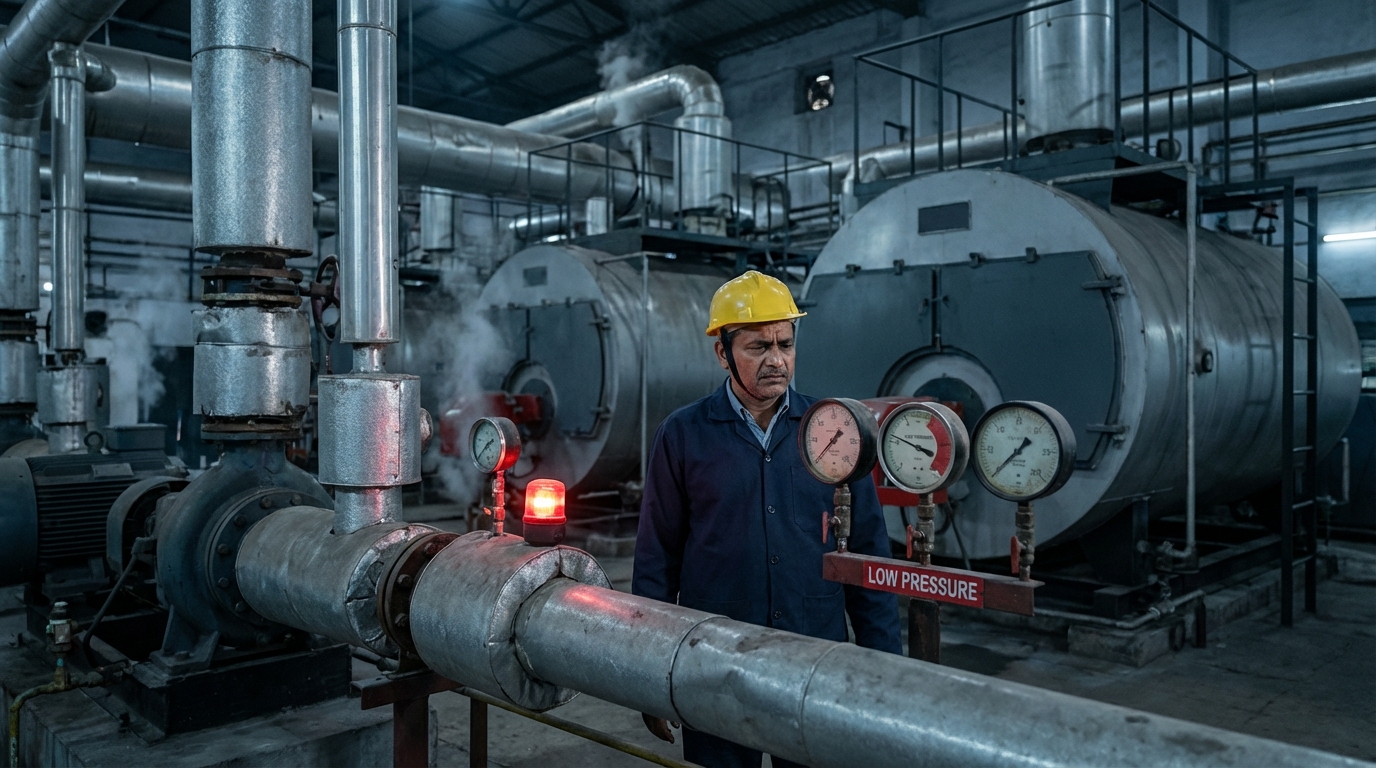
The Situation as of April 2026
- Strait of Hormuz: Closed since March 1, 2026
- Qatar's Ras Laffan: Struck by Iranian missiles on March 18 — major LNG infrastructure damaged
- India's gas imports: 55% under force majeure
- PNG price (industrial): Surged from ~₹40/SCM to ~₹119/SCM — a 3x increase
- Asian LNG spot prices: Up over 140%
- Government response: Essential Commodities Act invoked; industrial gas allocations cut
What Happened and Why It Matters to Your Factory
India imports over 50% of its natural gas, and approximately 90% of those imports transit through the Strait of Hormuz. When coordinated US-Israeli strikes hit Iran's nuclear and military infrastructure in late February 2026, and Iran retaliated with naval mines in the Strait and missile strikes on Qatar's Ras Laffan Industrial City, it didn't just disrupt a shipping lane. It severed the artery that feeds Indian manufacturing.
The International Energy Agency has called this the "largest supply disruption in the history of the global oil market."
For factory owners, the impact has been immediate and brutal:
| Impact | Before Crisis (Feb 2026) | After Crisis (April 2026) |
|---|---|---|
| Industrial PNG price | ~₹40/SCM | ~₹119/SCM |
| Gas allocation (non-priority) | 100% | 65–80% |
| Brent crude (per barrel) | ~US$80 | ~US$120 |
| Supply certainty | Contracted volumes honoured | 55% under force majeure |
The Government's Response: Rationing Has Begun
On March 9, the government invoked the Essential Commodities Act and issued a Natural Gas Control Order establishing a four-tier priority system:
Gas Allocation Priority Tiers
Full allocation: Domestic PNG, CNG for transport, LPG production
70% allocation: Fertilizer plants, power grid
~80% allocation: Other industrial users
~65% or lower: Non-priority industrial, commercial LPG cut by up to 80%
If your factory uses piped natural gas or LNG for process heating, you are in Tier 3 or Tier 4. Your supply is being rationed, and there is no timeline for when full allocations will resume. Even when the conflict ends, the damage to Ras Laffan will take years to reconstruct.
What This Means for Your Unit Economics
Let's be specific. Consider a factory with a 500 kW process heating load running 8 hours a day, 300 days a year:
| Cost Component | Pre-Crisis (Gas Boiler) | Today (Gas Boiler) |
|---|---|---|
| Fuel cost per unit | ₹40/SCM | ₹119/SCM |
| Annual heating cost (est.) | ₹23–25 L | ₹69–75 L |
| Supply availability | 100% | 65–80% |
| Price predictability | Quarterly revisions | Spot-linked, daily volatility |
Your heating bill just tripled. But here's the part that isn't on the invoice: every day you operate at 65-80% gas allocation, you are losing production. Missed delivery deadlines. Penalty clauses triggered. Customers looking for alternative suppliers. The real cost of this crisis isn't just the price of gas — it's the cost of not being able to run your factory.
This Is Not Temporary
It's tempting to wait this out. But consider the structural realities:
- Ras Laffan reconstruction: Qatar's LNG megafacility sustained significant damage. Reconstruction timelines for facilities of this scale are measured in years, not months. Even an optimistic scenario means 18-24 months before full capacity.
- Strait of Hormuz: Even after a ceasefire, de-mining and re-establishing safe shipping lanes takes months. Insurance premiums for Hormuz transit will remain elevated for much longer.
- India's import dependence hasn't changed: India still imports over 50% of its gas. Russia is offering to increase supply, but pipeline infrastructure from Russia to India doesn't exist — LNG from Russia's Pacific coast still faces shipping constraints.
- Global competition for supply: Every gas-importing nation in Asia is scrambling for the same limited non-Hormuz LNG. India is competing with Japan, South Korea, China, and Europe for a shrinking pool of available cargoes.
The bottom line: even in the best-case scenario, Indian industrial gas supply will remain tight and expensive through 2027. The factories that act now will have a structural cost advantage for years.
The One Energy Source That Isn't Affected
While the gas crisis has consumed headlines, something important has gone unnoticed: India's electricity supply is completely unaffected by the Iran conflict.
Why? Because India generates 100% of its electricity domestically:
- 266 GW of renewable energy capacity (solar, wind, hydro) — now 51% of India's total installed power capacity
- Domestic coal powers the remaining thermal generation — Coal India is ramping production to 1 billion tonnes/year
- No dependence on the Strait of Hormuz — no force majeure, no shipping disruptions, no rationing
- Industrial electricity prices have remained stable at ₹7–9/kWh through the entire crisis
The crisis has exposed a fundamental truth: any factory process that depends on imported fuel is a liability. Any process that runs on domestically generated electricity is resilient.
Electrification of Factory Heating: How It Works
Most factories use gas boilers to heat water, air, or other fluids for their manufacturing process — dyeing, washing, drying, pasteurizing, chemical reactions, paint curing. The temperatures typically range from 40°C to 90°C.
There is a proven technology that does the same job using electricity, and it does it 3-5 times more efficiently than a boiler. It's called an industrial heat pump.
Think of it this way: a gas boiler burns fuel to create heat. An industrial heat pump moves heat from one place to another — from ambient air, from waste water, from process exhaust — and concentrates it to the temperature your process needs. For every 1 unit of electricity it uses, it delivers 3 to 5 units of heat.
The result:
Gas Boiler vs. Industrial Heat Pump: Crisis Economics
Gas Boiler (at crisis prices)
Industrial Heat Pump
At today's crisis gas prices, factories on heat pumps are saving 80%+ on heating costs — while running at full capacity with zero supply disruption.
"But I Can't Afford a Big Capital Investment Right Now"
We hear this. Your margins are already under pressure from tripled gas costs. A large equipment purchase feels impossible. That's why many factories are choosing the shared-savings (ESCO) model:
- Zero upfront cost. We install the heat pump system at our investment.
- You pay a share of the savings. Your heating bill drops from day one.
- No risk. If it doesn't save, you don't pay.
Read the full details in our guide: Zero Upfront Cost: How to Eliminate Your Factory's Fuel Bill with a Shared-Savings Model.
What You Should Do This Week
Immediate Action Plan
- 1. Assess your exposure: What percentage of your process heating runs on PNG, LNG, LPG, or diesel? What is your current allocation under the Natural Gas Control Order?
- 2. Calculate the crisis cost: At ₹119/SCM, what is your monthly heating bill? What was it three months ago? Use our savings calculator to see the difference.
- 3. Get a free site assessment: Our engineering team can evaluate your process heating requirements and tell you within 48 hours whether electrification is feasible, what it would save, and how quickly it can be installed.
- 4. Don't wait for the crisis to end. Even in the best case, gas supply and prices won't normalize before 2027. The factories that switch now will have 12+ months of cost and production advantage.
Your Factory Doesn't Have to Depend on Imported Gas
Get a free site assessment. Our engineers will evaluate your heating requirements and show you how to switch to domestically generated electricity — with zero supply risk and 70%+ cost savings.
Or call us directly: +91 78359 98980
Frequently Asked Questions
How quickly can a heat pump system be installed?
For standard process heating applications (40–90°C), installation typically takes 4–8 weeks from order confirmation. We are prioritizing crisis-affected factories and can expedite delivery for urgent cases.
Will my existing piping and distribution system work?
In most cases, yes. The heat pump integrates with your existing hot water or hot air distribution system. Our engineers assess compatibility during the free site visit.
What if my factory needs temperatures above 90°C?
Industrial heat pumps are most efficient for process temperatures up to 90°C. For higher temperatures, we design hybrid systems that handle the base load with heat pumps and use a smaller boiler only for the top-up. This still eliminates 60–80% of your gas consumption.
Is my electricity supply reliable enough?
India's grid electricity is generated 100% domestically and is unaffected by the Hormuz crisis. For additional reliability, many factories pair heat pumps with rooftop solar under the PM Surya Ghar scheme, further reducing costs.
Continue Reading
How Factories That Switched Off Gas Boilers Are Running at Full Capacity
Real examples of Indian factories that made the switch before the crisis — and are now running at 100% while competitors struggle with rationing.
The Real Cost of Your Factory's Gas Dependence
Beyond the fuel bill: supply disruption, production losses, customer attrition, and the hidden costs of running on imported fuel.
About Tetra Heat Pump
Tetra Heat Pump, a brand of Promethean Energy, is a leading manufacturer of industrial heat pumps in India. With over 200 installations across automotive, pharmaceutical, textile, food & beverage, and chemical industries, we help factories eliminate their dependence on imported fuel and switch to efficient, domestically powered process heating.